
Penny Dreadfuls, 1857 · page 88 of 394
Agnes, or, Beauty and Pleasure — page 88: what you’re looking at
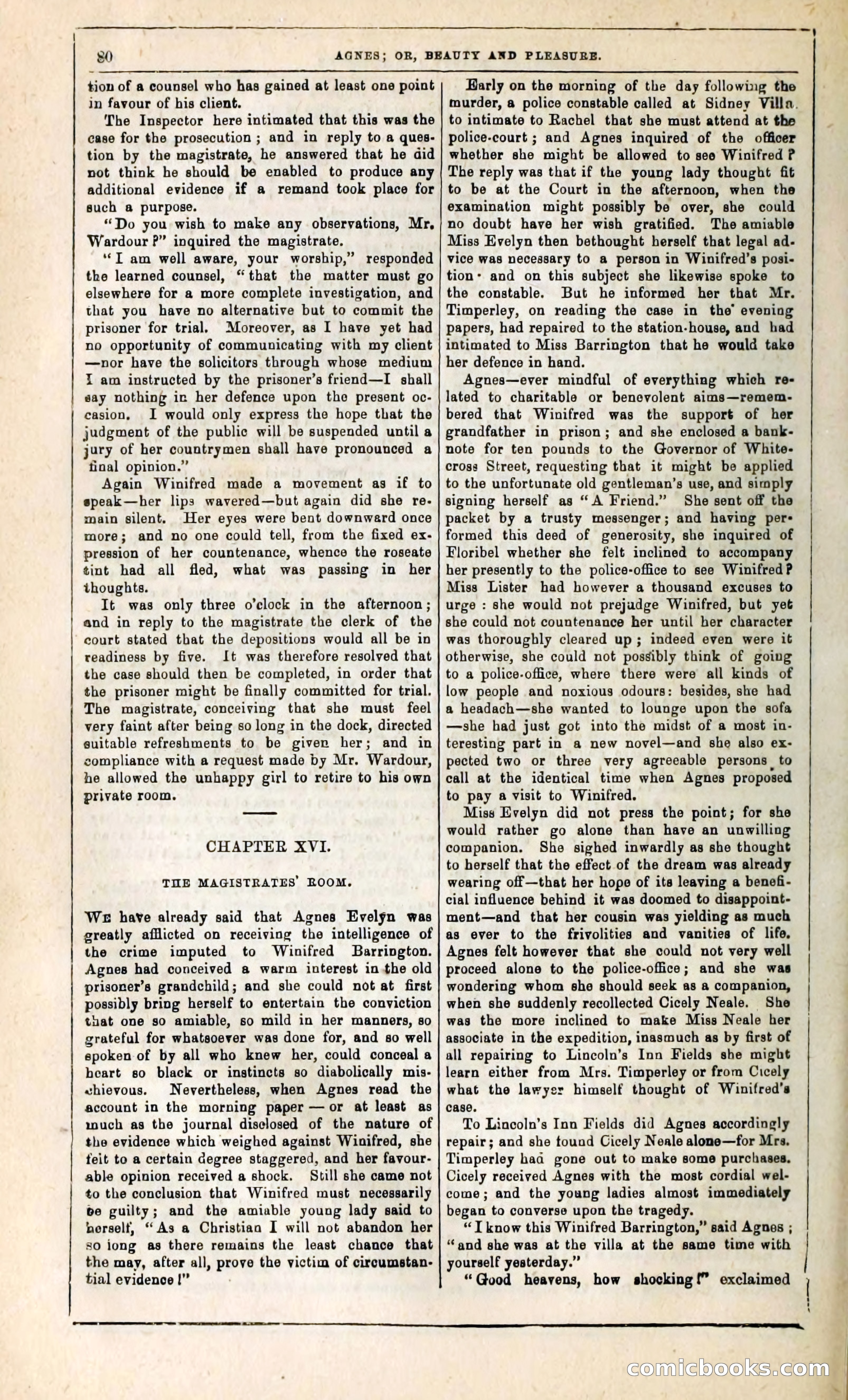
A restored page from Penny Dreadfuls, 1857. Page through the whole issue in the reader above.
📄 Transcribed text from this page (OCR, searchable)
Machine-transcribed from the original scan — historical spelling and the odd misread are preserved.
le a —_—_———— 80 tion of a counsel who has gained at least one point in favour of his client. The Inspector here intimated that this was the case for the prosecution ; and in reply to a ques- tion by the magistrate, he answered that he did not think he should be enabled to produce any additional evidence if a remand took place for such a purpose. “Do you wish to make any observations, Mr, Wardour P” inquired the magistrate. ‘‘T am well aware, your worship,” responded the learned counsel, “that the matter must go elsewhere for a more complete investigation, and that you have no alternative but to commit the prisoner for trial. Moreover, as I have yet had no opportunity of communicating with my client —nor have the solicitors through whose medium I am instructed by the prisoner’s friend—I shall say nothing in her defence upon the present oc- easiong I would only express the hope that the judgment of the public will be suspended until a jury of her countrymen shall have pronounced a final opinion,” Again Winifred made a movement as if to speak—her lips wavered—but again did she re- main silent. Her eyes were bent downward once more; and no one could tell, from the fixed ex- pression of her countenance, whence the roseate tint had all fled, what was passing in her thoughts. It was only three o'clock in the afternoon; and in reply to the magistrate the clerk of the court stated that the depositions would all be in readiness by five. It was therefore resolved that the case should then be completed, in order that the prisoner might be finally committed for trial. The magistrate, conceiving that she must feel very faint after being so long in the dock, directed suitable refreshments to be given her; and in compliance with a request made by Mr. Wardour, he allowed the unhappy girl to retire to his own private room. CHAPTER XVI. TIE MAGISTRATES’ ROOM. We have already said that Agnes Evelyn was greatly afflicted on receiving the intelligence of the crime imputed to Winifred Barrington. Agnes had conceived a warm interest in the old prisoner’s grandchild; and she could not at first possibly bring herself to entertain the conviction that one so amiable, so mild in her manners, so grateful for whatsoever was done for, and so well spoken of by all who knew her, could conceal a heart so black or instincts so diabolically mis- whievous. Nevertheless, when Agnes read the account in the morning paper —or at least as wouch as the journal disclosed of the nature of the evidence which weighed against Winifred, she teit to a certain degree staggered, and her favour- able opinion received a shock. Still she came not to the conclusion that Winifred must necessarily be guilty; and the amiable young lady said to nerself, “As a Christiano I will not abandon her s0 jong as there remains the least chance that the may, after all, prove the victim of circumstan- tial evidence |” AGNES; OR, BEAUTY AND PLEASURE. Harly on the morning of the day following the murder, a police constable called at Sidney Villa. to intimate to Rachel that she must attend at the police-court ; and Agnes inquired of the officer whether she might be allowed to see Winifred ? The reply was that if the young lady thought fit to be at the Court in the afternoon, when the examination might possibly be over, she could no doubt have her wish gratified. The amiable Miss Evelyn then bethought herself that legal ad- vice was necessary to a person in Winifred’s posi- tion: and on this subject she likewise spoke to the constable. But he informed her that Mr. Timperley, on reading the case in the evening papers, had repaired to the station-house, and had intimated to Miss Barrington that he would take her defence in hand. Agnes—ever mindful of everything which re- lated to charitable or benevolent aims—remem- bered that Winifred was the support of her grandfather in prison; and she enclosed a bank- note for ten pounds to the Governor of White- cross Street, requesting that it might be applied to the unfortunate old gentleman’s use, and simply signing herself as “A Friend.” She sent off the packet by a trusty messenger; and having pers formed this deed of generosity, she inquired of Floribel whether she felt inclined to accompany her presently to the police-office to see Winifred P Miss Lister had however a thousand excuses to urge : she would not prejudge Winifred, but yet she could not countenance her until her character was thoroughly cleared up; indeed even were it otherwise, she could not possibly think of going to a police-office, where there were all kinds of low people and noxious odours: besides, she had a headach—she wanted to lounge upon the sofa —she had just got into the midst of a most in- teresting part in a new novel—and she also ex- pected two or three very agreeable persons to call at the identical time when Agnes proposed to pay a visit to Winifred. Miss Evelyn did not press the point; for she would rather go alone than have an unwilling companion. She sighed inwardly as she thought to herself that the effect of the dream was already wearing off—that her hope of its leaving a benefi- cial influence behind it was doomed to disappoint- ment—and that her cousin was yielding as much as ever to the frivolities and vanities of life, Agnes felt however that she could not very well proceed alone to the police-office; and she was wondering whom she should seek as a companion, when she suddenly recollected Cicely Neale. She was the more inclined to make Miss Neale her associate in the expedition, inasmuch as by first of all repairing to Lincoln’s Inn Fields she might learn either from Mrs. Timperley or from Cicely what the lawyer himself thought of Winifred’s case. To Lincoln’s Inn Fields did Agnes accordingly repair; and she tound Cicely Neale alone—for Mrs. Timperley haa gone out to make some purchases. Cicely received Agnes with the most cordial wel- come; and the young ladies almost immediately began to converse upon the tragedy. “T know this Winifred Barrington,” said Agnes ; “and she was at the villa at the same time with yourself yesterday.” “Good heavens, how shocking!” exclaimed (E s) COMnicoookKxs G es ees se 6 RR . . x (9) im ~*~ |