
Penny Dreadfuls, 1857 · page 84 of 394
Agnes, or, Beauty and Pleasure — page 84: what you’re looking at
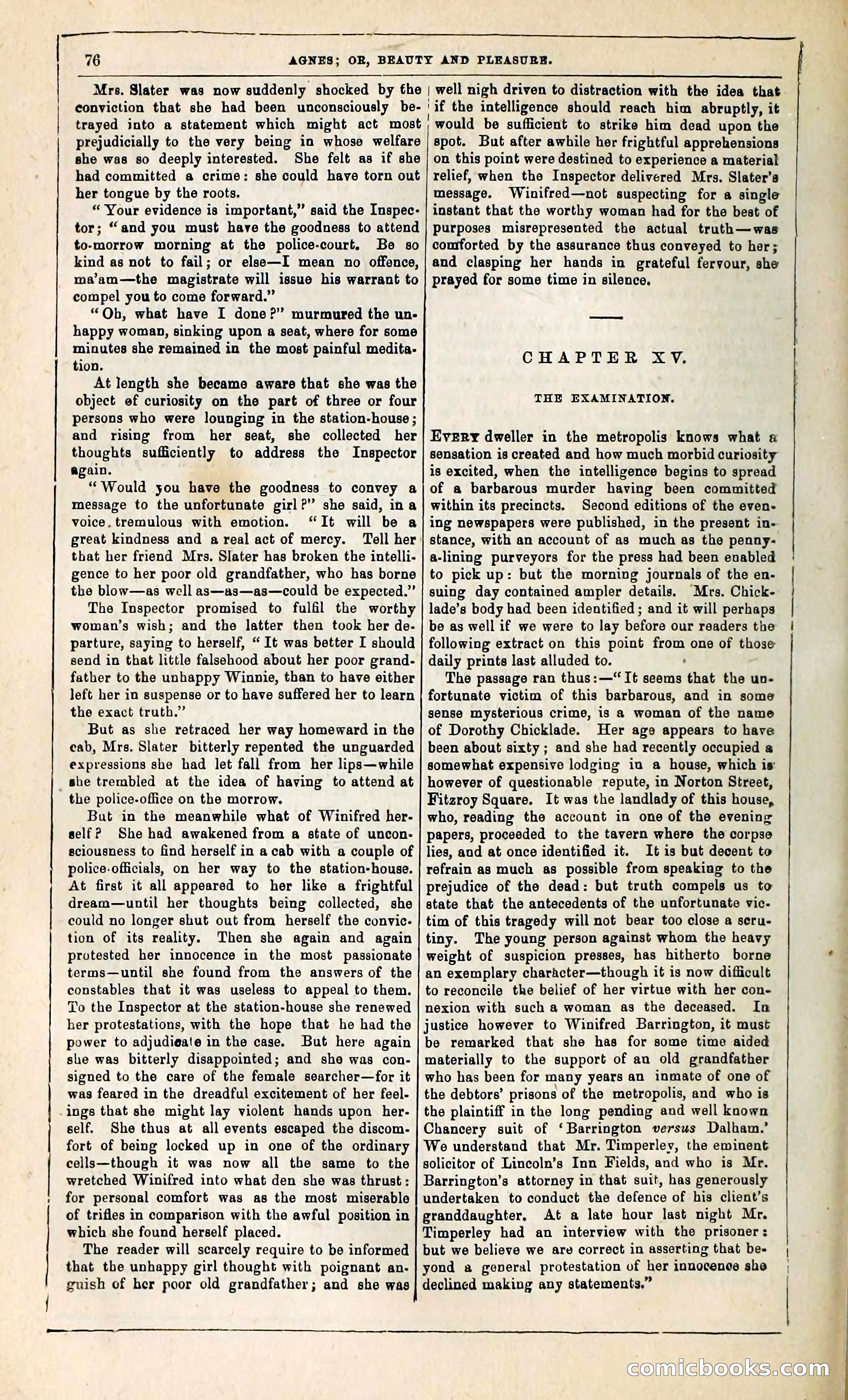
A restored page from Penny Dreadfuls, 1857. Page through the whole issue in the reader above.
📄 Transcribed text from this page (OCR, searchable)
Machine-transcribed from the original scan — historical spelling and the odd misread are preserved.
—_—— 76 AGNES; OR, —_|_—__$_$_—_. — ——— OES Eeeeeee BEAUTY AND PLEASURE. Mrs. Slater was now suddenly shocked by the | well nigh driven to distraction with the idea that conviction that she had been unconsciously be- ‘if the intelligence should reach him abruptly, it trayed into a statement which might act most prejudicially to the very being in whose welfare she was so deeply interested. She felt as if she had committed a crime: she could have torn out her tongue by the roots. “Your evidence is important,” said the Inspec- tor; “and you must have the goodness to attend to-morrow morning at the police-court. Be so kind as not to fail; or else—I mean no offence, ma’am—the magistrate will issue his warrant to compel you to come forward.” “Ob, what have I done?” murmured the un- happy woman, sinking upon a seat, where for some minutes she remained in the most painful medita- tion. At length she became aware that she was the object ef curiosity on the part of three or four persons who were lounging in the station-house ; and rising from her seat, she collected her thoughts sufficiently to address the Inspector again. “Would you have the goodness to convey a message to the unfortunate girl?” she said, ina voice. tremulous with emotion. “It will be a great kindness and areal act of mercy. Tell her: that her friend Mrs. Slater has broken the intelli- gence to her poor old grandfather, who has borne the blow—as well as—as—as—could be expected.” The Inspector promised to fulfil the worthy woman’s wish; and the latter then took her de- parture, saying to herself, “ It was better I should send in that little falsehood about her poor grand- father to the unhappy Winnie, than to have either left her in suspense or to have suffered her to learn the exact truth.” But as she retraced her way homeward in the cab, Mrs. Slater bitterly repented the unguarded expressions she had let fall from her lips—while she trembled at the idea of having to attend at the police-office on the morrow. But in the meanwhile what of Winifred her- self? She had awakened from a state of uncon- sciousness to find herself in a cab with a couple of police-officials, on her way to the station-house. At first it all appeared to her like a frightful dream—until her thoughts being collected, she could no longer shut out from herself the convic- tion of its reality. Then she again and again protested her innocence in the most passionate terms—until she found from the answers of the constables that it was useless to appeal to them. To the Inspector at the station-house she renewed her protestations, with the hope that he had the power to adjudieate in the case. But here again she was bitterly disappointed; and she was con- signed to the care of the female searcher—for it was feared in the dreadful excitement of her feel- ings that she might lay violent hands upon her- self. She thus at all events escaped the discom- fort of being locked up in one of the ordinary cells—though it was now all the same to the wretched Winifred into what den she was thrust : for personal comfort was as the most miserable of trifles in comparison with the awful position in which she found herself placed. The reader will scarcely require to be informed that the unhappy girl thought with poignant an.- guish of her poor old grandfather; and she was would be sufficient to strike him dead upon the spot. But after awhile her frightful apprehensions on this point were destined to experience a material relief, when the Inspector delivered Mrs. Slater’s message. Winifred—not suspecting for a single instant that the worthy woman had for the best of purposes misrepresented the actual truth—was comforted by the assurance thus conveyed to her; and clasping her hands in grateful fervour, she prayed for some time in silence. CHAPTER XV. THE EXAMINATION. Every dweller in the metropolis knows what « sensation is created and how much morbid curiosity is excited, when the intelligence begins to spread of a barbarous murder having been committed within its precincts. Second editions of the even- ing newspapers were published, in the present in- stance, with an account of as much as the penny- a-lining purveyors for the press had been enabled to pick up: but the morning journals of the en- suing day contained ampler details. Mrs. Chick- lade’s body had been identified ; and it will perhaps be as well if we were to lay before our readers the following extract on this point rae one of those daily prints last alluded to. The passage ran thus :—“ It seems ‘that the un- fortunate victim of this barbarous, and in some sense mysterious crime, is a woman of the name of Dorothy Chicklade. Her age appears to have been about sixty ; and she had recently occupied a somewhat expensive lodging in a house, which is: however of questionable repute, in Norton Street, Fitzroy Square. It was the landlady of this house, who, reading the account in one of the evening papers, proceeded to the tavern where the corpse lies, and at once identified it. It is but decent to refrain as much as possible from speaking to the prejudice of the dead: but truth compels us to state that the antecedents of the unfortunate vic- tim of this tragedy will not bear too close a seru- tiny. The young person against whom the heavy weight of suspicion presses, has hitherto borne an exemplary character—though it is now difficult to reconcile the belief of her virtue with her con- nexion with such a woman as the deceased. In justice however to Winifred Barrington, it must be remarked that she has for some time aided materially to the support of an old grandfather who has been for many years an inmate of one of the debtors’ prisons of the metropolis, and who is the plaintiff in the long pending and well known Chancery suit of ‘Barrington versus Dalham.’ We understand that Mr. Timperley, the eminent solicitor of Lincoln’s Inn Fields, and who is Mr. Barrington’s attorney in that suit, has generously undertaken to conduct the defence of his client’s granddaughter, At a late hour last night Mr. Timperley had an interview with the prisoner: but we believe we are correct in asserting that be- yond a general protestation of her innocence she declined making any statements.” book (Q) : a)