
Penny Dreadfuls, 1857 · page 48 of 394
Agnes, or, Beauty and Pleasure — page 48: what you’re looking at
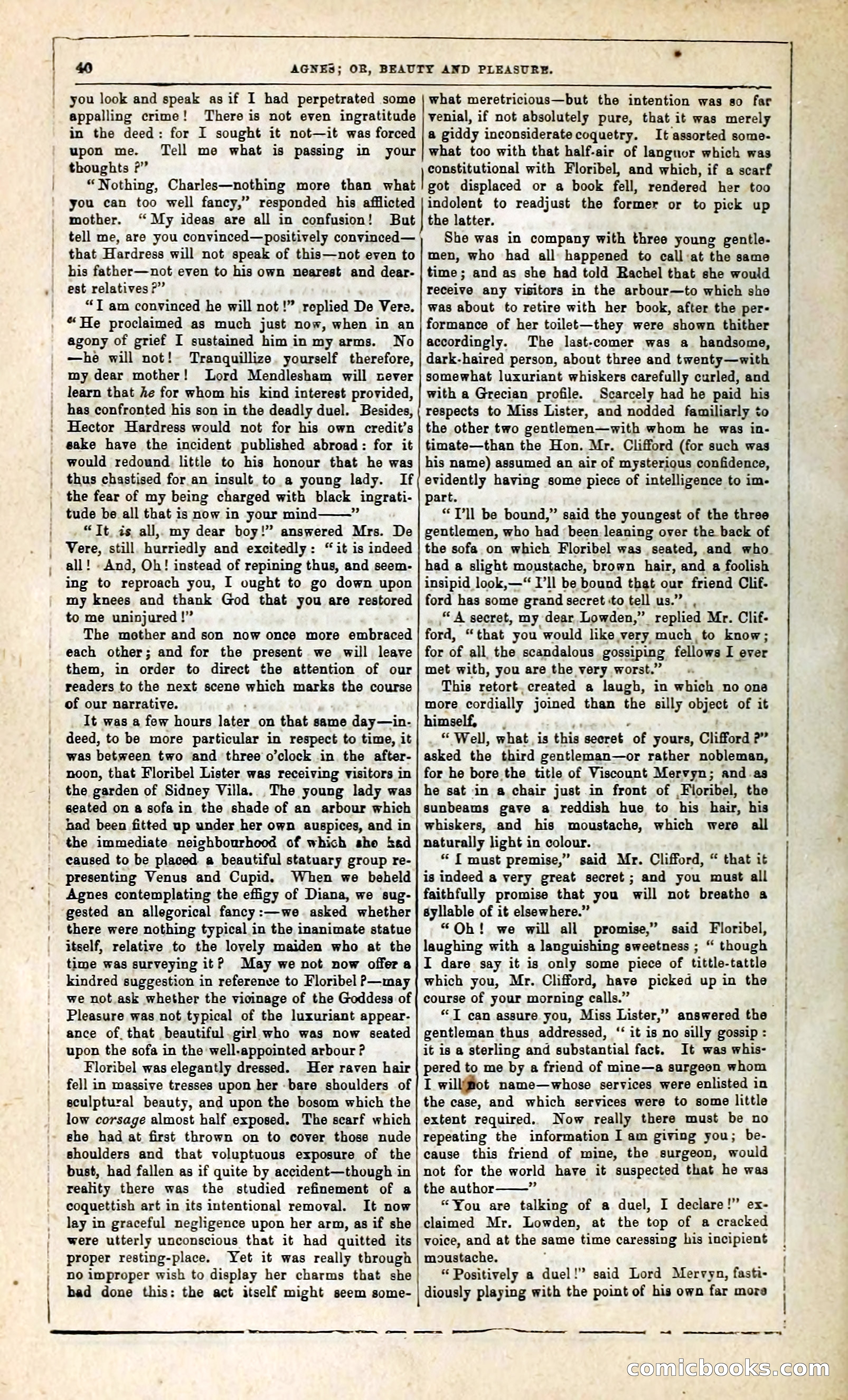
A restored page from Penny Dreadfuls, 1857. Page through the whole issue in the reader above.
📄 Transcribed text from this page (OCR, searchable)
Machine-transcribed from the original scan — historical spelling and the odd misread are preserved.
| ae ~ AGNES; OR, BEAUTY AND PLEASURE. Se a ea eM ee ME ane ie een nae a el you look and speak as if I had perpetrated some | what meretricious—but the intention was so far appalling crime! There is not even ingratitude | venial, if not absolutely pure, that it was merely in the deed: for I sought it not—it was forced | a giddy inconsiderate coquetry. Tell me what is passing in your} what too with that half-air of languor which was upon me. thoughts ?” “ Nothing, you can too well fancy,” responded his afflicted mother. “ My ideas are all in confusion! But tell me, are you convinced—positively convinced— that Hardress will not speak of this—not even to his father—not even to his own nearest and dear- est relatives?” “T am convinced he will not!” replied De Vere. “He proclaimed as much just now, when in an agony of grief I sustained him in my arms. No —he will not! Tranquillize. yourself therefore, my dear mother! Lord Mendlesham will sever learn that he for whom his kind interest provided, has confronted his son in the deadly duel. Besides, Hector Hardress would not for his own credit’s _ gake have the incident published abroad: for it | would redound. little to his honour that he was thus chastised for an insult to a young lady. If the fear of my being charged with black ingrati- tude be all that is now in your mind ? _ “Tt. ds all, my dear boy!” answered Mrs. De Vere, still. hurriedly and excitedly: “it is indeed all! .And, Oh! instead of repining thus, and seem- ing to reproach you, I ought to go down upon my knees and thank God that you are restored to me uninjured !” The mother and son now once more embraced each other; and for the present we will leave them, in order to direct the attention of our readers to the next scene which marks the course of our narrative. It was a few hours later on that same day—in- deed, to be more particular in respect to time, it was between two and three o’clock in the after- noon, that Floribel Lister was receiving visitors in the garden of Sidney Villa. The young lady was seated on a sofa in the shade of an arbour which had been fitted up under her own auspices, and in the immediate neighbourhood of which she bad caused to be placed. a beautiful statuary group re- presenting Venus and Cupid. When we beheld Agnes contemplating the effigy of Diana, we sug- gested an allegorical fancy:—we asked whether there were nothing typical in the inanimate statue itself, relative to the lovely maiden who at the time was surveying it? May we not now offer a kindred suggestion in reference to Floribel P—may we not ask whether the vicinage of the Goddess of Pleasure was not typical of the luxuriant appear- ance of. that beautiful.girl who was now seated upon the sofa in the well-appointed arbour ? Floribel was elegantly dressed. Her raven hair fell in massive tresses upon her ‘bare shoulders of sculptural beauty, and upon the bosom which the low corsage almost half exposed. The scarf which ehe had at first thrown on to cover those nude shoulders and that voluptuous exposure of the bust, had fallen as if quite by accident—though in reality there was the studied refinement of a coquettish art in its intentional removal. It now lay in graceful negligence upon her arm, as if she were utterly unconscious that it had quitted its proper resting-place. Yet it was really through no improper wish to display her charms that she bad done this: the act itself might seem some- Charles—nothing more than what | wei sO OOO It assorted some- constitutional with Floribel, and which, if a scarf got displaced or a book fell, rendered her too indolent to readjust the former or to pick up the latter. She was in company with three young gentle- men, who had all happened to call:at the same time ; and as she had told Rachel that she would receive any visitors in the arbour—to which sho was about to retire with her book, after the per- formance of her toile-—they were shown thither accordingly. The last-comer was a handsome, dark-haired person, about three and twenty—with somewhat luxuriant whiskers carefully curled, and with a Grecian profile. Scarcely had he paid his respects to Miss Lister, and nodded familiarly to the other two gentlemen—with whom he was in- timate—than the Hon. Mr. Clifford (for such was his name) assumed an air of mysterious confidence, evidently having some piece of intelligence to im- art, *T’ll be bound,” said the youngest of the three gentlemen, who had ‘been. leaning over the back of the sofa on which Floribel was seated, and who had a slight moustache, brown hair, and a foolish insipid look,—“ I’ll be bound that our friend Clif. ford has some grand secret to tell us.”, , “A secret, my dear Lowden,” replied Mr. Clif- ford, “that you would like very, much to know; for of all the scandalous gossiping fellows I ever met with, you are the very worst.” This retort. created a laugh, in which no one more cordially joined than the silly abipck of it himself, “ Well, what, is this secret “of yours, Clifford ?” asked the third gentleman—or rather nobleman, for he bore the title of Viscount Mervyn; and.as he sat in a chair just in front of Fioribel, the sunbeams gave a reddish hue to his hair, his whiskers, and his moustache, which were all naturally light in colour. ** [ must premise,” said Mr. Clifford, “ that it is indeed a very great secret; and you must all faithfully promise that you will not breathe a syllable of it elsewhere.” “Oh! we will all promise,” said Floribel, laughing with a languishing sweetness ; “ though I dare say it is only some piece of tittle-tattle which you, Mr. Clifford, have picked up in the course of your morning calls.” *T can assure you, Miss Lister,” answered the . gentleman thus addressed, “‘ it is no silly gossip : it is a sterling and substantial fact. It was whis- pered to me by a friend of mine—a surgeon whom I will@fot name—whose services were enlisted in the case, and which services were to some little extent required. Now really there must be no repeating the information I am giving you; be- cause this friend of mine, the surgeon, would not for the world have it suspected that he was the author “You are talking of a duel, I declare!” ex- claimed Mr. Lowden, at the top of a cracked voice, and at the same time caressing his incipient moustache. “ Positively a duel!” said Lord Mervyn, fasti- diously playing with the point of his own far mors —_ COMmmicboookxs ——— —— am «2 (EC)