
Penny Dreadfuls, 1857 · page 391 of 394
Agnes, or, Beauty and Pleasure — page 391: what you’re looking at
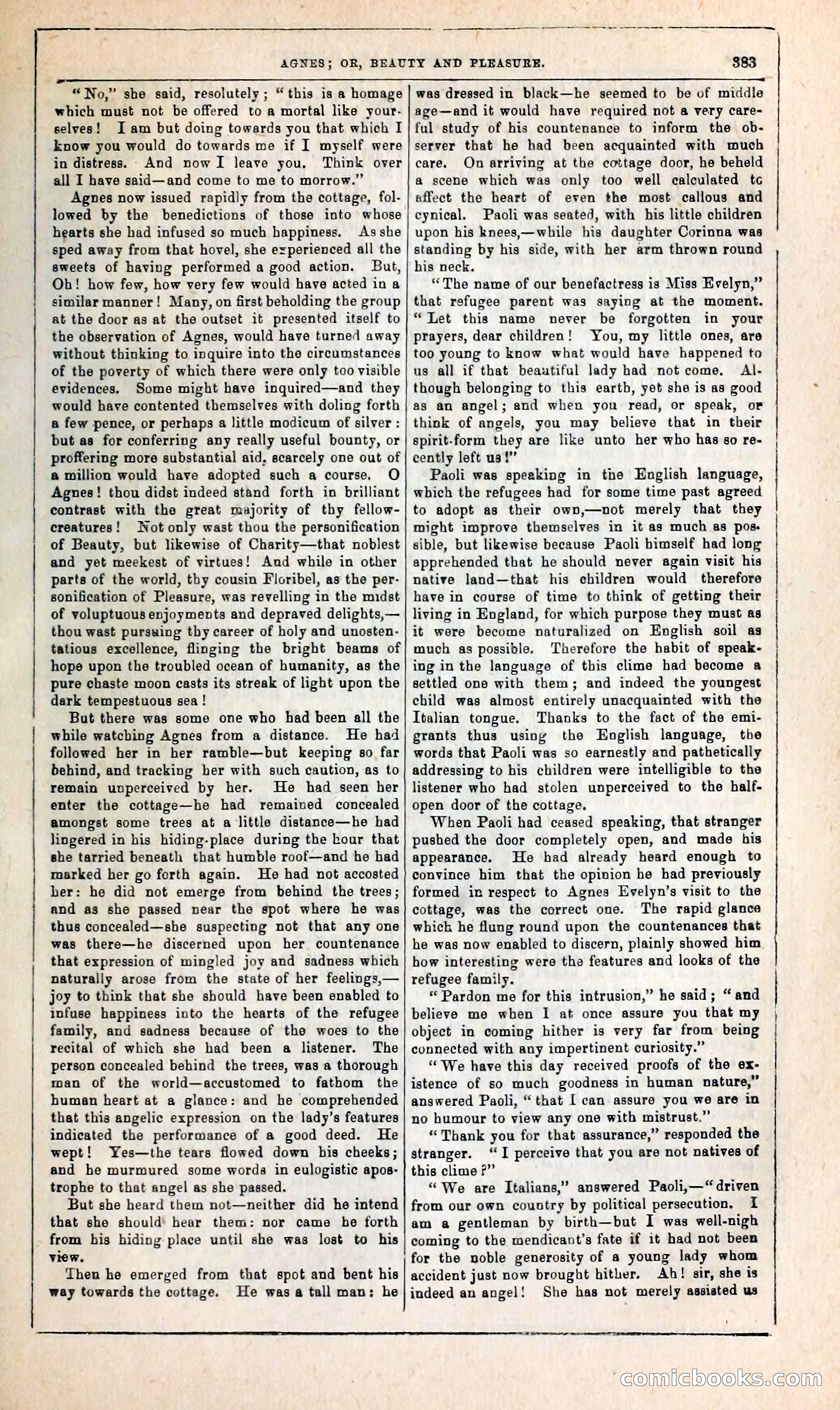
A restored page from Penny Dreadfuls, 1857. Page through the whole issue in the reader above.
📄 Transcribed text from this page (OCR, searchable)
Machine-transcribed from the original scan — historical spelling and the odd misread are preserved.
“No,” she said, resolutely; “this is a homage which must not be offered to a mortal like your- selves! Jam but doing towards you that which I know you would do towards me if I myself were in distress. And nowI leave you, Think over all I have said—and come to me to morrow.” Agnes now issued rapidly from the cottage, fol- lowed by the benedictions of those into whose hearts she had infused so much happiness. As she sped away from that hovel, she experienced all the sweets of having performed a good action. But, Ob! how few, how very few would have acted in a similar manner! Many, on first beholding the group at the door as at the outset it presented itself to the observation of Agnes, would have turned away without thinking to inquire into the circumstances of the poverty of which there were only too visible evidences. Some might have inquired—and they would have contented themselves with doling forth a few pence, or perhaps a little modicum of silver : but as for conferring any really useful bounty, or proffering more substantial aid, scarcely one out of a million would have adopted such a course. O Agnes! thou didst indeed stand forth in brilliant contrast with the great majority of thy fellow- creatures! Not only wast thou the personification of Beauty, but likewise of Charity—that noblest and yet meekest of virtues! And while in other parts of the world, thy cousin Floribel, as the per- sonification of Pleasure, was revelling in the midst of voluptuous enjoyments and depraved delights,— thou wast pursuing tby career of holy and unosten- tatious excellence, flinging the bright beams of hope upon the troubled ocean of humanity, as the pure chaste moon casts its streak of light upon the dark tempestuous sea ! But there was some one who had been all the while watching Agnes from a distance. He had followed her in her ramble—but keeping so far behind, and tracking her with such caution, as to remain uuperceived by her. He had seen her enter the cottage—he had remained concealed amongst some trees at a little distance—he had lingered in his hiding-place during the bour that she tarried beneath that humble roof—and he had marked her go forth again. He had not accosted her: he did not emerge from behind the trees; and as she passed near the spot where he was thus concealed—she suspecting not that any one was there—he discerned upon her countenance that expression of mingled joy and sadness which naturally arose from the state of her feelings,— joy to think that she should have been enabled to infuse happiness into the hearts of the refugee family, and sadness because of the woes to the recital of which she had been a listener. The person concealed behind the trees, was a thorough man of the world—accustomed to fathom the human heart at a glance: and he comprehended that this angelic expression on the lady’s features indicated the performance of a good deed. He wept! Yes—the tears flowed down his cheeks; and he murmured some worda in eulogistic apos- trophe to that angel as she passed. But she heard them not—neither did he intend that she should’ hear them: nor came he forth from his hiding place until she was lost to his view. Then he emerged from that spot and bent his AGNES; OR, BEAUTY AND PLEASURE. —_—--+-—— — + + - 383 was dressed in black—he seemed to be of middle age—and it would have required not a very care- ful study of his countenance to inform the ob- server that he had been acquainted with much care. On arriving at the cottage door, he beheld a scene which was only too well calculated te affect the heart of even the most callous and cynical. Paoli was seated, with his little children upon his knees,—while his daughter Corinna was standing by his side, with her arm thrown round his neck. “The name of our benefactress is Miss Evelyn,” that refugee parent was saying at the moment. “Let this name never be forgotten in your prayers, dear children! You, my little ones, are too young to know what would have happened to us all if that beautiful lady had not come. Al- though belonging to this earth, yet she is as good as an angel; and when you read, or speak, or think of angels, you may believe that in their spirit-form they are like unto her who has 80 re- cently left ua!” Paoli was speaking in the English language, which the refugees had for some time past agreed to adopt as their own,—not merely that they might improve themselves in it as much as pos sible, but likewise because Paoli himself had long apprehended that he should never again visit his native land—that his children would therefore have in course of time to think of getting their living in England, for which purpose they must as it were become naturalized on English soil as much as possible. Therefore the habit of speak- ing in the language of this clime had become a settled one with them; and indeed the youngest child was almost entirely unacquainted with the Italian tongue. Thanks to the fact of the emi- grants thus using the English language, the words that Paoli was so earnestly and pathetically addressing to his children were intelligible to the listener who had stolen unperceived to the half- open door of the cottage, When Paoli had ceased speaking, that stranger pushed the door completely open, and made his appearance. He bad already heard enough to convince him that the opinion he had previously formed in respect to Agnes Evelyn’s visit to the cottage, was the correct one. The rapid glance whick he flung round upon the countenances that he was now enabled to discern, plainly showed him how interesting were the features and looks of the refugee family. “ Pardon me for this intrusion,” he said; “ and believe me when I at once assure you that my object in coming hither is very far from being connected with any impertinent curiosity.” “We have this day received proofs of the ex- istence of so much goodness in human nature,” answered Paoli, “that I can assure you we are in no humour to view any one with mistrust.”’ “Thank you for that assurance,” responded the stranger. ‘I perceive that you are not natives of this clime ?” “We are Italians,” answered Paoli,—“ driven from our own country by political persecution. I am a gentleman by birth—but I was well-nigh coming to the mendicant’s fate if it had not been for the noble generosity of a young lady whom accident just now brought hither. Ah! sir, she is way towards the cottage. He was a tall man: he} indeed an angel! She has not merely assisted us ors Comiclooolks Olin