
Penny Dreadfuls, 1857 · page 39 of 394
Agnes, or, Beauty and Pleasure — page 39: what you’re looking at
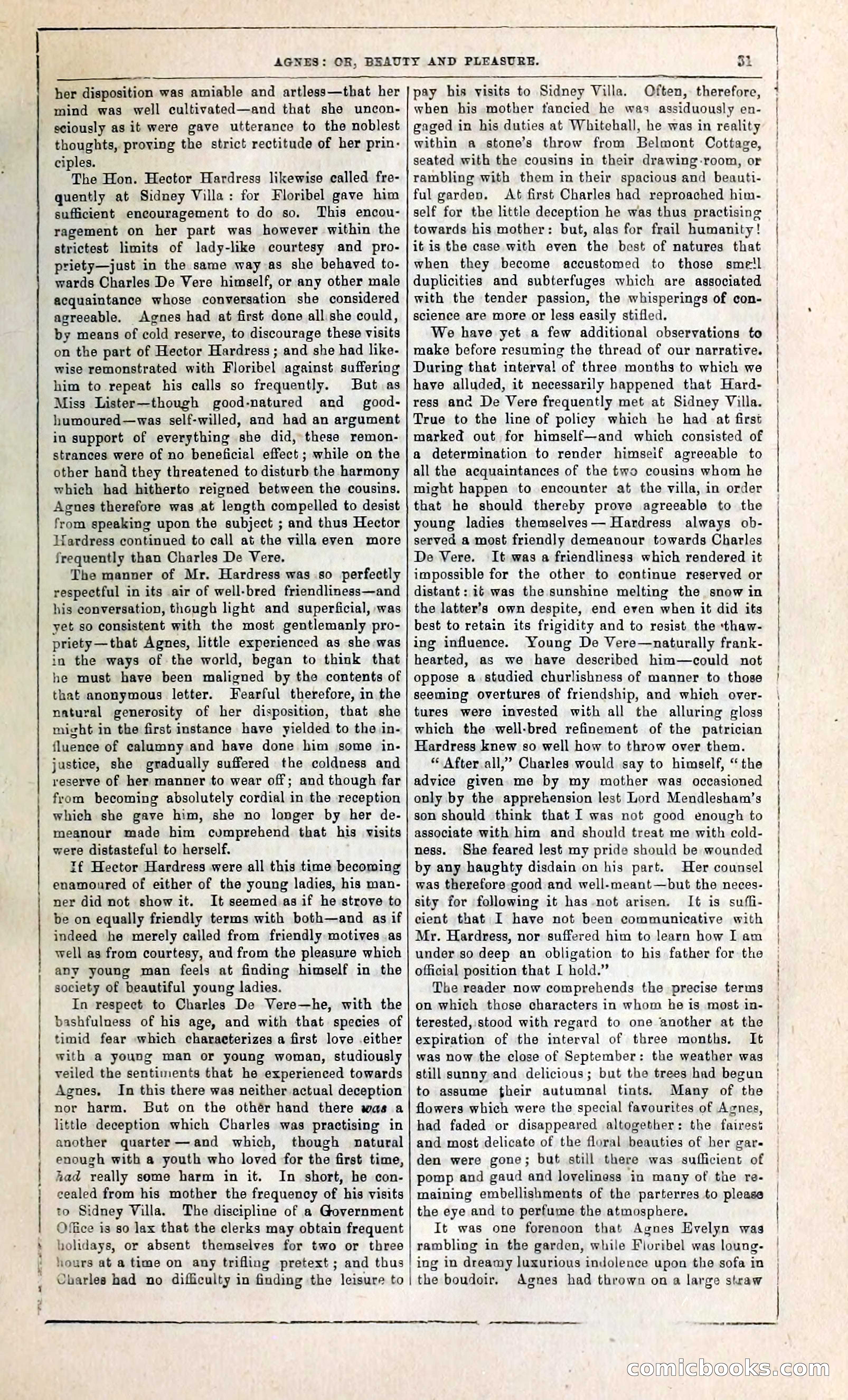
A restored page from Penny Dreadfuls, 1857. Page through the whole issue in the reader above.
📄 Transcribed text from this page (OCR, searchable)
Machine-transcribed from the original scan — historical spelling and the odd misread are preserved.
eee her disposition was amiable and artless—that her mind was well cultivated—and that she uncon- sciously as it were gave utterance to the noblest thoughts, proving the strict rectitude of her prin- ciples. The Hon. Hector Hardress likewise called fre- quently at Sidney Villa: for Floribel gave him sufficient encouragement to do so. This encou- ragement on her part was however within the strictest limits of lady-like courtesy and pro- priety—just in the same way as she behaved to- wards Charles De Vere himself, or any other male acquaintance whose conversation she considered agreeable. Agnes had at first done all she could, by means of cold reserve, to discourage these visits on the part of Hector Hardress ; and she had like- wise remonstrated with Floribel against suffering him to repeat his calls so frequently. But as Miss Lister—though good-natured and _ good- humoured—was self-willed, and had an argument in support of everything she did, these remon- strances were of no beneficiel effect ; while on the other hand they threatened to disturb the harmony which had hitherto reigned between the cousins. Agnes therefore was at length compelled to desist from speaking upon the subject ; and thus Hector Hardress continued to call at the villaeven more frequently than Charles De Vere. The manner of Mr. Hardress was so perfectly respectful in its air of well-bred friendliness—and his conversation, though light and superficial, was yet so consistent with the most gentlemanly pro- priety — that Agnes, little experienced as she was in the ways of the world, began to think that he must have been maligned by the contents of that anonymous letter. Fearful therefore, in the natural generosity of her disposition, that she might in the first instance have yielded to the in- fluence of calumny and have done him some in- justice, she gradually suffered the coldness and reserve of her manner to wear off; and though far from becoming absolutely cordial in the reception which she gave him, she no longer by her de- meanour made him cumprehend that his visits were distasteful to herself. If Heetor Hardress were all this time becoming enamoured of either of the young ladies, his man- ner did not show it. It seemed as if he strove to be on equally friendly terms with both—and as if indeed he merely called from friendly motives .as well as from courtesy, and from the pleasure which any young man feels at finding himself in the society of beautiful young ladies. In respect to Charles De Vere—he, with the bashfulness of his age, and with that species of timid fear which characterizes a first love either with a young man or young woman, studiously veiled the sentiments that he experienced towards Agnes, In this there was neither actual deception nor harm. But on the othér hand there was a little deception which Charles was practising in another quarter—and which, though natural enough with a youth who loved for the first time, had really some harm in it. In short, he con- eealed from his mother the frequency of his visits to Sidney Villa. The discipline of a Government Office is so lax that the clerks may obtain frequent holidays, or absent themselves for two or three hours at a time on any trifling pretext; and thus Charles had no difficulty in finding the leisure to AGNES: OR, BEAUTY AND PLEASURE. $i pay his visits to Sidney Villa. Often, therefore, when his mother tancied he was assiduously en- gaged in his duties at Whitehall, he was in reality within a stone’s throw from Belmont Cottage, seated with the cousins in their drawing-room, or rambling with them in their spacious and beauti- ful garden. At first Charles had reproached him- self for the little deception he was thus practising towards his mother: but, alas for frail humanity! it is the case with even the best of natures that when they become accustomed to those sme'l duplicities and subterfuges which are associated with the tender passion, the whisperings of con- science are more or less easily stifled. We have yet a few additional observations to make before resuming the thread of our narrative. During that interval! of three months to which we have alluded, it necessarily happened that Hard- ress anc De Vere frequently met at Sidney Villa. True to the line of policy which he had at first marked out for himself—and which consisted of a determination to render himseif agreeable to all the acquaintances of the two cousins whom he might happen to encounter at the villa, in order that he should thereby prove agreeable to the young ladies themselves— Hardress always ob- served a most friendly demeanour towards Charles De Vere. It was a friendliness which rendered it impossible for the other to continue reserved or distant: it was the sunshine melting the snow in the latter’s own despite, end even when it did its best to retain its frigidity and to resist the ‘thaw- ing influence. Young De Vere—naturally frank- hearted, as we have described him—could not oppose a studied churlishness of manner to those seeming overtures of friendship, and which over- tures were invested with all the alluring gloss which the well-bred refinement of the patrician Hardress knew so well how to throw over them. * After all,’ Charles would say to himself, “ the advice given me by my mother was occasioned only by the apprehension lest Lord Mendlesham’s son should think that I was not good enough to associate with him and should treat me with cold- ness. She feared lest my pride should be wounded by any haughty disdain on his part. Her counsel was therefore good and well-meant—but the neces- sity for following it has not arisen. It is suffi- cient that I have not been communicative with Mr. Hardress, nor suffered him to learn how I am under so deep an obligation to his father for the official position that [ hold.” The reader now comprehends the precise terms on which those characters in whom he is most in- terested, stood with regard to one another at the expiration of the interval of three months. It was now the close of September: the weather was still sunny and delicious; but the trees had begun to assume their autumnal tints. Many of the flowers which were the special favourites of Agnes, had faded or disappeared altogether: the fairesé and most delicate of the floral beauties of her gar- den were gone; but still there was suflicient of pomp and gaud and loveliness in many of the re- maining embellishments of the parterres to please the eye and to perfume the atmosphere, It was one forenoon that Agnes Evelyn was rambling in the garden, while Fioribel was loung- ing in dreamy luxurious indolence upon the sofa in the boudoir. Agnes had thrown on a large straw Cc tC te Conn — eee (CO)