
Penny Dreadfuls, 1857 · page 387 of 394
Agnes, or, Beauty and Pleasure — page 387: what you’re looking at
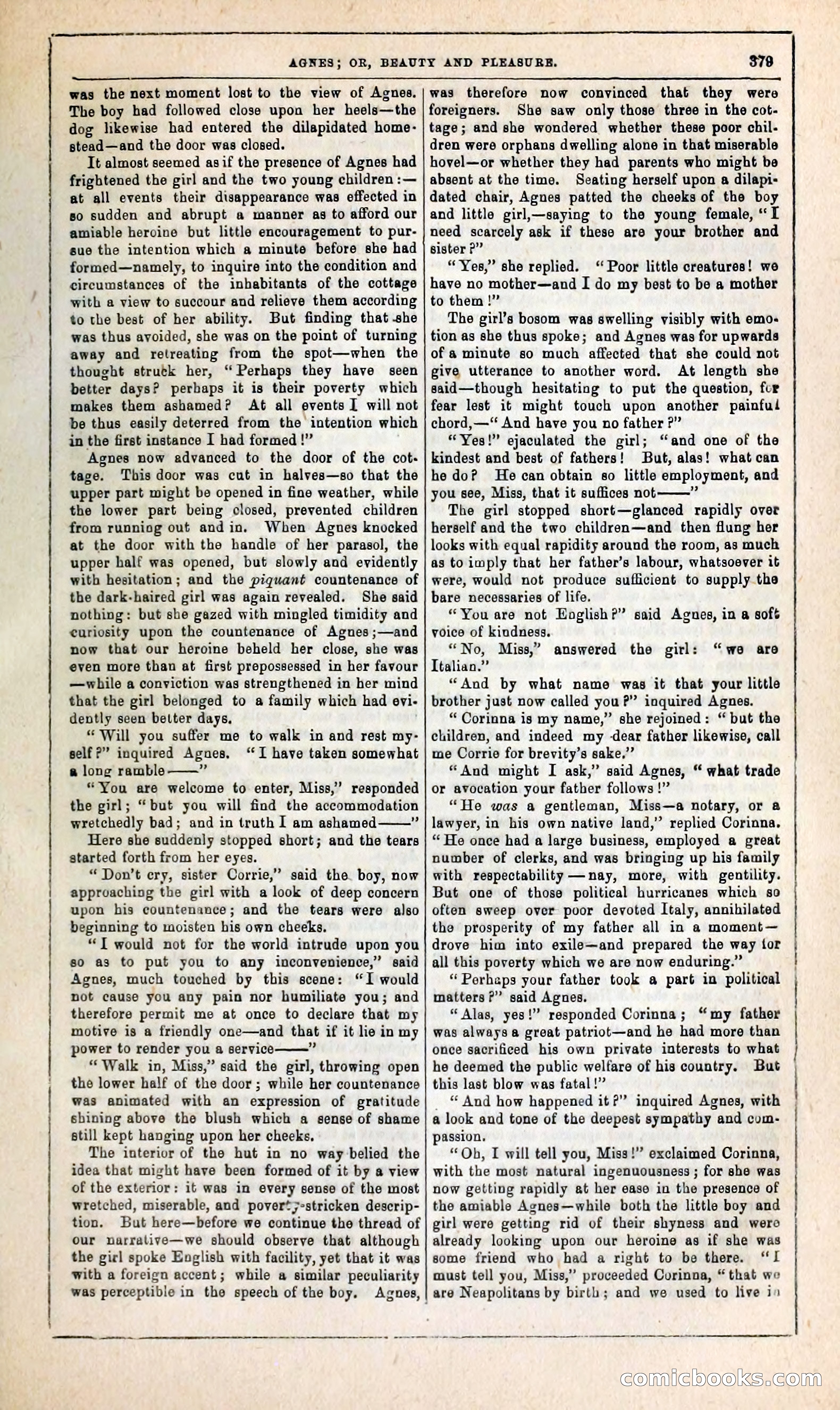
A restored page from Penny Dreadfuls, 1857. Page through the whole issue in the reader above.
📄 Transcribed text from this page (OCR, searchable)
Machine-transcribed from the original scan — historical spelling and the odd misread are preserved.
LL LLL LO LLL OL LL AL LLL LEAL LL LLL ALLA ALLL LLL LLL LAL LL AL LLL LLL ALLA LL LLL DAL LEAL LLL LLL LD mr ee ao AGNES; OR, BEAUTY AND PLEASURE. was the next moment lost to the view of Agnes. The boy had followed close upon her heels—the dog likewise had entered the dilapidated home- stead—and the door was closed. Tt almost seemed asif the presence of Agnes had frightened the girl and the two young children :— at all events their disappearance was effected in so sudden and abrupt a manner as to afford our amiable heroine but little encouragement to pur- sue the intention which a minute before she had formed—namely, to inquire into the condition and circumstances of the inhabitants of the cottage with a view to succour and relieve them according to the best of her ability. But finding that -she was thus avoided, she was on the point of turning away and retreating from the spot—when the thought struck her, “Perhaps they have seen better days? perbaps it is their poverty which makes them ashamed? At all events 1 will not be thus easily deterred from the intention which in the first instance I had formed !” Agnes now advanced to the door of the cot- tage. This door was cut in halves—so that the upper part might be opened in fine weather, while the lower part being closed, prevented children from runniog out andin. When Agnes knocked at the door with the handle of her parasol, the upper half was opened, but slowly and evidently with hesitation; and the piquant countenance of the dark-haired girl was again revealed. She said nothing: but she gazed with mingled timidity and curiosity upon the countenance of Agnes ;—and now that our heroine beheld her close, she was even more than at first prepossessed in her favour —while a conviction was strengthened in her mind that the girl belonged to a family which had evi- dently seen better days, * Will you suffer me to walk in and rest my- self?” inquired Agnes, “I have taken somewhat a long ramble ——” “You are welcome to enter, Miss,” responded the girl; “but you will find the accommodation wretchedly bad; and in truth I am ashamed u Here she suddenly stopped short; and the tears started forth from her eyes. “Don’t ery, sister Corrie,” said the boy, now approaching the girl with a look of deep concern upon his countenance; and the tears were also beginning to moisten his own cheeks. “JT would not for the world intrude upon you so as to put you to any inconvenience,” said Agnes, much touched by this scene: “I would not cause you any pain nor humiliate you; and therefore permit me at once to declare that my motive is a friendly one—and that if it lie in my power to render you a service ‘id “Walk in, Miss,” said the girl, throwing open the lower half of the door; while her countenance was animated with an expression of gratitude shining above the blush which a sense of shame still kept hanging upon her cheeks, The interior of the hut in no way belied the idea that might have been formed of it by a view of the exterior: it was in every sense of the most wretched, miserable, and povert;-stricken descrip- tion. But here—before we continue the thread of our narrative—we should observe that although the girl spoke English with facility, yet that it was with a foreign accent; while a similar peculiarity was perceptible in the speech of the boy. Agnes, | 378 was therefore now convinced that they were foreigners. She saw only those three in the cot- tage; and she wondered whether these poor chil- dren were orphans dwelling alone in that miserable hovel—or whether they had parents who might be absent at the time. Seating herself upon a dilapi- dated chair, Agnes patted the cheeks of the boy and little girl—saying to the young female, ‘I need scarcely ask if these are your brother and sister P” “Yes,” she replied. ‘Poor little creatures! we have no mother—and I do my best to be a mother to them !” The girl’s bosom was swelling visibly with emo- tion as she thus spoke; and Agnes was for upwards of a minute so much affected that she could not give utterance to another word. At length she said—though hesitating to put the question, ftir fear lest it might touch upon another painful chord,—‘‘ And have you no father ?” Yes!” ejaculated the girl; “and one of the kindest and best of fathers! But, alas! what can he do? He can obtain so little employment, and you see, Miss, that it sufices not———” The girl stopped short—glanced rapidly over herself and the two children—and then flung her looks with equal rapidity around the room, as much as to imply that her father’s labour, whatsoever it were, would not produce sufficient to supply the bare necessaries of life. “You are not English?” said Agnes, in a soft voice of kindness. “No, Miss,” answered the girl: Italian.” “And by what name was it that your little brother just now called you ?” inquired Agnes. “ Corinna is my name,” she rejoined: “ but the children, and indeed my -dear father likewise, call me Corrie for brevity’s sake,” “And might I ask,” said Agnes, “ what trade or avocation your father follows !” “He was a gentleman, Miss—a notary, or a lawyer, in his own native land,” replied Corinna. “He once had a large business, employed a great number of clerks, and was bringing up his family with respectability —nay, more, with gentility. But one of those political hurricanes which so often sweep over poor devoted Italy, annihilated the prosperity of my father all in a moment— drove him into exile—and prepared the way tor all this poverty which we are now enduring.” “ Perhaps your father took a part in political matters?” said Agnes. * Alas, yes!” responded Corinna; “my father was always a great patriot—and he had more than once sacrificed his own private interests to what he deemed the public welfare of his country. But this last blow was fatal !” _ © And how happened it?” inquired Agnes, with a look and tone of the deepest sympathy and cum- passion. “Oh, I will tell you, Miss!” exclaimed Corinna, with the most natural ingenuousness ; for she was now getting rapidly at her ease in the presence of the amiable Agnes—while both the little boy and girl were getting rid of their shyness and wero already looking upon our heroine as if she was some friend who had a right to be there. ‘I must tell you, Miss,” proceeded Corinna, “that we are Neapolitans by birth; and we used to live in “woe aro CoOMmiclooolkks ee RR TTT ET EEE LLL ee ee ee ee