
Penny Dreadfuls, 1857 · page 37 of 394
Agnes, or, Beauty and Pleasure — page 37: what you’re looking at
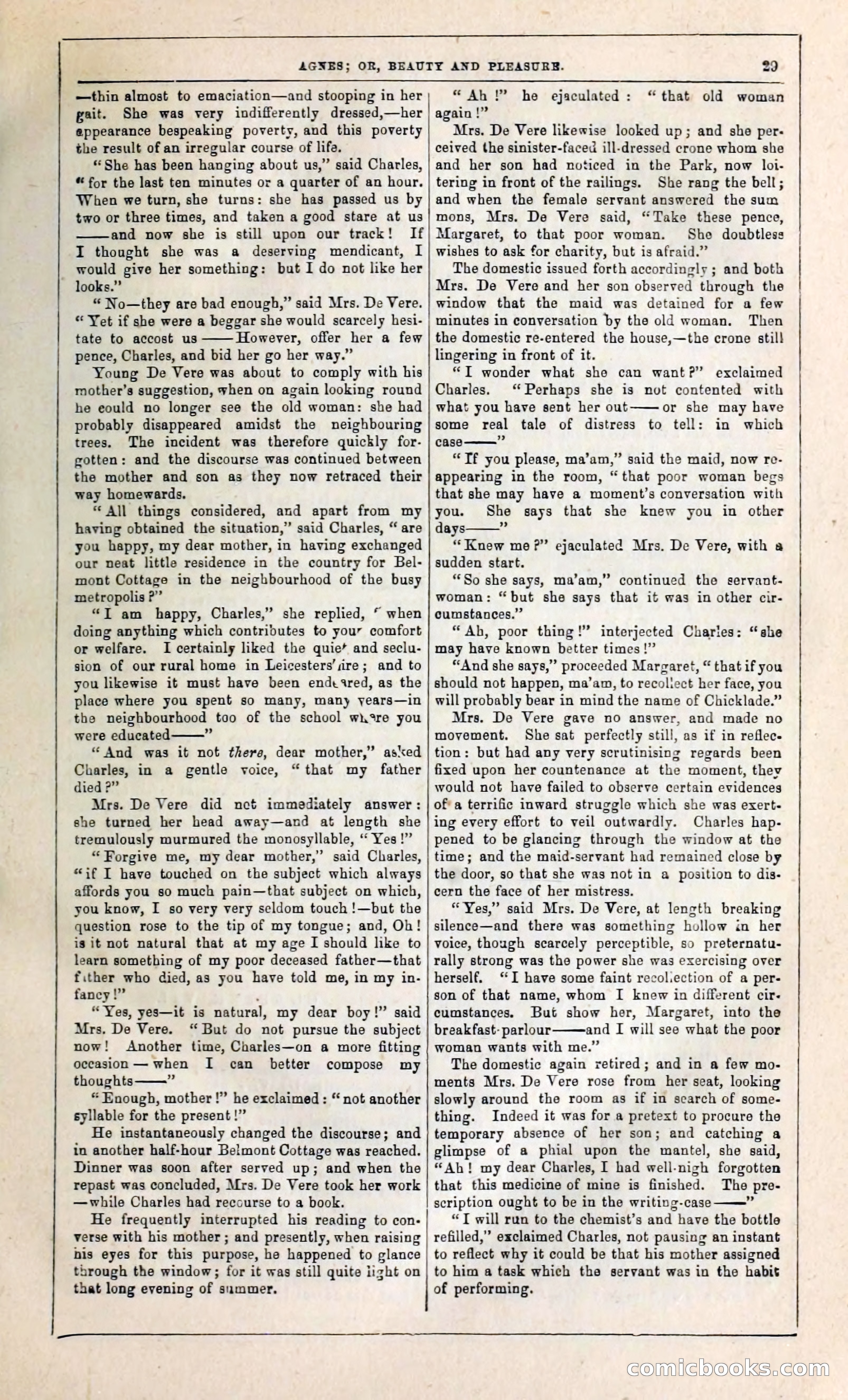
A restored page from Penny Dreadfuls, 1857. Page through the whole issue in the reader above.
📄 Transcribed text from this page (OCR, searchable)
Machine-transcribed from the original scan — historical spelling and the odd misread are preserved.
—thin almost to emaciation—and stooping in her eS ee eel AGNES; OR, BEAUTY AND PLEASURE. 29 “Ah !” he ejaculated: “that old woman again !” pait. She was very indifferently dressed,—her eppearance bespeaking poverty, and this poverty the result of an irregular course of life. ‘She has been hanging about us,” said Charles, “for the last ten minutes or a quarter of an hour. When we turn, she turns: she has passed us by two or three times, and taken a good stare at us and now she is still upon our track! If I thought she was a deserving mendicant, I would give her something: but I do not like her looks.” “ No—they are bad enough,” said Mrs. De Vere. “ Yet if she were a beggar she would scarcely hesi- tate to accost us However, offer her a few pence, Charles, and bid her go her way.” Young De Vere was about to comply with his mother’s suggestion, when on again looking round he eould no longer see the old woman: she had probably disappeared amidst the neighbouring trees. The incident was therefore quickly for- gotten: and the discourse was continued between the mother and son as they now retraced their way homewards. * All things considered, and apart from my having obtained the situation,” said Charles, “ are you happy, my dear mother, in having exchanged our neat little residence in the country for Bel- mont Cottage in the neighbourhood of the busy metropolis ?” “T am happy, Charles,” she replied, * when doing anything which contributes to your comfort or welfare. I certainly liked the quie’ and seclu- sion of our rural home in Leicesters’”re; and to you likewise it must have been endeared, as the place where you spent so many, many years—in the neighbourhood too of the school wh re you were educated i “ And was it not there, dear mother,” asked Charles, in a gentle voice, “that my father died ?” Mrs. De Vere did net immediately answer: she turned her head away—and at length she tremulously murmured the monosyllable, ‘‘ Yes!” “Forgive me, my dear mother,” said Charles, “if I have touched on the subject which always affords you so much pain—that subject on which, you know, I so very very seldom touch !—but the question rose to the tip of my tongue; and, Oh! is it not natural that at my age I should like to learn something of my poor deceased father—that fither who died, as you have told me, in my in- fancy !” “Yes, yes—it is natural, my dear boy!” said Mrs. De Vere. “But do not pursue the subject now! Another time, Charles—on a more fitting oceasion — when I can better compose my thoughts a * Enough, mother !” he exclaimed : “ not another syllable for the present!” He instantaneously changed the discourse; and in another half-hour Belmont Cottage was reached. Dinner was soon after served up; and when the repast was concluded, Mrs. De Vere took her work —while Charles had recourse to a book. He frequently interrupted his reading to con- verse with his mother ; and presently, when raising nis eyes for this purpose, he happened to glance through the window; for it was still quite iight on that long evening of summer. Mrs. De Vere likewise looked up; and she per- ceived the sinister-faced ill-dressed crone whom she and her son had noticed in the Park, now loi- tering in front of the railings. She rang the bell; and when the female servant answered the sum mons, Mrs. De Vere said, “Take these pence, Margaret, to that poor woman. She doubtless wishes to ask for charity, but is afraid.” The domestic issued forth accordingly ; and both Mrs. De Vere and her son observed through the window that the maid was detained for a few minutes in conversation by the old woman. Then the domestic re-entered the house,—the crone still lingering in front of it. *T wonder what she can want?” exclaimed Charles. ‘Perhaps she is not contented with what you have sent her out——-or she may have some real tale of distress to tell: in which case o “Tf you please, ma’am,” said the maid, now re- appearing in the room, “that poor woman begs that she may have a moment’s conversation with you. She says that she knew you in other days ts “Knew me?” ejaculated Mrs. De Vere, with a sudden start. “So she says, ma’am,” continued the servant- woman: “but she says that it was in other cir- cumstances.” “Ah, poor thing!” interjected Charies: “she may have known better times!” “And she says,’ proceeded Margaret, “thatif you should not happen, ma’am, to recoliect her face, you will probably bear in mind the name of Chicklade.” Mrs. De Vere gave no answer, and made no movement. She sat perfectly still, as if in reflec. tion: but had any very scrutinising regards been fixed upon her countenance at the moment, thev would not have failed to observe certain evidences ofa terrific inward struggle which she was exert- ing every effort to veil outwardly. Charles hap- pened to be glancing through the window at the time; and the maid-servant had remained close by the door, so that she was not in a position to dis- cern the face of her mistress. “Yes,” said Mrs. De Vere, at length breaking silence—and there was something hollow in her voice, though scarcely perceptible, so preternatu- rally strong was the power she was exercising over herself. ‘I have some faint recol.ection of a per- son of that name, whom I knew in different cir- cumstances. But show her, Margaret, into the breakfast: parlour and I will see what the poor woman wants with me.” The domestic again retired; and in a few mo- ments Mrs. De Vere rose from her seat, looking slowly around the room as if in search of some- thing. Indeed it was for a pretext to procure the temporary absence of her son; and catching a glimpse of a phial upon the mantel, she said, “Ah! my dear Charles, I had well-nigh forgotten that this medicine of mine is finished. The pre- scription ought to be in the writing-case o “T will run to the chemist’s and have the bottle refilled,” exclaimed Charles, not pausing an instant to reflect why it could be that his mother assigned to him a task which the servant was in the habit of performing. p? comlceloolks