
Penny Dreadfuls, 1857 · page 35 of 394
Agnes, or, Beauty and Pleasure — page 35: what you’re looking at
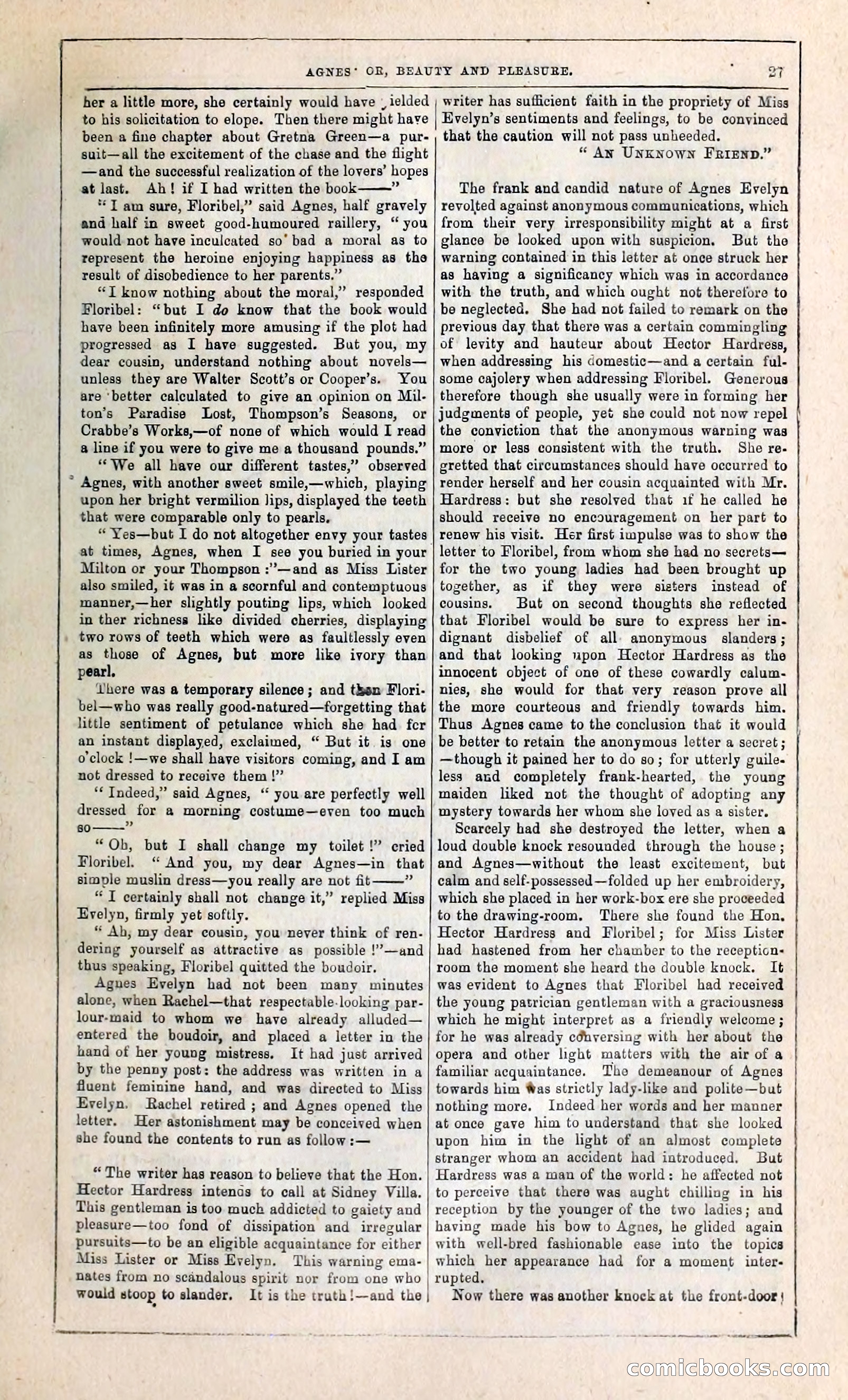
A restored page from Penny Dreadfuls, 1857. Page through the whole issue in the reader above.
📄 Transcribed text from this page (OCR, searchable)
Machine-transcribed from the original scan — historical spelling and the odd misread are preserved.
———s ———— AGNES’ OR, BEAUTY AND PLEASURE, oO” | her a little more, she certainly would have _ ielded | writer has sufficient faith in the propriety of Miss o to his solicitation to elope. Then there might have been a fine chapter about Gretna Green—a pur- suit—all the excitement of the chase and the flight —and the successful realization of the lovers’ hopes at last. Ah! if I had written the book a **T am sure, Floribel,” said Agnes, half gravely and half in sweet good-humoured raillery, “ you would not have inculcated so’ bad a moral as to represent the heroine enjoying happiness as the result of disobedience to her parents.” “J know nothing about the moral,” responded Floribel: “but I do know that the book would have been infinitely more amusing if the plot had progressed as I have suggested. But you, my dear cousin, understand nothing about novels— unless they are Walter Scott’s or Cooper’s. You are ‘better calculated to give an opinion on Mil- ton’s Paradise Lost, Thompson’s Seasons, or Crabbe’s Works,—of none of which would I read a line if you were to give me a thousand pounds.” *“We all have our different tastes,’ observed Agnes, with another sweet smile,—which, playing upon her bright vermilion lips, displayed the teeth that were comparable only to pearls. “ Yes—but I do not altogether envy your tastes at times, Agnes, when I see you buried in your Milton or your Thompson :’—and as Miss Lister also smiled, if was in a scornful and contemptuous manner,—her slightly pouting lips, which looked in ther richness like divided cherries, displaying two rows of teeth which were as faultlessly even as those of Agnes, but more like ivory than pearl, here was a temporary silence; and then Flori- bel—who was really good-natured—forgetting that little sentiment of petulance which she had fer an instant displayed, exclaimed, “ But it is one o'clock !—we shall have visitors coming, and I am not dressed to receive them !” ** Indeed,” said Agnes, “ you are perfectly well dressed for a morning costume—even too much 80 » “Ob, but I shall change my toilet !” cried Floribel. “ And you, my dear Agnes—in that simple muslin dress—you really are not fit——” “I certainly shall not change it,” replied Miss Evelyn, firmly yet softly. * Ah, my dear cousin, you never think of ren- dering yourself as attractive as possible !’—and thus speaking, Floribel quitted the boudoir. Agnes Evelyn had not been many minutes alone, when Rachel—that respectable-looking par- lour-maid to whom we have already alluded— entered the boudoir, and placed a letter in the hand of her young mistress. It had just arrived by the penny post: the address was written in a fluent feminine hand, and was directed to Miss Evelyn. Rachel retired ; and Agnes opened the letter. Her astonishment may be conceived when she found the contents to run as follow :— “The writer has reason to believe that the Hon. Hector Hardress intenas to call at Sidney Villa. This gentleman is too muck addicted to gaiety and pleasure—too fond of dissipation and irregular pursuits—to be an eligible acquaintance for either Miss Lister or Miss Evelyn. This warning ema- nates from no scandalous spirit nor from one who Evelyn’s sentiments and feelings, to be convinced that the caution will not pass unheeded. * AN UNKNOWN FRIEND.” The frank and candid nature of Agnes Evelyn revolted against anonymous communications, which from their very irresponsibility might at a first glance be looked upon with suspicion. But the warning contained in this letter at once struck her as having a significancy which was in accordance with the truth, and which ought not therefore to be neglected. She had not failed to remark on the previous day that there was a certain commingling of levity and hauteur about Hector Hardress, when addressing his domestic—and a certain ful- some cajolery when addressing Floribel. Generous therefore though she usually were in forming her judgments of people, yet she could not now repel the conviction that the anonymous warning was more or less consistent with the truth. She re- gretted that circumstances should have occurred to render herself and her cousin acquainted with Mr. Hardress: but she resolved that if he called he should receive no encouragement on her part to renew his visit. Her first impulse was to show the letter to Floribel, from whom she had no secrets— for the two young ladies had been brought up together, as if they were sigters instead of cousins. But on second thoughts she reflected that Floribel would be sure to express her in- dignant disbelief of all. anonymous slanders ; and that looking upon Hector Hardress as the innocent object of one of these cowardly calum- nies, she would for that very reason prove all the more courteous and friendly towards him. Thus Agnes came to the conclusion that if would be better to retain the anonymous letter a secret; —though it pained her to do so; for utterly guile. less and completely frank-hearted, the young maiden liked not the thought of adopting any mystery towards her whom she loved as a sister. Searcely had she destroyed the letter, when a loud double knock resounded through the house; and Agnes—without the least excitement, but calm and self-possessed—folded up her embroidery, which she placed in her work-box ere she proceeded to the drawing-room. There she found the Hon, Hector Hardress and Floribel; for Miss Lister had hastened from her chamber to the reception- room the moment she heard the double knock. It was evident to Agnes that Floribel had received the young patrician gentleman with a graciousness which he might interpret as a friendly welcome ; for he was already cdnversing with her about the opera and other light matters with the air of a familiar acquaintance. The demeanour of Agnes towards him Was strictly lady-like and polite—but nothing more. Indeed her words and her manner at once gave him to understand that she looked upon him in the light of an almost complete stranger whom an accident had introduced. But Hardress was a man of the world: he affected not to perceive that there was aught chilling in his reception by the younger of the two ladies; and having made his bow to Agnes, he glided again with well-bred fashionable ease into the topics which her appearance had for a moment inter- rupted, would stoop to slander. It is the truth!—and the; Now there was another knock at the front-door| ee = Com