
Penny Dreadfuls, 1857 · page 330 of 394
Agnes, or, Beauty and Pleasure — page 330: what you’re looking at
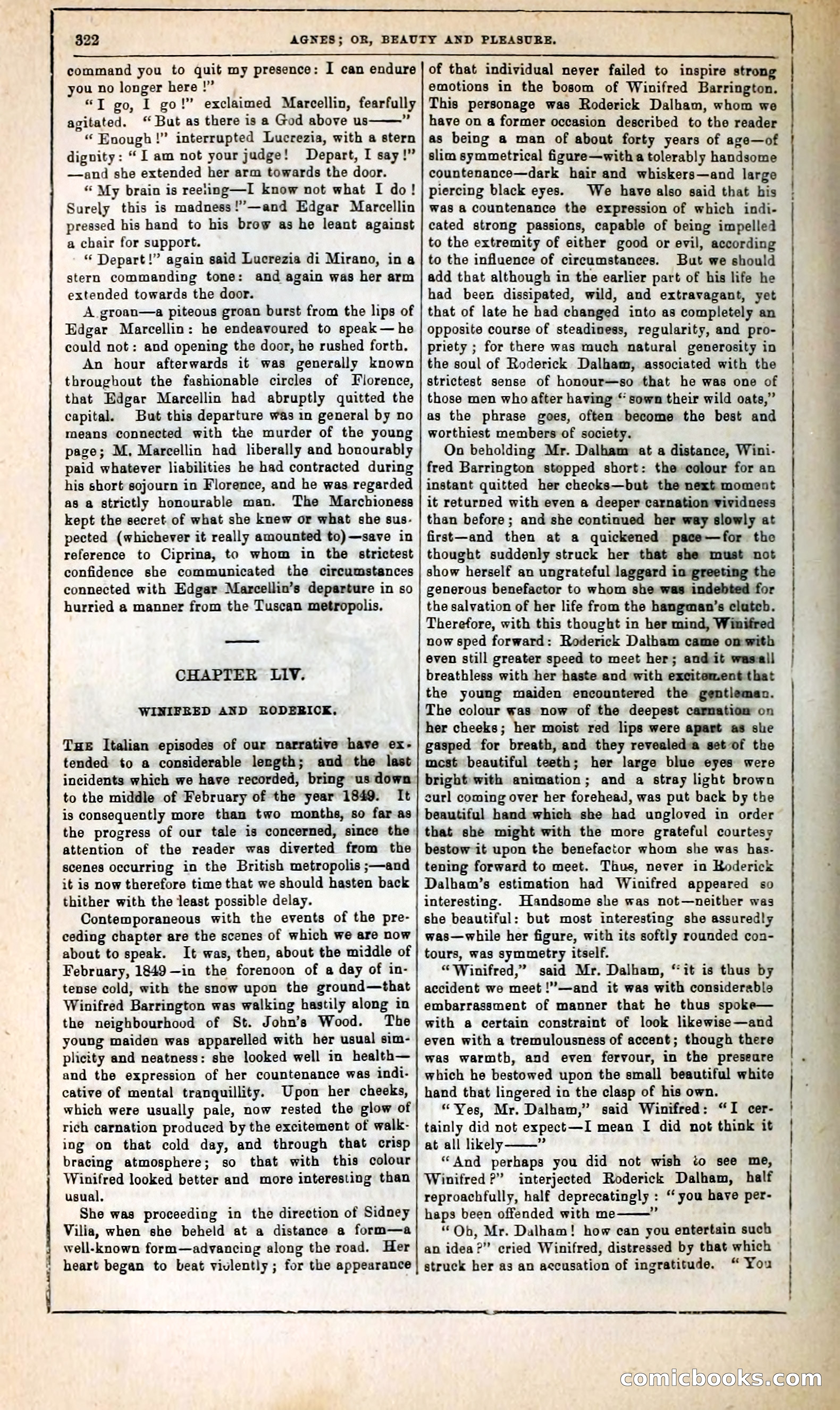
A restored page from Penny Dreadfuls, 1857. Page through the whole issue in the reader above.
📄 Transcribed text from this page (OCR, searchable)
Machine-transcribed from the original scan — historical spelling and the odd misread are preserved.
t ‘ 322 AGNES; OR, BEAUTY AND PLEASURE. command you to quit my presence: I can endure you no longer here !” “T go, I go!” exclaimed Marcellin, fearfully agitated. ‘ But as there is a God above us x “ Enough!” interrupted Lucrezia, with a stern dignity: “I am not your judge! Depart, I say!” —and she extended her arm towards the door. ““ My brain is ree:ing—I know not what I do! Surely this is madness!’—and Edgar Marcellin pressed his hand to his brow as he leant against a chair for support. “* Depart!” again said Lucrezia di Mirano, ina stern commanding tone: and again was her arm extended towards the door. A groan—a piteous groan burst from the lips of Edgar Marcellin: he endeavoured to speak — he could not: and opening the door, he rushed forth. An hour afterwards it was generally known throughout the fashionable circles of Florence, that Edgar Marcellin had abruptly quitted the capital. But this departure was in general by no means connected with the murder of the young page; M, Marcellin had liberally and bonourably paid whatever liabilities he had contracted during his short sojourn in Florence, and he was regarded as a strictly honourable man. The Marchioness kept the secret. of what she knew or what she sus- pected (whichever it really amounted to)—save in reference to Ciprina, to whom in the strictest confidence she communicated the circumstances connected with Edgar Marcellin’s departure in so hurried a manner from the Tuscan metropolis. CHAPTER LIV. WINIFEED AND EODERICK. Tue Italian episodes of our narrative have ex- tended to a considerable length; and the last incidents which we have recorded, bring us down to the middle of February of the year 1849. It is consequently more than two months, so far as the progress of our tale is concerned, since the attention of the reader was diverted from the scenes occurring in the British metropolis ;—and it is now therefore time that we should hasten back thither with the least possible delay. Contemporaneous with the events of the pre- ceding chapter are the scenes of which we are now about to speak. It was, then, about the middle of February, 1849—in the forenoon of a day of in- tense cold, with the snow upon the ground—that Winifred Barrington was walking hastily along in the neighbourhood of St. John’s Wood. The young maiden was apparelled with her usual sim- plicity and neatness: she looked well in health— and the expression of her countenance was indi- cative of mental tranquillity. Upon her cheeks, which were usually pale, now rested the glow of rich carnation produced by the excitement of walk- ing on that cold day, and through that crisp bracing atmosphere; so that with this colour Winifred looked better and more interesting than usual, She was proceeding in the direction of Sidney Vilia, when she beheld at a distance a form—a well-known form—advancing along the road. Her heart began to beat vivlently; for the appearance of that individual never failed to inspire strong emotions in the bosom of Winifred Barrington. This personage was Roderick Dalham, whom we have on a former occasion described to the reader as being a man of about forty years of age—of slim symmetrical figure—with a tolerably handsome countenance—dark hair and whiskers—and large piercing black eyes. We have also said that his was a countenance the expression of which indi- cated strong passions, capable of being impelled to the extremity of either good or evil, according to the influence of circumstances. But we should add that although in the earlier part of his life he had been dissipated, wild, and extravagant, yet that of late he had changed into as completely an opposite course of steadiness, regularity, and pro- priety ; for there was much natural generosity in the soul of Roderick Dalham, associated with the strictest sense of honourso that he was one of those men who after having “ sown their wild oats,” as the phrase goes, often become the best and worthiest members of society. On beholding Mr. Dalham at a distance, Wini- fred Barrington stopped short: the colour for an instant quitted her cheoks—but the next moment it returned with even a deeper carnation vividness than before; and she continued her way slowly at first—and then at a quickened pace—for the thought suddenly struck her that she must not show herself an ungrateful laggard in-pgreeting the generous benefactor to whom she was indebted for the salvation of her life from the hangman’s clateb. Therefore, with this thought in her mind, Winifred now sped forward: Roderick Dalham came om with even still greater speed to meet her; and it wasall breathless with her haste and with excitement that the young maiden encountered the gentleman. The colour was now of the deepest carmation on her cheeks; her moist red lips were apart as she gasped for breath, and they revealeda setof the mest beautiful teeth; her large blue eyes were bright with animation; and a stray light brown curl coming over her forehead, was put back by the beautiful hand which she had ungloved in order that she might with the more grateful courtesy bestow it upon the benefactor whom she was has- tening forward to meet. Thus, never in Roderick Dalham’s estimation had Winifred appeared so interesting. Handsome she was not—neither was she beautiful: but most interesting she assuredly was—while her figure, with its softly rounded con- tours, was symmetry itself. “Winifred,” said Mr. Dalham, “it is thus by accident we meet !”—and it was with considerable embarrassment of manner that he thus spoke— with a certain constraint of look likewise—and even with a tremulousness of accent; though there was warmtb, and even fervour, in the preseare which he bestowed upon the small beautiful white hand that lingered in the clasp of his own. “Yes, Mr. Dalham,” said Winifred: “I cer- tainly did not expect—I mean I did not think it at all likely ri “And perhaps you did not wish to see me, Winifred?” interjected Roderick Dalham, half reproachfully, half deprecatingly : “ you have per- haps been offended with me “Ob, Mr. Dalham! how can you entertain such an idea?” cried Winifred, distressed by that which struck her as an accusation of ingratitude. “ You comilcbooks * eS eee ee ee