
Penny Dreadfuls, 1857 · page 326 of 394
Agnes, or, Beauty and Pleasure — page 326: what you’re looking at
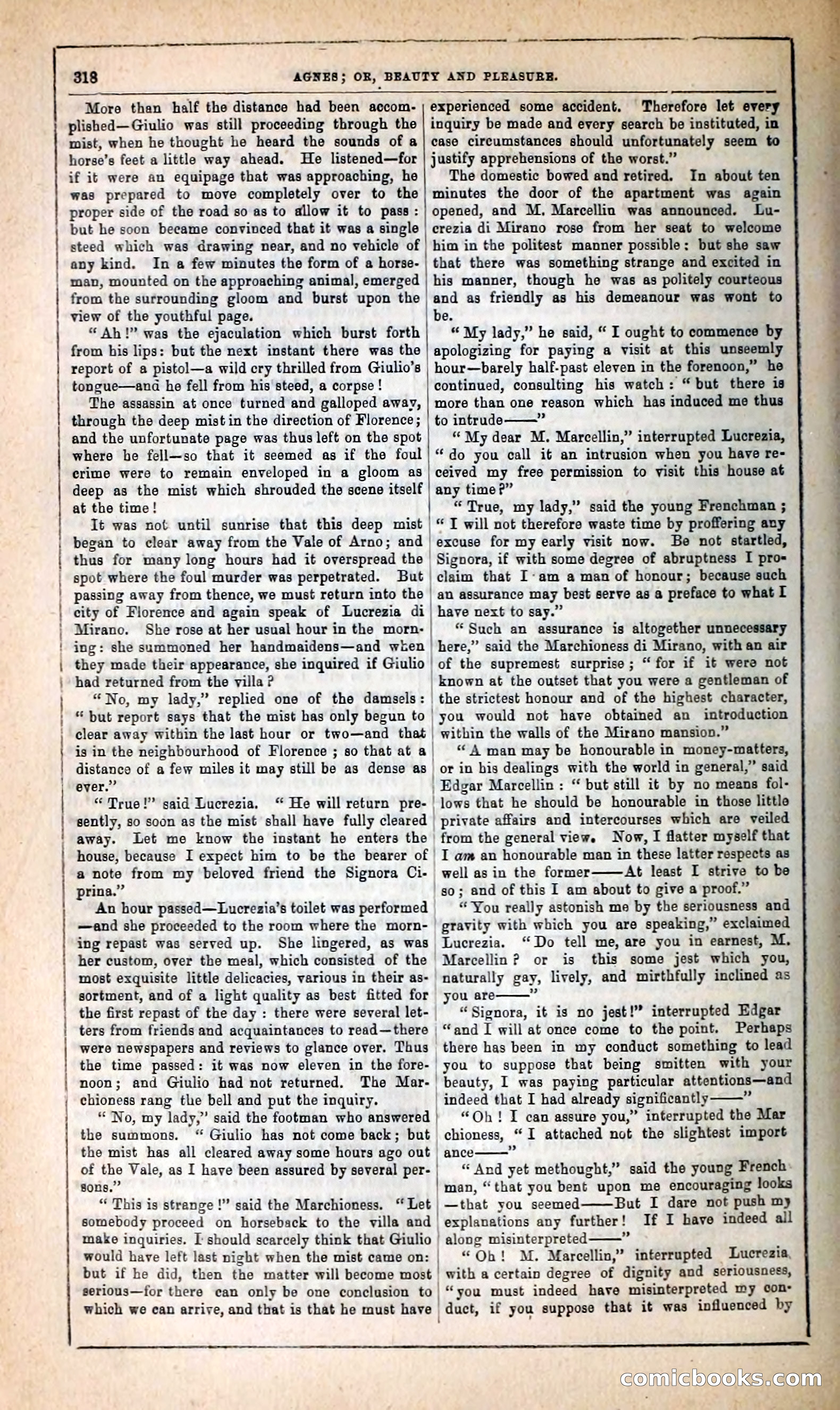
A restored page from Penny Dreadfuls, 1857. Page through the whole issue in the reader above.
📄 Transcribed text from this page (OCR, searchable)
Machine-transcribed from the original scan — historical spelling and the odd misread are preserved.
: Se . ‘ a’ eC ee , ‘ " 4.7 a ee +. 4 oki . ‘ » rr. ~ 318 AGNES; OR, BEAUTY AND PLEASURE. a . “ More than half the distance had been accom- plished—Giulio was still proceeding through the mist, when he thought he heard the sounds of a horse’s feet a little way ahead. He listened—for experienced some accident. Therefore let every } inquiry be made and every search be instituted, in } case circumstances should unfortunately seem to | justify apprehensions of the worst.” } waz if it were an equipage that was approaching, he was prepared to move completely over to the proper side of the road so as to allow it to pass: but he soon became convinced that it was a single steed which was drawing near, and no vehicle of any kind. In a few minutes the form of a horse- man, mounted on the approaching animal, emerged from the surrounding gloom and burst upon the | and as friendly as his demeanour was wont to view of the youthful page. “Ah!” was the ejaculation which burst forth from his lips: but the next instant there was the report of a pistol—a wild cry thrilled from Giulio’s tongue—ana he fell from his steed, a corpse! The assassin at once turned and galloped away, through the deep mist in the direction of Florence; and the unfortunate page was thus left on the spot where be fell—so that it seemed as if the foul crime were to remain enveloped in a gloom as deep as the mist which shrouded the scene itself at the time! It was not until sunrise that this deep mist began to clear away from the Vale of Arno; and thus for many long hours had it overspread the spot where the foul murder was perpetrated. But passing away from thence, we must return into the city of Florence and again speak of Lucrezia di Mirano. She rose at her usual hour in the morn- ing: she summoned her handmaidens—and when they made their appearance, she inquired if Giulio had returned from the villa ? “No, my lady,” replied one of the damsels : “ but report says that the mist has only begun to | clear away within the last hour or two—and that is in the neighbourhood of Florence ; so that at a distance of a few miles it may still be as dense as | ever.” * True!” said Lucrezia. ‘“ He will return pre- sently, so soon as the mist shall have fully cleared away. Let me know the instant he enters the house, because I expect him to be the bearer of | a note from my beloved friend the Signora Ci- prina.” An hour passed—Lucrezia’s toilet was performed —and she proceeded to the room where the morn- ing repast was served up. She lingered, as was her custom, over the meal, which consisted of the most exquisite little delicacies, various in their as- sortment, and of a light quality as best fitted for the first repast of the day : there were several let- ters from friends and acquaintances to read—there were newspapers and reviews to glance over. Thus the time passed: it was now eleven in the fore- noon; and Giulio had not returned. The Mar- chioness rang the bell and put the inquiry. “No, my lady,” said the footman who answered the summons. “ Giulio has not come back; but the mist has all cleared away some hours ago out of the Vale, as I have been assured by several per- sons.” “ This is strange !” said the Marchioness. “ Let somebody proceed on horseback to the villa and make inquiries. | should scarcely think that Giulio would have left last night when the mist came on: but if he did, then the matter will become most serious—for there can only be one conclusion to which we can arrive, and that is that he must have LT The domestic bowed and retired. In about ten minutes the door of the apartment was again opened, and M, Marcellin was announced. Lu- crezia di Mirano rose from her seat to welcome him in the politest manner possible: but she saw that there was something strange and excited in his manner, though he was as politely courteous be. “ My lady,” he said, “ I ought to commence by apologizing for paying a visit at this unseemly hour—barely half-past eleven in the forenoon,” he continued, consulting his watch: “but there is more than one reason which has induced me thus to intrude “ My dear M. Marcellin,” interrupted Lucrezia, * do you call it an intrusion when you have re- ceived my free permission to visit this house at any time?” “True, my lady,” said the young Frenchman ; © T will not therefore waste time by proffering any excuse for my early visit now. Be not startled, Signora, if with some degree of abruptness I pro= claim that I-am a man of honour; because such | an assurance may best serve as a preface to what I have next to say.” * Such an assurance is altogether unnecessary here,” said the Marchioness di Mirano, with an air of the supremest surprise ; “for if it were not known at the outset that you were a gentleman of | the strictest honour and of the highest character, you would not have obtained an introduction within the walls of the Mirano mansion.” “4 man may be honourable in money-matters, or in bis dealings with the world in general,” said Edgar Marcellin : “ but still it by no means fol- ‘lows that he should be honourable in those little private affairs and intercourses which are veiled from the general view. Now, I flatter myself that I am an honourable man in these latter respects as well as in the former——At least I strive to be so; and of this I am about to give a proof.” “You really astonish me by the seriousness and gravity with which you are speaking,” exclaimed Lucrezia. “Do tell me, are you in earnest, M. Marcellin? or is this some jest which you, naturally gay, lively, and mirthfully inclined as you are 7% “Signora, it is no jest!” interrupted Edgar “and I will at once come to the point. Perhaps there has been in my conduct something to lead you to suppose that being smitten with your beauty, I was paying particular attentions—and indeed that I had already significantly ? “Oh! I can assure you,” interrupted the Mar chioness, “I attached not the slightest import ance 3 “ And yet methought,” said the young French: man, “that you bent upon me encouraging looks _—that you seemed But I dare not push my explanations any further! If I have indeed all ' along misinterpreted f | “Qh! M. Marcellin”? interrupted Lucrezia, | with a certain degree of dignity and seriousness, | “you must indeed have misinterpreted my con- duet, if you suppose that it was influenced by GComichooks i a