
Penny Dreadfuls, 1857 · page 323 of 394
Agnes, or, Beauty and Pleasure — page 323: what you’re looking at
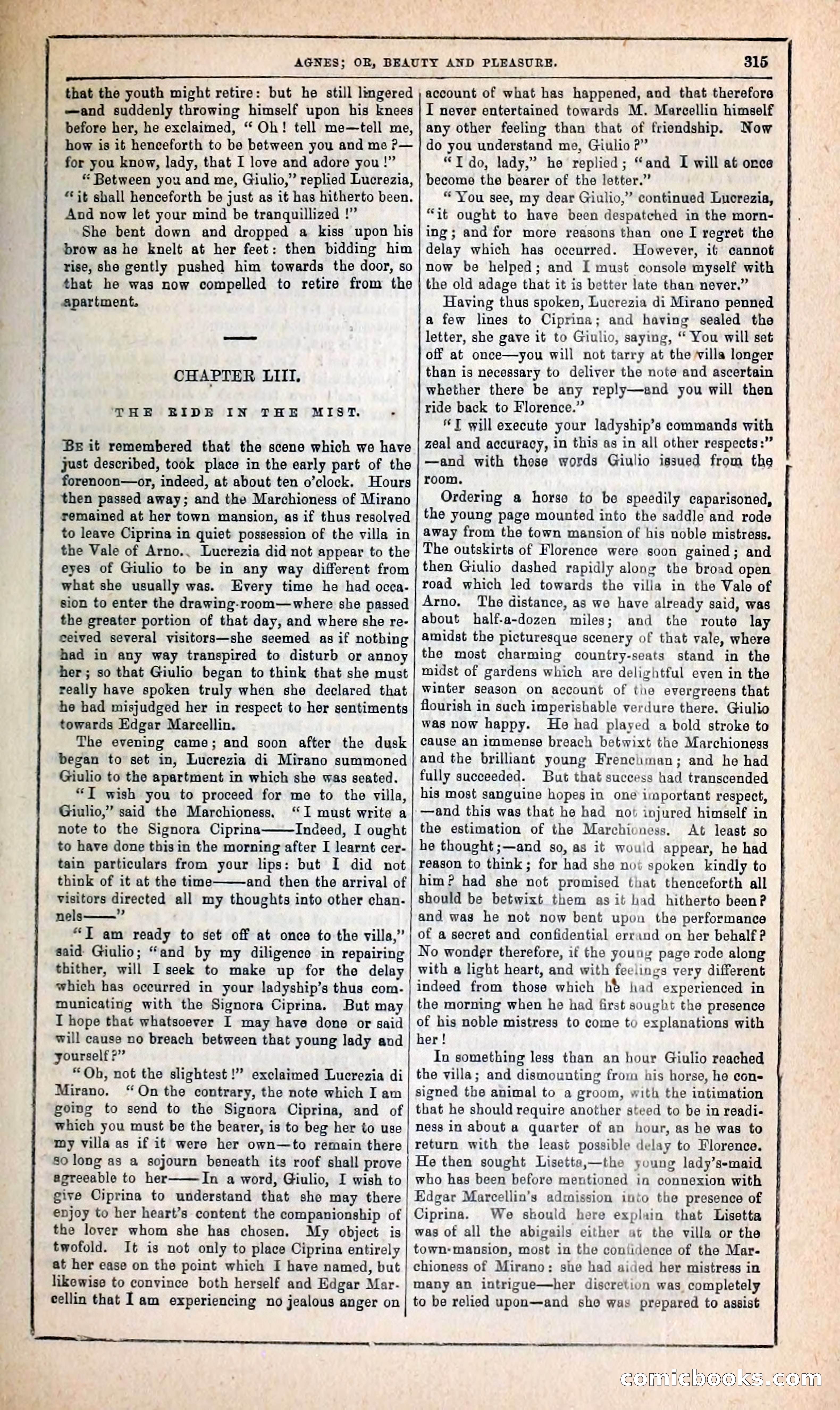
A restored page from Penny Dreadfuls, 1857. Page through the whole issue in the reader above.
📄 Transcribed text from this page (OCR, searchable)
Machine-transcribed from the original scan — historical spelling and the odd misread are preserved.
ad AGNES; OR, BEAUTY AND PLEASURE. 315 that the youth might retire: but he still lingered —and suddenly throwing himself upon his knees before her, he exclaimed, “ Oh! tell me—tell me, how is it henceforth to be between you and me P— for you know, lady, that I love and adore you!” * Between you and me, Giulio,” replied Lucrezia, “it shall henceforth be just as it has hitherto been. And now let your mind be tranquillized !” She bent down and dropped a kiss upon his brow as he knelt at her feet: then bidding him rise, she gently pushed him towards the door, so that he was now compelled to retire from the apartment. CHAPTER LIII. THE BIDE IN THE MIST. - Br it remembered that the scene which we have yust described, took place in the early part of the forenoon—or, indeed, at about ten o’clock. Hours then passed away; and the Marchioness of Mirano remained at her town mansion, as if thus resolved to leave Ciprina in quiet possession of the villa in the Vale of Arno.. Lucrezia did not appear to the eyes of Giulio to be in any way different from what she usually was. Every time he had ocea- sion to enter the drawing-room—where she passed the greater portion of that day, and where she re- eeived several visitors—she seemed as if nothing had in any way transpired to disturb or annoy her; so that Giulio began to think that she must really have spoken truly when she declared that he had misjudged her in respect to her sentiments towards Edgar Marcellin. The evening came; and soon after the dusk began to set in, Lucrezia di Mirano summoned Giulio to the apartment in which she was seated. “TI wish you to proceed for me to the villa, Giulio,” said the Marchioness. “I must write a note to the Signora Ciprina Indeed, I ought to have done thisin the morning after I learnt cer- tain particulars from your lips: but I did not think of it at the time and then the arrival of visitors directed all my thoughts into other chan- nels——” “T am ready to set off at once to the villa,” said Giulio; “and by my diligence in repairing thither, will I seek to make up for the delay which has occurred in your ladyship’s thus com- municating with the Signora Ciprina. But may I hope that whatsoever I may have done or said will cause no breach between that young lady and yourself?” “Oh, not the slightest!” exclaimed Lucrezia di Mirano. “On the contrary, the note which I am going to send to the Signora Ciprina, and of which you must be the bearer, is to beg her to use my villa as if if were her own—to remain there So long as a sojourn beneath its roof shall prove agreeable to her——JIn a word, Giulio, I wish to give Ciprina to understand that she may there enjoy to her heart’s content the companionship of the lover whom she has chosen. My object is twofold. It is not only to place Ciprina entirely at her ease on the point which I have named, but likewise to convince both herself and Edgar Mar- cellin that Iam experiencing no jealous anger on account of what has happened, and that therefore I never entertained towards M. Marcellin himself any other feeling than that of friendship. Now do you understand me, Giulio ?” “T do, lady,” he replied; “and I will at once become the bearer of the letter.” “You see, my dear Giulio,” continued Lucrezia, “it ought to have been despatched in the morn- ing; and for more reasons than one I regret the delay which has occurred. However, if cannot now be helped; and I must console myself with the old adage that it is better late than never.” Having thus spoken, Lucrezia di Mirano penned a few lines to Ciprina; and having sealed the letter, she gave it to Giulio, saying, “ You will set off at once—you will not tarry at the villa longer than is necessary to deliver the note and ascertain whether there be any reply—and you will then ride back to Florence.” T will execute your ladyship’s commands with zeal and accuracy, in this as in all other respects:” —and with these words Giulio issued from the room. Ordering a horse to be speedily caparisoned, the young page mounted into the saddle and rode away from the town mansion of his noble mistress. The outskirts of Florence were soon gained; and then Giulio dashed rapidly along the broad open road which led towards the villa in the Vale of Arno. The distance, as we have already said, was about half-a-dozen miles; and the route lay amidst the picturesque scenery of that vale, where the most charming country-seats stand in the midst of gardens which are delightful even in the winter season on account of the evergreens that flourish in such imperishable verdure there. Giulio was now happy. He had played a bold stroke to cause an immense breach betwixt the Marchioness and the brilliant young Frenciman; and he had fully succeeded. But that success had transcended his most sanguine hopes in one important respect, —and this was that he had not injured himself in the estimation of the Marchivness. At least so he thought;—and so, as it would appear, he had reason to think; for had she not spoken kindly to him? had she not promised that thenceforth all should be betwixt them as it had hitherto been? and was he not now bent upon the performance of a secret and confidential errand on her behalf? No wonder therefore, if the young page rode along with a light heart, and with feelings very different indeed from those which ht had experienced in the morning when he had first sought the presence of his noble mistress to come to explanations with her! In something less than an hour Giulio reached the villa; and dismounting from his horse, he con- signed the animal to a groom, with the intimation that he should require another steed to be in readi- ness in about a quarter of an hour, as he was to return with the least possible delay to Florence. He then sought Lisetta,—the young lady’semaid who has been before mentioned in connexion with Edgar Marcellin’s admission into the presence of Ciprina. We should here explain that Lisetta was of all the abigails either at the villa or the town-mansion, most in the conlidence of the Mar- chioness of Mirano: she had aided her mistress in many an intrigue—her discretion was completely to be relied upon—and she was prepared to assist — COMmcooolkxs (E