
Penny Dreadfuls, 1857 · page 311 of 394
Agnes, or, Beauty and Pleasure — page 311: what you’re looking at
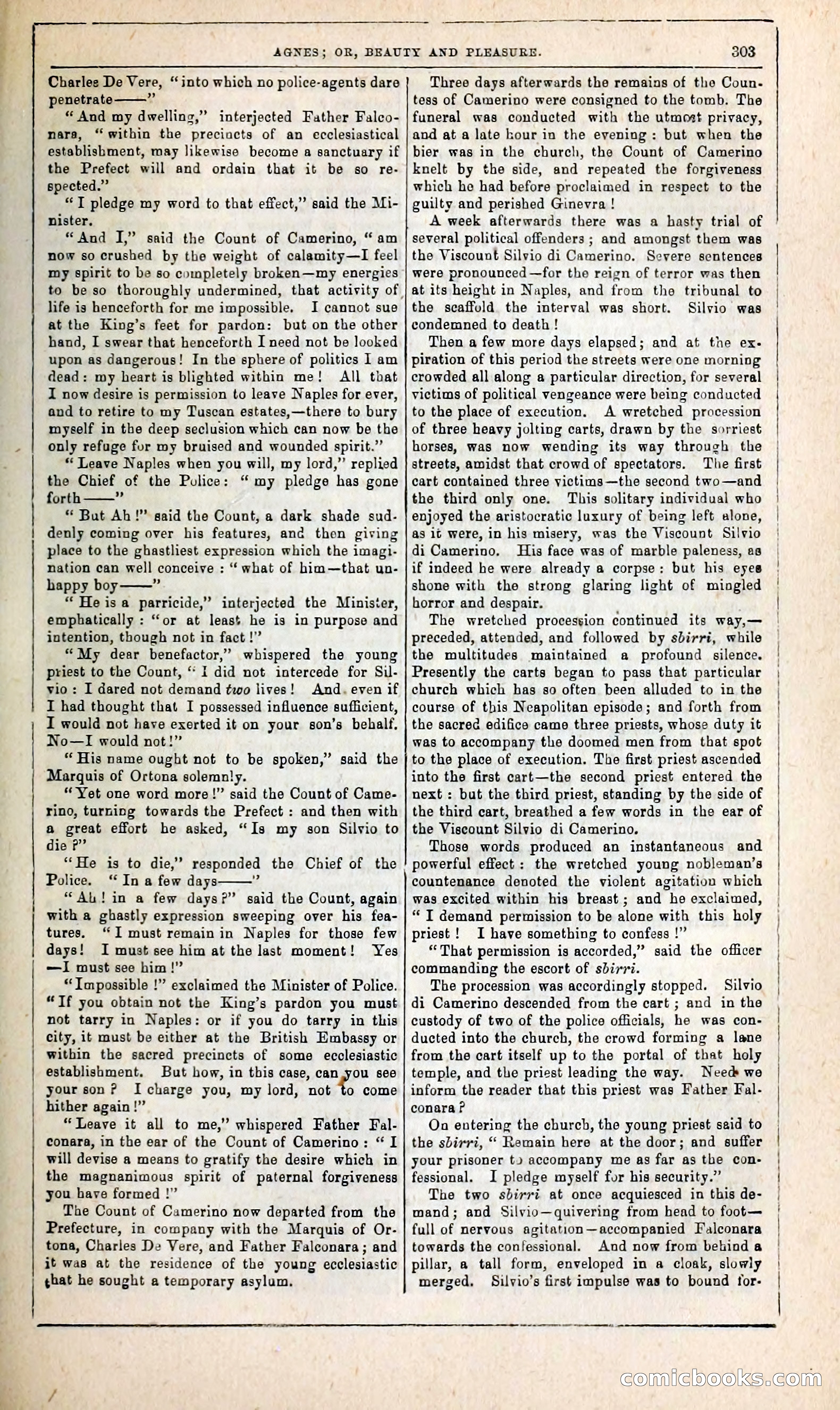
A restored page from Penny Dreadfuls, 1857. Page through the whole issue in the reader above.
📄 Transcribed text from this page (OCR, searchable)
Machine-transcribed from the original scan — historical spelling and the odd misread are preserved.
. a a — ee ee Charlee De Vere, “into which no police-agents dare penetrate * “And my dwelling,” interjected Father Falco- mara, “within the preciacts of an ecclesiastical establishment, may likewise become a sanctuary if the Prefect will and ordain that it be so re- spected.” “I pledge my word to that effect,” said the Mi- nister. * And I,” said the Count of Camerino, “am now so crushed by the weight of calamity—l feel my spirit to be so completely broken—my energies to be so thoroughly undermined, that activity of life is henceforth for me impossible. I cannot sue at the King’s feet for pardon: but on the other hand, I swear that henceforth I need not be looked upon as dangerous! In the sphere of politics I am dead: my heart is blighted within me! All that I now desire is permission to leave Naples for ever, and to retire to my Tuscan estates,—there to bury myself in the deep seclusion which can now be the only refuge fur my bruised and wounded spirit.” ** Leave Naples when you will, my lord,”’ replied the Chief of the Police: “ my pledge has gone forth i * But Ah!” said the Count, a dark shade sud- denly coming over his features, anc thon giving place to the ghastliest expression which the imagi- nation can well conceive : “ what of him—that un- happy boy ——” “He isa parricide,” interjected the Minister, emphatically : ‘or at least he is in purpose and intention, though not in fact !” “My dear benefactor,” whispered the young priest to the Count, ‘* I did not intercede for Si- vio: I dared not demand two lives! And. even if I had thought that I possessed influence sufficient, I would not have exerted it on your son’s behalf, No—I would not!” “His name ought not to be spoken,” said the Marquis of Ortona solemn!y. “Yet one word more!” said the Count of Came- rino, turning towards the Prefect : and then with a great effort he asked, “Is my son Silvio to die ?” “He is to die,’ responded the Chief of the Police. ‘“ In a few days 4 “Al! in a few days?” said the Count, again with a ghastly expression sweeping over his fea- tures. “I must remain in Naples for those few days! I must see him at the last moment! Yes —I must see him!” “‘Tmpossible !” exclaimed the Minister of Police. “Tf you obtain not the King’s pardon you must not tarry in Naples: or if you do tarry in this city, it must be either at the British Embassy or within the sacred precincts of some ecclesiastic establishment. But how, in tbis case, can you see yourson? Icharge you, my lord, not to come hither again!” “Leave it all to me,” whispered Father Fal- conara, in the ear of the Count of Camerino: “ I will devise a means to gratify the desire which in the magnanimous spirit of paternal forgiveness you have formed !” The Count of Camerino now departed from the Prefecture, in company with the Marquis of Or- tona, Charles De Vere, and Father Falconara; and it was at the residence of the young ecclesiastic ¢hat he sought a temporary asylum. AGNES; OR, BEAUTY AND PLEASURE. TT 303 Three days afterwards the remains of the Coun- tess of Camerino were consigned to the tomb. The funeral was conducted with the utmost privacy, and at a late hour in the evening: but when the bier was in the church, the Count of Camerino knelt by the side, and repeated the forgiveness which he had before proclaimed in respect to the guilty and perished Ginevra ! A week afterwards there was a hasty trial of several political offenders ; and amongst them was the Viscount Silvio di Camerino. Severe sentences were pronounced —for the reign of terror was then at its height in Naples, and from the tribunal to the scaffuld the interval was short. Silvio was condemned to death ! Then a few more days elapsed; and at the ex- piration of this period the streets were one morning crowded all along a particular direction, for several victims of political vengeance were being conducted to the place of execution. A wretched procession of three heavy jolting carts, drawn by the sorriest horses, was now wending its way through the streets, amidst that crowd of spectators. The first cart contained three victims—the second two—and the third only one. This solitary individual who enjoyed the aristocratic luxury of being left alone, as 16 were, in his misery, was the Viscount Silvio di Camerino. His face was of marble paleness, as if indeed he were already a corpse: but his eyes shone with the strong glaring light of mingled horror and despair. The wretched procession continued its way,— preceded, attended, and followed by sbirri, while the multitudes maintained a profound silence. Presently the carts began to pass that particular chureh which has so often been alluded to in the course of this Neapolitan episode; and forth from the sacred edifice came three priests, whose duty it was to accompany the doomed men from that spot to the place of execution. The first priest ascended into the first cart—the second priest entered the next : but the third priest, standing by the side of the third cart, breathed a few words in the ear of the Viscount Silvio di Camerino. Those words produced an instantaneous and powerful effect : the wretched young nobleman’s countenance denoted the violent agitation which was excited within his breast ; and he exclaimed, “ T demand permission to be alone with this holy priest! I have something to confess !” ‘That permission is accorded,” said the officer commanding the escort of sbirri. The procession was accordingly stopped. Silvio di Camerino descended from the cart ; and in the custody of two of the police officials, he was con- ducted into the church, the crowd forming a lane from the cart itself up to the portal of that holy temple, and the priest leading the way. Need we inform the reader that this priest was Father Fal- conara? On entering the church, the young priest said to the sbirri, “ Remain here at the door; and suffer your prisoner t2 accompany me as far as the con- fessional. I pledge myself for his security.” The two sbirri at once acquiesced in this de- mand; and Silvio—quivering from head to foot— full of nervous agitation—accompanied Falconara towards the confessional. And now from behind a pillar, a tall form, enveloped in a cloak, slowly merged. Silvio’s first impulse was to bound for- COMmiclooolkks ————eeEEEE—eEeEeEe Onn