
Penny Dreadfuls, 1857 · page 303 of 394
Agnes, or, Beauty and Pleasure — page 303: what you’re looking at
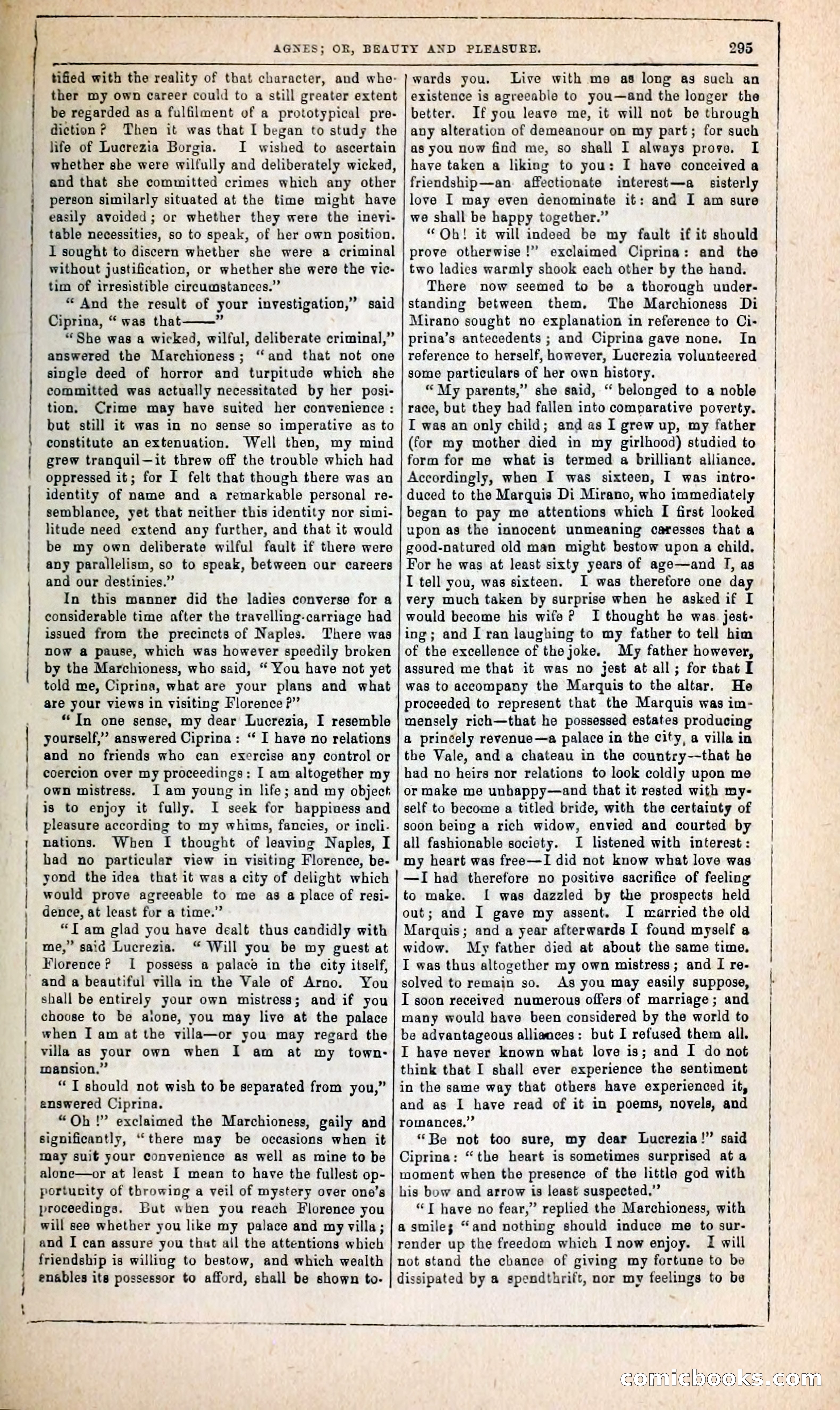
A restored page from Penny Dreadfuls, 1857. Page through the whole issue in the reader above.
📄 Transcribed text from this page (OCR, searchable)
Machine-transcribed from the original scan — historical spelling and the odd misread are preserved.
—————— A A TT Si - oe 4 - — ee | lpn cities AGNES; OR, BEAUTY AND PLEASURE. 295 tified with the reality of that character, and whe- ther my own career could to a still greater extent be regarded as a fulfilment of a prototypical pre- diction? Then it was that I began to study the life of Lucrezia Borgia. I wished to ascertain whether she were wilfully and deliberately wicked, and that she committed crimes which any other person similarly situated at the time might have easily avoided; or whether they were the ineyi- table necessities, so to speak, of her own position. I sought to discern whether she were a criminal without justification, or whether she were the vic- tim of irresistible circumstances.” “And the result of your investigation,” said Ciprina, “ was that-——~” “She was a wicked, wilful, deliberate criminal,” answered the Marchioness; “‘and that not one single deed of horror and turpitude which she committed was actually necessitated by her posi- tion. Crime may have suited her convenience : but still it was in no sense so imperative as to constitute an extenuation. Well then, my mind grew tranquil—it threw off the trouble which had oppressed it; for I felt that though there was an identity of name and a remarkable personal re- semblance, yet that neither this identity nor simi- litude need extend any further, and that it would be my own deliberate wilful fault if there were any parallelism, so to speak, between our careers and our destinies.” In this manner did the ladies converse for a considerable time after the travelling-carriage had issued from the precincts of Naples. There was now a pause, which was however speedily broken by the Marchioness, who said, “ You have not yet told me, Ciprina, what are your plans and what are your views in visiting Florence?” ‘In one sense, my dear Lucrezia, I resemble yourself,’ answered Ciprina: “ I have no relations and no friends who can exercise any control or coercion over my proceedings: I am altogether my own mistress. 1am young in life; and my object is to enjoy it fully. I seek for happiness and pleasure according to my whims, fancies, or incli- nations. When I thought of leaving Naples, I had no particular view in visiting Florence, be- yond the idea that it was a city of delight which would prove agreeable to me as a place of resi- dence, at least for a time.” “Tam glad you have dealt thus candidly with me,” said Lucrezia. “ Will you be my guest at Florence? I possess a palace in the city itself, and a beautiful villa in the Vale of Arno. You shall be entirely your own mistress; and if you choose to be aione, you may live at the palace when I am at the villa—or you may regard the villa as your own when I am at my town- mansion,” “T should not wish to be separated from you,” enswered Ciprina. “Oh !” exclaimed the Marchioness, gaily and significantly, “there may be occasions when it may suit your convenience as well as mine to be alone—or at lenst I mean to have the fullest op- portucity of throwing a veil of mystery over one’s proceedings. But when you reach Florence you will see whether you like my palace and my villa; and I can assure you thut ail the attentions which friendship is willing to bestow, and which wealth enables its possessor to afford, shall be shown to- Os ee ee wards you. Live with me as long as such an existence is agreeable to you—and the longer the better. Ifyou leave me, it will not be through any alteration of demeanour on my part; for such as you now find me, so shall I always prove. I have taken a liking to you: I have conceived a friendship—an affectionate interest—a_ sisterly love I may even denominate it: and I am sure we shall be happy together.” Oh! it will indeed be my fault if it should prove otherwise !” exclaimed Ciprina: and the two ladies warmly shook each other by the hand. There now seemed to be a thorough under- standing between them, The Marchioness Di Mirano sought no explanation in reference to Ci- prina’s antecedents ; and Ciprina gave none. In reference to herself, however, Lucrezia volunteered some particulars of her own history. “ My parents,” she said, “ belonged to a noble race, but they had fallen into comparative poverty. I was an only child; and as I grew up, my father (for my mother died in my girlhood) studied to form for me what is termed a brilliant alliance. Accordingly, when I was sixteen, I was intro- duced to the Marquis Di Mirano, who immediately began to pay me attentions which I first looked upon as the innocent unmeaning caresses that a good-natured old man might bestow upon a child, For he was at least sixty years of age—and I, as I tell you, was sixteen. IL was therefore one day very much taken by surprise when he asked if I would become his wife? I thought he was jest- ing; and I ran laughing to my father to tell him of the excellence of thejoke. My father however, assured me that it was no jest at all; for that I was to accompany the Marguis to the altar. He proceeded to represent that the Marquis was im- mensely rich—that he possessed estates producing a princely revenue—a palace in the city, a villa in the Vale, and a chateau in the country—that he had no heirs nor relations to look coldly upon me or make me unhappy—and that it rested with my- self to become a titled bride, with the certainty of soon being a rich widow, envied and courted by all fashionable society. I listened with interest : my heart was free—I did not know what love was —TI had therefore no positive sacrifice of feeling to make. IL was dazzled by the prospects held out; and I gave my assent. I married the old Marquis; and a year afterwards I found myself a widow. My father died at about the same time, I was thus altogether my own mistress; and I re- solved to remain so. As you may easily suppose, I soon received numerous offers of marriage; and many would have been considered by the world to be advantageous alliances: but I refused them all. I have never known what love is; and I do not think that I shall ever experience the sentiment in the same way that others have experienced it, and as I have read of it in poems, novels, and romances.” “Be not too sure, my dear Lucrezia!” said Ciprina: “the heart is sometimes surprised at a tooment when the presence of the little god with his bow and arrow is least suspected,” “T have no fear,” replied the Marchioness, with a smiles “and nothing should induce me to sur- render up the freedom which I now enjoy. [I will not stand the chance of giving my fortune to be dissipated by a spendthrift, nor my feelings to be 19? CoOMmiclooolkxs —_— OimM