
Penny Dreadfuls, 1857 · page 293 of 394
Agnes, or, Beauty and Pleasure — page 293: what you’re looking at
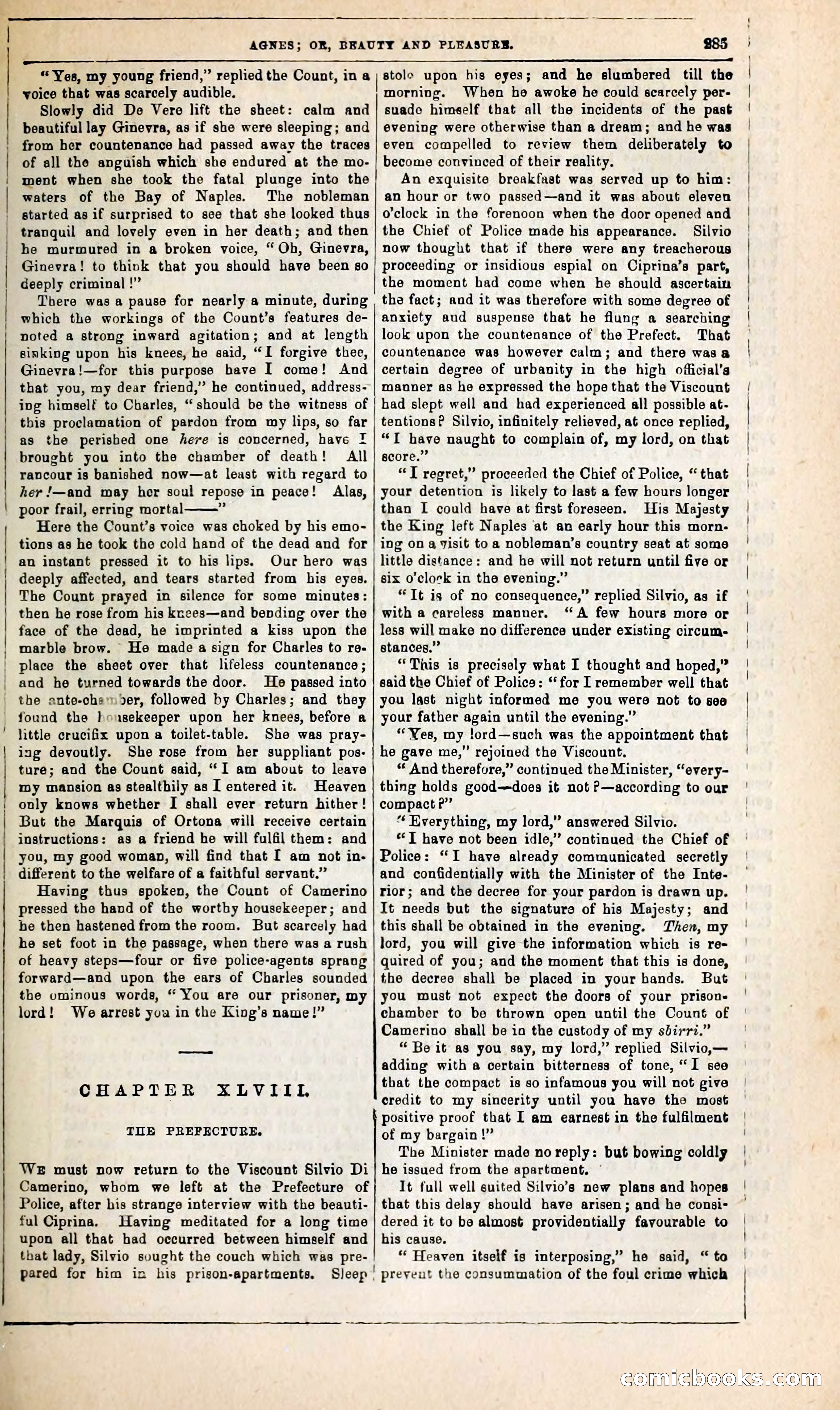
A restored page from Penny Dreadfuls, 1857. Page through the whole issue in the reader above.
📄 Transcribed text from this page (OCR, searchable)
Machine-transcribed from the original scan — historical spelling and the odd misread are preserved.
AGNES; OR, BEAUTY AND PLEASURB, “Yes, my young friend,” replied the Count, in a voice that was scarcely audible. Slowly did De Vere lift the sheet: calm and beautiful lay Ginevra, as if she were sleeping; and from her countenance had passed away the traces of all the anguish which she endured at the mo- ment when she took the fatal plunge into the waters of the Bay of Naples. The nobleman started as if surprised to see that she looked thus tranquil and lovely even in her death; and then he murmured in a broken voice, “ Oh, Ginevra, Ginevra! to think that you should have been so deeply criminal !” There was a pause for nearly a minute, during which the workings of the Count’s features de- noted a strong inward agitation; and at length sinking upon his knees, he said, “I forgive thee, Ginevra!—for this purpose have I come! And that you, my dear friend,” he continued, address- ing himself to Charles, “should be the witness of this proclamation of pardon from my lips, so far as the perished one here is concerned, have I brought you into the chamber of death! All rancour is banished now—at least with regard to her !—and may her soul repose in peace! Alas, poor frail, erring mortal 2 Here the Count’s voice was choked by his emo- tions as he took the cold hand of the dead and for an instant pressed it to his lips. Our hero was deeply affected, and tears started from his eyes. The Count prayed in silence for some minutes: then he rose from his knees—and bending over the face of the dead, he imprinted a kiss upon the marble brow. He made a sign for Charles to re- place the sheet over that lifeless countenance ; and he turned towards the door. He passed into the ante-cha der, followed by Charles; and they found the housekeeper upon her knees, before a little crucifix upon a toilet-table. She was pray- ing devoutly. She rose from her suppliant pos- ture; and the Count said, “I am about to leave my mansion as stealthily as I entered it. Heaven only knows whether I shall ever return hither! But the Marquis of Ortona will receive certain instructions: as a friend he will fulfil them: and you, my good woman, will find that I am not in- different to the welfare of a faithful servant.” Having thus spoken, the Count of Camerino pressed the hand of the worthy housekeeper; and he then hastened from the room. But scarcely had he set foot in the passage, when there was a rush of heavy steps—four or five police-agents spraug forward—and upon the ears of Charles sounded the ominous words, “You are our prisoner, my lord! We arrest you in the King’s name!” CHAPTER XLVIIL THE PREFECTURE. We must now return to the Viscount Silvio Di Camerino, whom we left at the Prefecture of Police, after his strange interview with the beauti- ful Ciprina. Having meditated for a long time upon all that bad occurred between himself and that lady, Silvio sought the couch which was pre- stolo upon his eyes; and he slumbered till the morning. When he awoke he could scarcely per- suade himself that all the incidents of the past evening were otherwise than a dream; and he was even compelled to review them deliberately to become convinced of their reality. An exquisite breakfast was served up to him: an hour or two passed—and it was about eleven o’clock in the forenoon when the door opened and the Chief of Police made his appearance. Silvio now thought that if there were any treacherous proceeding or insidious espial on Ciprina’s part, the moment had come when he should ascertain the fact; and it was therefore with some degree of anxiety and suspense that he flung a searching look upon the countenance of the Prefect. That countenance was however calm; and there wasa certain degree of urbanity in the high official's manner as he expressed the hope that the Viscount had slept well and had experienced all possible at- tentionsP Silvio, infinitely relieved, at once replied, ““T have naught to complain of, my lord, on that score.” “T regret,” proceeded the Chief of Police, “ that your detention is likely to last a few hours longer than I could have at first foreseen. His Majesty the King left Naples at an early hour this morn- ing on a visit to a nobleman’s country seat at some little distance: and he will not return until five or six o'clock in the evening.” “It is of no consequence,” replied Silvio, as if with a careless manner. “A few hours more or less will make no difference under existing circum- stances,” “This is precisely what I thought and hoped,” said the Chief of Polics: “for I remember well that you last night informed me you were not to see your father again until the evening.” ‘Yes, my !ord—such was the appointment that he gave me,” rejoined the Viscount. “ And therefore,” continued the Minister, “every- thing holds good—does it not P—according to our compact P” “ Everything, my lord,” answered Silvio. “7 have not been idle,’”’ continued the Chief of Police: “I have already communicated secretly and confidentially with the Minister of the Inte- rior; and the decree for your pardon is drawn up. It needs but the signature of his Majesty; and this shall be obtained in the evening. Then, my lord, you will give the information which is re- quired of you; and the moment that this is done, the decree shall be placed in your hands. But you must not expect the doors of your prison- chamber to be thrown open until the Count of Camerino shall be io the custody of my sbirrz.” “ Be it as you say, my lord,” replied Silvio,— adding with a certain bitterness of tone, “I see tbat the compact is so infamous you will not give credit to my sincerity until you have the most positive proof that I am earnest in the fulfilment of my bargain !” The Minister made no reply: but bowing coldly he issued from the apartment. ° It full well suited Silvio’s new plans and hopes that this delay should have arisen; and he consi- dered it to be almost providentially favourable to his cause. “ Heaven itself is interposing,” he said, “ to pared for him in his prison-apartments. Sleep! preyeut the consummation of the foul crime which CoOMmiclooolks