
Penny Dreadfuls, 1857 · page 28 of 394
Agnes, or, Beauty and Pleasure — page 28: what you’re looking at
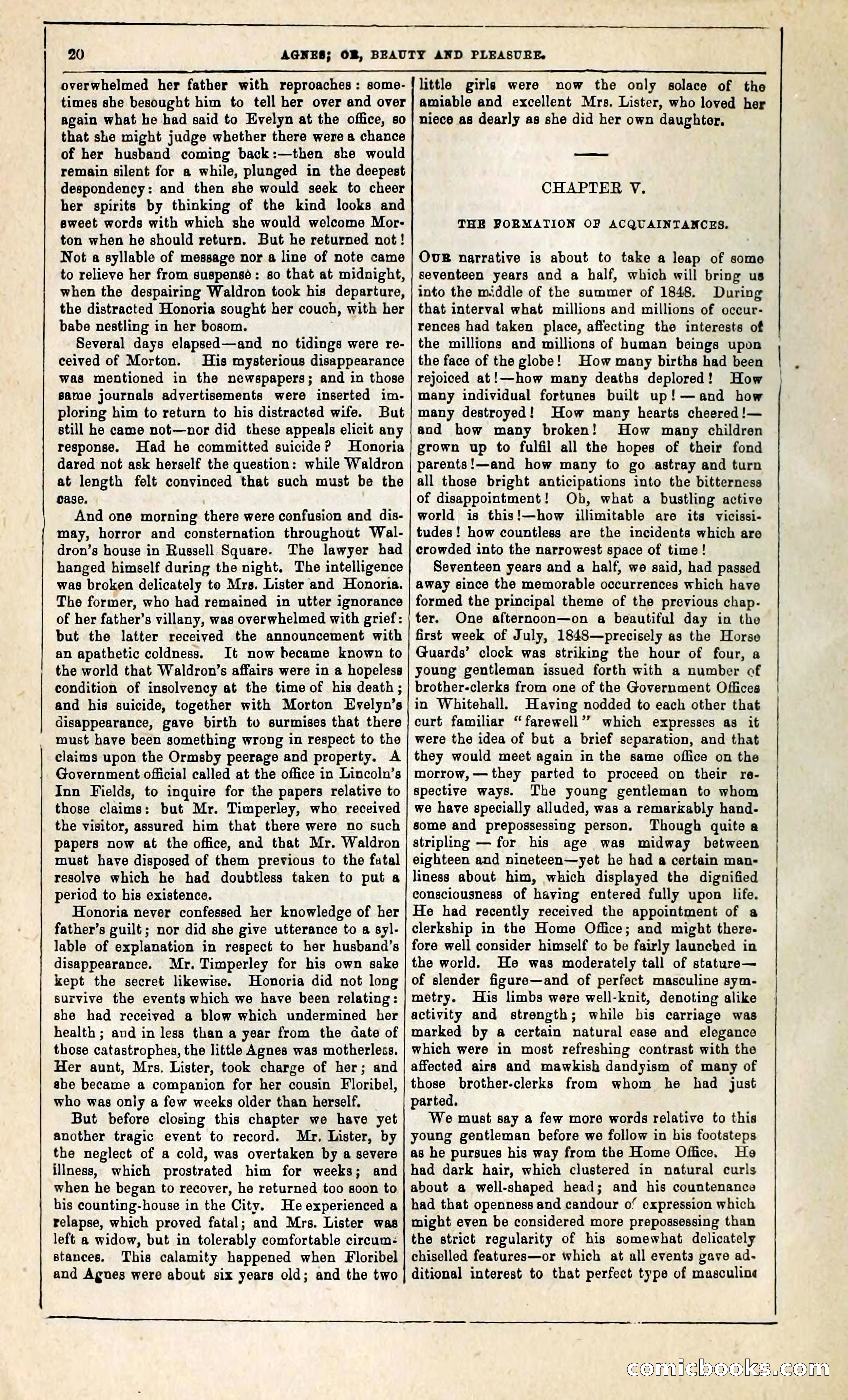
A restored page from Penny Dreadfuls, 1857. Page through the whole issue in the reader above.
📄 Transcribed text from this page (OCR, searchable)
Machine-transcribed from the original scan — historical spelling and the odd misread are preserved.
20 rrr ee AGNES; OB, BEAUTY AND PLEASURE. overwhelmed her father with reproaches: some-! little girls were now the only solace of the times she besought him to tell her over and over again what he had said to Evelyn at the office, so that she might judge whether there were a chance of her husband coming back:—then ske would remain silent for a while, plunged in the deepest despondency: and then she would seek to cheer her spirits by thinking of the kind looks and eweet words with which she would welcome Mor- ton when he should return. But he returned not! Not a syllable of message nor a line of note came to relieve her from suspensé: so that at midnight, when the despairing Waldron took his departure, the distracted Honoria sought her couch, with her babe nestling in her bosom. Several days elapsed—and no tidings were re- ceived of Morton. His mysterious disappearance was mentioned in the newspapers; and in those same journals advertisements were inserted im- ploring him to return to his distracted wife. But still he came not—nor did these appeals elicit any response. Had he committed suicide? Honoria dared not ask herself the question: while Waldron at length felt convinced that such must be the case, | And one morning there were confusion and dis- may, horror and consternation throughout Wal- dron’s house in Russell Square. The lawyer had hanged himself during the night. The intelligence was broken delicately to Mrs. Lister and Honoria. The former, who had remained in utter ignorance of her father’s villany, was overwhelmed with grief: but the latter received the announcement with an apathetic coldness. It now hecame known to the world that Waldron’s affairs were in a hopeless condition of insolvency at the time of his death ; and his suicide, together with Morton Evelyn’s disappearance, gave birth to surmises that there must have been something wrong in respect to the claims upon the Ormsby peerage and property. A Government official called at the office in Lincoln’s Inn Fields, to inquire for the papers relative to those claims: but Mr. Timperley, who received the visitor, assured him that there were no such papers now at the office, and that Mr. Waldron must have disposed of them previous to the fatal resolve which he had doubtless taken to put a period to his existence. Honoria never confessed her knowledge of her father’s guilt; nor did she give utterance to a syl- lable of explanation in respect to her husband’s disappearance. Mr. Timperley for his own sake kept the secret likewise. Honoria did not long survive the events which we have been relating: she had received a blow which undermined her health ; and in less than a year from the date of those catastrophes, the little Agnes was motherless. Her aunt, Mrs. Lister, took charge of her; and she became a companion for her cousin Floribel, who was only a few weeks older than herself, But before closing this chapter we have yet another tragic event to record. Mr, Lister, by the neglect of a cold, was overtaken by a severe illness, which prostrated him for weeks; and when he began to recover, he returned too soon to his counting-house in the City. He experienced a relapse, which proved fatal; and Mrs. Lister was left a widow, but in tolerably comfortable circum: stances. This calamity happened when Floribel and Agnes were about six years old; and the two amiable and excellent Mrs. Lister, who loved her niece as dearly as she did her own daughter. CHAPTER V. THE FORMATION OF ACQUAINTANCES. OvBk narrative is about to take a leap of some seventeen years and a half, which will bring us into the middle of the summer of 1848. During that interval what millions and millions of occur- rences had taken place, affecting the interests of the millions and millions of human beings upon the face of the globe! How many births had been rejoiced at!—how many deaths deplored! How many individual fortunes built up!—and how many destroyed! How many hearts cheered !— and how many broken! How many children grown up to fulfil all the hopes of their fond parents!—and how many to go astray and turn all those bright anticipations into the bitterness of disappointment! Oh, what a bustling active world is this!—how illimitable are its vicissi- tudes! how countless are the incidents which are crowded into the narrowest space of time! Seventeen years and a half, we said, had passed away since the memorable occurrences which have formed the principal theme of the previous chap- ter. One afternoon—on a beautiful day in the first week of July, 1848—precisely as the Horse Guards’ clock was striking the hour of four, a young gentleman issued forth with a number of brother-clerks from one of the Government Offices in Whitehall. Having nodded to each other that curt familiar “farewell’”’ which expresses as it were the idea of but a brief separation, and that they would meet again in the same office on the morrow, — they parted to proceed on their re- spective ways. The young gentleman to whom we have specially alluded, was a remarkably hand- some and prepossessing person. Though quite a stripling — for his age was midway between eighteen and nineteen—yet he had a certain man- liness about him, which displayed the dignified consciousness of having entered fully upon life. He had recently received the appointment of a clerkship in the Home Office; and might there- fore well consider himself to be fairly launched in the world. He was moderately tall of stature— of slender figure—and of perfect masculine sym- metry. His limbs were well-knit, denoting alike activity and strength; while bis carriage was marked by a certain natural ease and elegance which were in most refreshing contrast with the affected airs and mawkish dandyism of many of those brother-clerks from whom he had just parted. We must say a few more words relative to this young gentleman before we follow in his footsteps as he pursues his way from the Home Office. He had dark hair, which clustered in natural curls about a well-shaped head; and his countenance had that openness and candour o¢ expression which might even be considered more prepossessing than the strict regularity of his somewhat delicately chiselled features—or which at all events gave ad- ditional interest to that perfect type of masculine comichook S