
Penny Dreadfuls, 1857 · page 270 of 394
Agnes, or, Beauty and Pleasure — page 270: what you’re looking at
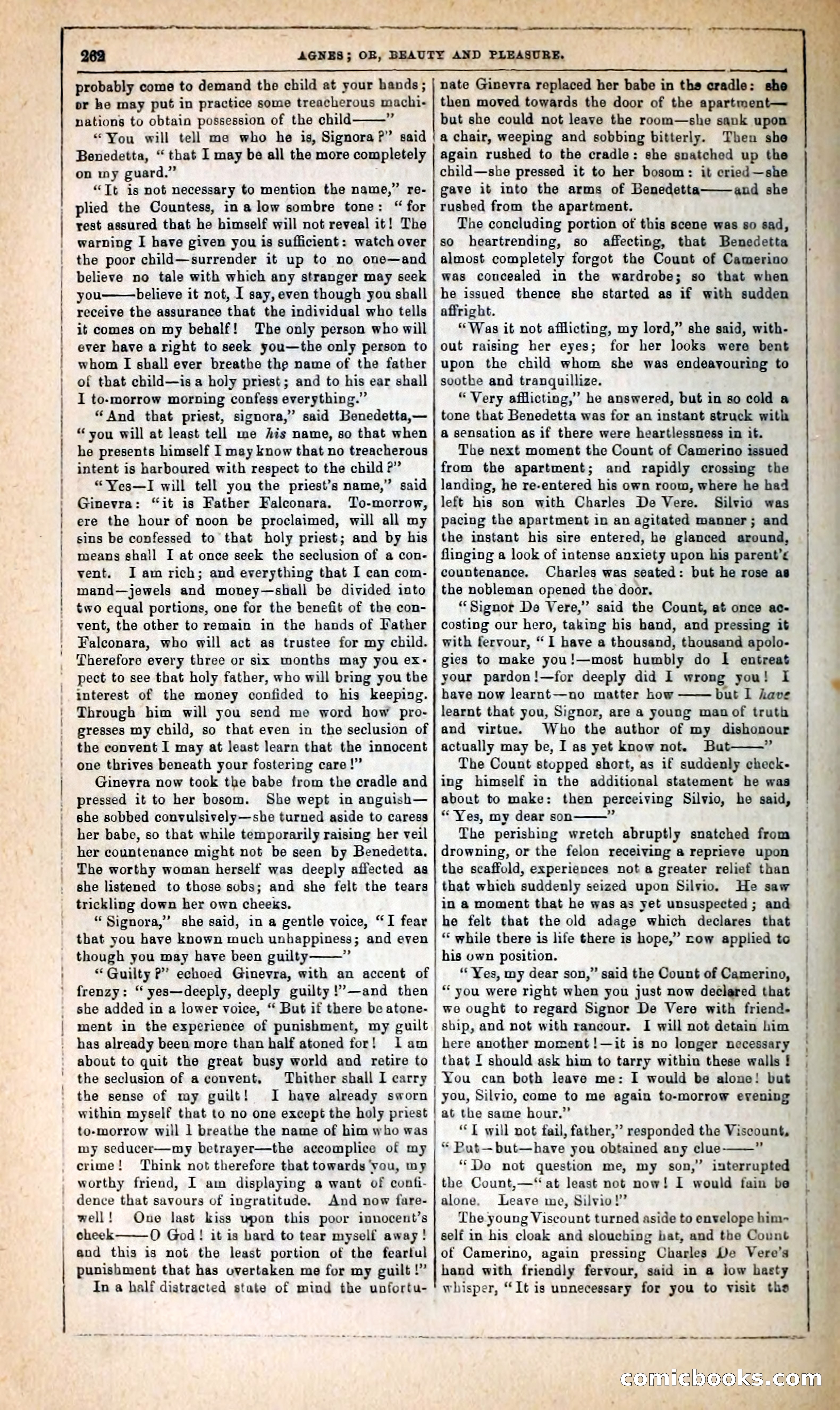
A restored page from Penny Dreadfuls, 1857. Page through the whole issue in the reader above.
📄 Transcribed text from this page (OCR, searchable)
Machine-transcribed from the original scan — historical spelling and the odd misread are preserved.
_ crime! _ dence that savours of ingratitude. | oheek probably come to demand the child at your hands; or he may put in practice some treacherous machi- nations to obtain possession of the child <4 “You will tell me who he is, Signora P” said Benedetta, “ that I may be all the more completely on my guard.” “Tt is not necessary to mention the name,” re- plied the Countess, ina low sombre tone: “ for rest assured that he himself will not reveal it! The warning I have given you is sufficient: watch over the poor child—surrender it up to no one—and believe no tale with which any stranger may seek you believe it not, I say, even though you shall receive the assurance that the individual who tells it comes on my behalf! The only person who will ever have a right to seek you—the only person to whom I shall ever breathe the name of the father of that child—is a holy priest; and to his ear shall I to-morrow morning confess everything.” * And that priest, signora,” said Benedetta,— “you will at least tell me Ais name, so that when he presents himself I may know that no treacherous intent is harboured with respect to the child ?” “Yes—I will tell you the priest’s name,” said Ginevra: “it is Father Falconara. To-morrow, ere the hour of noon be proclaimed, will all my sins be confessed to that holy priest; and by his means shall I at once seek the seclusion of a con- vent. Iam rich; and everything that I can com- mand—jewels and money—shall be divided into two equal portions, one for the benefit of the con- vent, the other to remain in the hands of Father Falconara, who will act as trustee for my child. Therefore every three or six months may you ex: pect to see that holy father, who will bring you the interest of the money confided to his keeping. Through him will you send me word how pro- gresses my child, so that even in the seclusion of the convent I may at least learn that the innocent one thrives beneath your fostering care!” Gineyra now took the babe from the cradle and pressed it to her bosom. Sbe wept in anguish— she sobbed convulsively—she turned aside to caress her babe, so that while temporarily raising her veil her countenance might not be seen by Benedetta. The worthy woman herself was deeply affected as she listened to those sobs; and she felt the tears trickling down her own cheeks. “ Signora,”’ she said, in a gentle voice, “I fear that you have known much unhappiness; and even though you may have been guilty 4 “Guilty ?” echoed Ginevra, with an accent of frenzy: “ yes—deeply, deeply guilty!’—and then she added in a lower voice, “ But if there be atone- ment in the experience of punishment, my guilt has already been more than half atoned for! lam about to quit the great busy world and retire to the seclusion of a convent, Thither shall I carry the sense of my guilt! I have already sworn within myself that to no one except the holy priest to-morrow will 1 breathe the name of him who was my seducer—my betrayer—the accomplice of my Think not therefore that towards ‘you, my worthy friend, I am displaying a want of confi- And now fare- One last kiss wpon this poor innocent’s O God! it is bard to tear myself away! and this is not the least portion of the feartul punishment that has overtaken me for my guilt !” In a half distracted state of mind the unfortu- well! AGNES; OR, BEAUTY AND PLEASURE, ~~ nate Ginevra replaced her babe in ths cradle: she — then moved towards the door of the apartment— but she could not leave the room—she sank upon a chair, weeping and sobbing bitterly. Then she again rushed to the cradle: she snatched up the child—she pressed it to her bosom: it eried—she gave it into the arms of Benedetta——and she rusbed from the apartment. The concluding portion of this scene was so sad, so heartrending, so affecting, that Benedetta almost completely forgot the Count of Camerino was concealed in the wardrobe; so that when he issued thence she started as if with sudden affright. ‘Was it not afflicting, my lord,” she said, with- out raising her eyes; for her looks were bent upon the child whom she was endeayouring to soothe and tranquillize. “ Very afflicting,” he answered, but in so cold a tone that Benedetta was for an instant struck with @ sensation as if there were heartlessness in if. The next moment the Count of Camerino issued from the apartment; and rapidly crossing the landing, he re-entered his own roow, where he had left his son with Charles De Vere. Silvio was pacing the apartment in an agitated manner; and the instant his sire entered, he glanced around, flinging a look of intense anxiety upon his parent’s countenance. Charles was seated: but he rose as the nobleman opened the door. “Signor De Vere,” said the Count, at once ac- costing our hero, taking his hand, and pressing it with fervour, “I have a thousand, thousand apolo- gies to make you!—most humbly do I entreat your pardon!—for deeply did 1 wrong you! I bave now learnt—no matter how but L have learnt that you, Signor, are a young manof truth and virtue. Who the author of my dishonour actually may be, I as yet know not. But——” The Count stopped short, as if suddenly check- ing himself in the additional statement he was about to make: then perceiving Silvio, he said, “Yes, my dear son _ The perishing wretch abruptly snatched from drowning, or the felon receiving a reprieve upon the scaffold, experiences not a greater relief than that which suddenly seized upon Silvio. He saw in a moment that he was as yet unsuspected; and he felt that the old adage which declares that “‘ while there is life there is hope,” row applied to his own position. ‘Yes, my dear son,” said the Count of Camerino, “you were right when you just now declared that we ought to regard Signor De Vere with friend. ship, and not with rancour. I will not detain him here another moment !—it is no longer necessary that I should ask him to tarry within these walls ! You can both leave me: I would be alone! but you, Silvio, come to me again to-morrow evening at the same hour.” ‘““[ will not fail, father,” responded the Viscount, “ Paut—but—have you obtained any clue ? ‘Do not question me, my son,” interrupted the Count,—‘“‘ at least not now! I would fain be alone. Leave me, Silvio!’ The young Viscount turned aside to envelope him- self in his cloak and slouching bat, and the Count of Camerino, again pressing Charles Ve Vere’s hand with friendly fervour, said in a low hasty whisper, “It is unnecessary for you to visit ths cComilcbooks com