
Penny Dreadfuls, 1857 · page 252 of 394
Agnes, or, Beauty and Pleasure — page 252: what you’re looking at
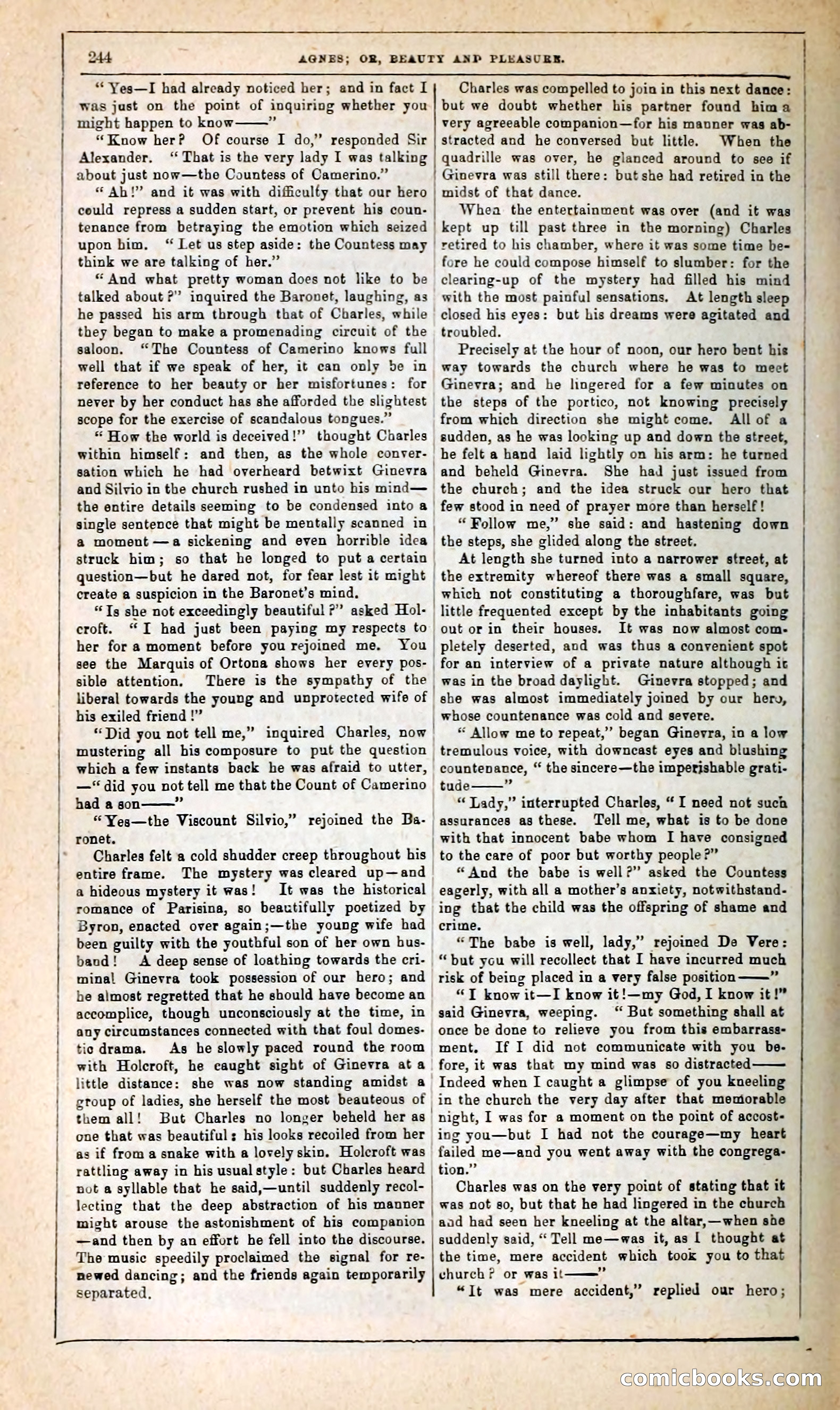
A restored page from Penny Dreadfuls, 1857. Page through the whole issue in the reader above.
📄 Transcribed text from this page (OCR, searchable)
Machine-transcribed from the original scan — historical spelling and the odd misread are preserved.
se NN : wt ** Yes—I had already noticed her; and in fact I was just on the point of inquiring whether you might happen to know Zs “Know her? Of course I do,” responded Sir Alexander. ‘“ That is the very lady I was talking about just now—the Countess of Camerino.” “ Ah!” and it was with difficulty that our hero could repress a sudden start, or prevent his coun- tenance from betraying the emotion which seized upon him, think we are talking of her.” “ And what pretty woman does not like to be talked about ?” inquired the Baronet, laughing, as he passed his arm through that of Charles, while they began to make a promenading circuit of the saloon. “The Countess of Camerino knows full well that if we speak of her, it can only be in reference to her beauty or her misfortunes: for never by her conduct has she afforded the slightest scope for the exercise of scandalous tongues.” “ How the world is deceived!” thought Charles within himself: and then, as the whole conver- sation which he had overheard betwixt Ginevra and Silvio in the church rushed in unto his mind— the entire details seeming to be condensed into a) single sentence that might be mentally scanned in a moment —a sickening and even horrible idea struck him; so that he longed to put a certain question—but he dared not, for fear lest it might create a suspicion in the Baronet’s mind. “Ts she not exceedingly beautiful?” asked Hol- croft. “I had just been paying my respects to her for a moment before you rejoined me. You see the Marquis of Ortona shows her every pos- sible attention, There is the sympathy of the liberal towards the young and unprotected wife of his exiled friend !” “Did you not tell me,” inquired Charles, now mustering all bis composure to put the question” which a few instants back he was afraid to utter, —did you not tell me that the Count of Camerino had a son o “VYes—the Viscount Silvio,” rejoined the Ba- ronet. Charles felt a cold shudder creep throughout his entire frame. a hideous mystery it was! It was the historical romance of Parisina, so beautifully poetized by Byron, enacted over again;—the young wife had been guilty with the youthful son of her own bus- band! A deep sense of loathing towards the cri- minal Ginevra took possession of our hero; and he almost regretted that he should have become an accomplice, though unconsciously at the time, in any circumstances connected with that foul domes- tic drama. As he slowly paced round the room with Holcroft, he caught sight of Ginevra ata little distance: she was now standing amidst a group of ladies, she herself the most beauteous of them all! But Charles no lonver beheld her as one that was beautiful: his looks recoiled from her as if from a snake with a lovely skin. Holcroft was rattling away in his usualstyle: but Charles heard not a syllable that he said,—until suddenly recol- lecting that the deep abstraction of his manner might arouse the astonishment of his companion —and then by an effort he fell into the discourse. The music speedily proclaimed the signal for re- ‘pewed dancing; and the friends again temporarily separated, AGNES; OR, BEAUTY ANP PLEASURE. * Let us step aside: the Countess may | The mystery was cleared up—and | Charles was compelled to join in this next dance: but we doubt whether his partner found hima very agreeable companion—for his manner was ab- stracted and he conversed but little. When the quadrille was over, he glanced around to see if | Ginevra was still there: butshe had retired in the | midst of that dance. Whea the entertainment was over (and it was kept up till past three in the morning) Charles retired to his chamber, where it was some time be- fore he could compose himself to slumber: for the clearing-up of the mystery had filled his mind with the most painful sensations, At length sleep closed his eyes: but his dreams were agitated and troubled. Precisely at the hour of noon, our hero bent his way towards the church where he was to meet Ginevra; and he lingered for a few minutes on the steps of the portico, not knowing precisely from which direction she might come. All of a sudden, as he was looking up and down the street, he felt a hand laid lightly on his arm: he turned and beheld Ginevra. She had just issued from the church; and the idea struck our hero that few stood in need of prayer more than herself! | “Follow me,” she said: and hastening down the steps, she glided along the street. At length she turned into a narrower street, at the extremity whereof there was a small square, which not constituting a thoroughfare, was but little frequented except by the inhabitants going out or in their houses. It was now almost com- pletely deserted, and was thus a convenient spot for an interview of a private nature although it was in the broaddaylight. Ginevra stopped; and she was almost immediately joined by our hers, whose countenance was cold and severe. * Allow me to repeat,” began Ginevra, in a low tremulous voice, with downcast eyes and blushing countenance, “ the sincere—the imperishable grati- tude . “ Lady,” interrupted Charles, “I need not such assurances as these. Tell me, what is to be done | with that innocent babe whom I have consigned to the care of poor but worthy people?” “And the babe is well?” asked the Countess eagerly, with all a mother’s anxiety, notwithstand- ing that the child was the offspring of shame and crime. “The babe is well, lady,” rejoined De Vere: “but you will recollect that I have incurred much risk of being placed in a very false position ——” “T know it—I know it!—my God, I know it!” said Ginevra, weeping. ‘“ But something shall at once be done to relieve you from this embarrass- ment. If I did not communicate with you be- fore, it was that my mind was so distracted Indeed when I caught a glimpse of you kneeling in the church the very day after that meniorable ‘night, I was for a moment on the point of accost- ing you—but I had not the courage—my heart failed me—and you went away with the congrega- tion.” Charles was on the very point of stating that it was not so, but that he had lingered in the church /aad had seen her kneeling at the altar,—when she | suddenly said, “ Tell me—was it, as | thought at the time, mere accident which took you to that church ? or was it “It was mere accident,” replied our hero; cComicbooks