
Penny Dreadfuls, 1857 · page 250 of 394
Agnes, or, Beauty and Pleasure — page 250: what you’re looking at
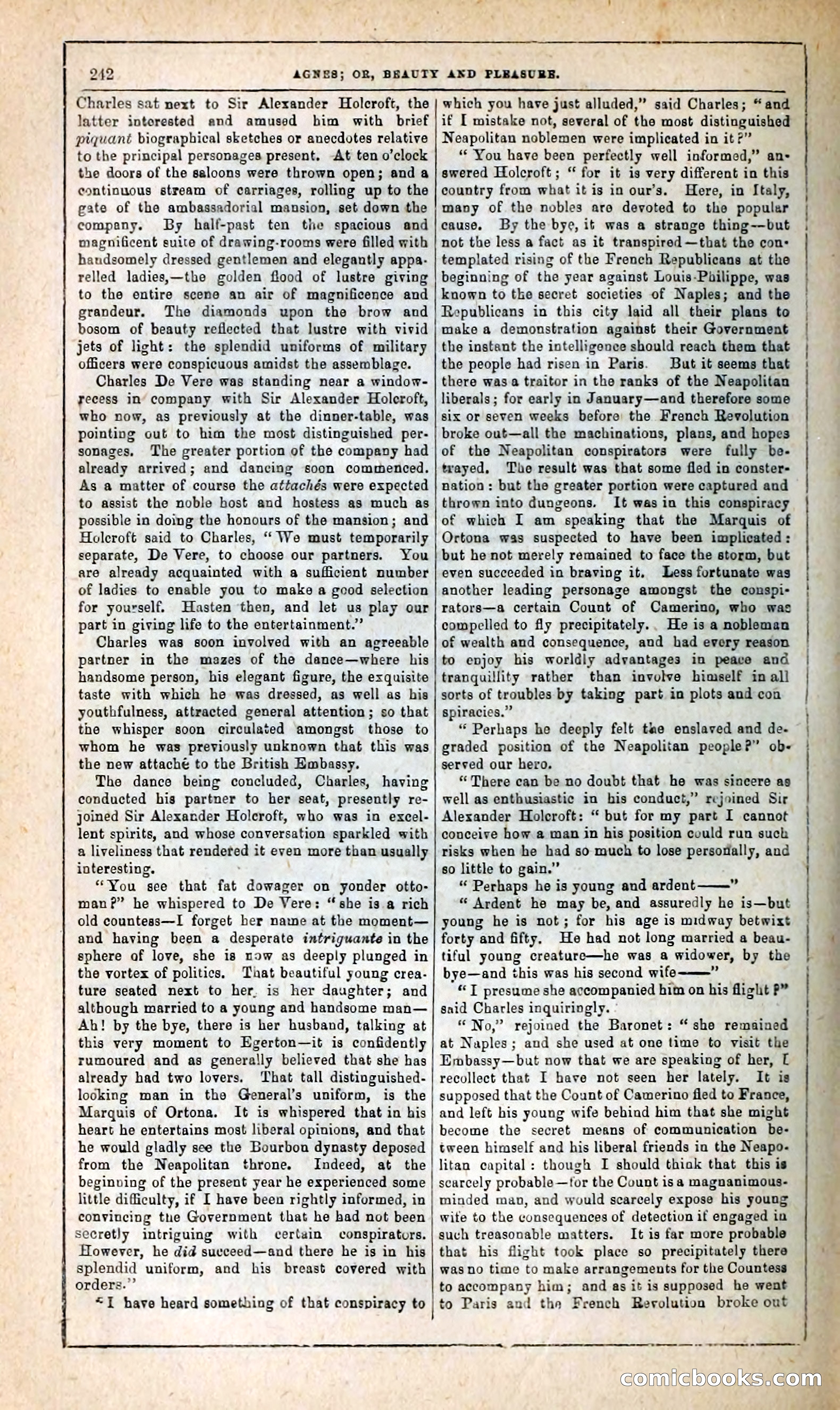
A restored page from Penny Dreadfuls, 1857. Page through the whole issue in the reader above.
📄 Transcribed text from this page (OCR, searchable)
Machine-transcribed from the original scan — historical spelling and the odd misread are preserved.
242 Charles sat next to Sir Alexander Holcroft, the latter interested and amused him with brief piquant biographical sketches or anecdotes relative to the principal personages present, At ten o’clock the doors of the saloons were thrown open; and a continuous stream of carriages, rolling up to the gate of the ambassadorial mansion, set down the company. By half-past ten the spacious and magnificent suite of drawing-rooms were filled with handsomely dressed gentlemen and elegantly appa- relled ladies,—the golden flood of lustre giving to the entire scene an air of magnificence and grandeur. The diamonds upon the brow and bosom of beauty reflected that lustre with vivid jets of light: the splendid uniforms of military officers were conspicuous amidst the assemblage. Charles De Vere was standing near a window- recess in’ company with Sir Alexander Holeroft, who now, as previously at the dinner-table, was pointing out to him the most distinguished per- sonages, The greater portion of the company had already arrived; and dancing soon commenced. As a matter of course the attachés were expected to assist the noble host and hostess as much as possible in doing the honours of the mansion; and Holeroft said to Charles, “ We must temporarily separate, De Vere, to choose our partners. You are already acquainted with a sufficient number of ladies to enable you to make a good selection for yourself. Hasten then, and let us play our part in giving life to the entertainment.” Charles was soon involved with an agreeable partner in the mazes of the dance—where his handsome person, his elegant figure, the exquisite taste with which he was dressed, as well as his youthfulness, attracted general attention; so that the whisper soon circulated amongst those to whom he was previously unknown that this was the new attaché to the British Embassy. The dance being concluded, Charles, having conducted his partner to her seat, presently re- joined Sir Alexander Holcroft, who was in excel- lent spirits, and whose conversation sparkled with a liveliness that rendeted it even more than usually interesting. “You see that fat dowager on yonder otto- man?” he whispered to De Vere: “she is a rich old countess—I forget her name at the moment— and having been a desperate intriguante in the sphere of love, she is now as deeply plunged in the vortex of politics. That beautiful young crea- ture seated next to her. is her daughter; and although married to a young and handsome man— Ah! by the bye, there is her husband, talking at this very moment to Egerton—it is confidently rumoured and as generally believed that she has already had two lovers. That tall distinguished- looking man in the General’s uniform, is the Marquis of Ortona. It is whispered that in his heart he entertains most liberal opinions, and that he would gladly see the Bourbon dynasty deposed from the Neapolitan throne. Indeed, at the beginving of the present year he experienced some little difficulty, if I have been rightly informed, in conviucing the Government that he had not been secretly intriguing with certain conspirators. However, he did sueceed—and there he is in his splendid uniform, and his breast covered with orders.” “I have heard something of that conspiracy to AGNES; OR, BBAUTY AND PLEASURE. which you have just alluded,” said Charles; “and if [ mistake not, several of the most distinguished Neapolitan noblemen were implicated in it ?” ‘You have been perfectly well informed,” an- swered Holcroft; “ for it is very different in this country from what it is in our’s. Here, in Italy, many of the nobles are devoted to the popular cause. By the bye, it was a strange thing-—but not the less a fact as it transpired —that the con- templated rising of the French Republicans at the beginning of the year against Louis-Philippe, was known to the secret societies of Naples; and the Republicans in this city laid all their plans to make a demonstration against their Government the instant the intelligence should reach them that the people had risen in Paris. But it seems that there was a traitor in the ranks of the Neapolitan liberals; for early in January—and therefore some six or seven weeks before the French Revolution broke out—all the machinations, plans, and hopes of the Neapolitan conspirators were fully be- trayed, The result was that some fled in conster- nation: but the greater portion were captured and thrown into dungeons. It was in this conspiracy of which I am speaking that the Marquis of Ortona was suspected to have been implicated: but he not merely remained to face the storm, but even succeeded in braving it. Less fortunate was another leading personage amongst the conspi- rators—a certain Count of Camerino, who was compelled to fly precipitately.. He is a nobleman of wealth and consequence, and had every reason to enjoy his worldly advantages in peace and tranquillity rather than involve himself in all sorts of troubles by taking part in plots and con spiracies.” “Perhaps he deeply felt tae enslaved and de- graded position of the Neapolitan people?” ob- served our hero. * There can be no doubt that he was sincere as well as enthusiastic in his conduct,” rejoined Sir Alexander Holcroft: “ but for my part I cannot conceive how a man in his position could run such risks when he had so much to lose personally, and so little to gain.” “ Perhaps he is young and ardent “ Ardent he may be, and assuredly he is—but young he is not; for his age is midway betwixt forty and fifty. He had not long married a beau- tiful young creature—he was a widower, by the bye—and this was his second wife sy “T presume she accompanied him on his fliglit ?” said Charles inquiringly. ° “No,” rejoined the Baronet: “ she remained at Naples; and she used at one time to visit the Embassy—but now that we are speaking of her, [ recollect that I have not seen her lately. It is supposed that the Count of Camerino fled to France, and left his young wife behind him that she might become the secret means of communication be- tween himself and his liberal friends in the Neapo- litan capital: though I should thiok that this is scarcely probable—tor the Count is a magnanimous- minded man, and would scarcely expose his young wite to the consequences of detection if engaged in such treasonable matters. It is far more probable that his flight took place so precipitately there was no time to make arrangements for the Countess to accompany him; and as it is supposed he went to Paris and the French Revolution broke out Gomichbooks