
Penny Dreadfuls, 1857 · page 242 of 394
Agnes, or, Beauty and Pleasure — page 242: what you’re looking at
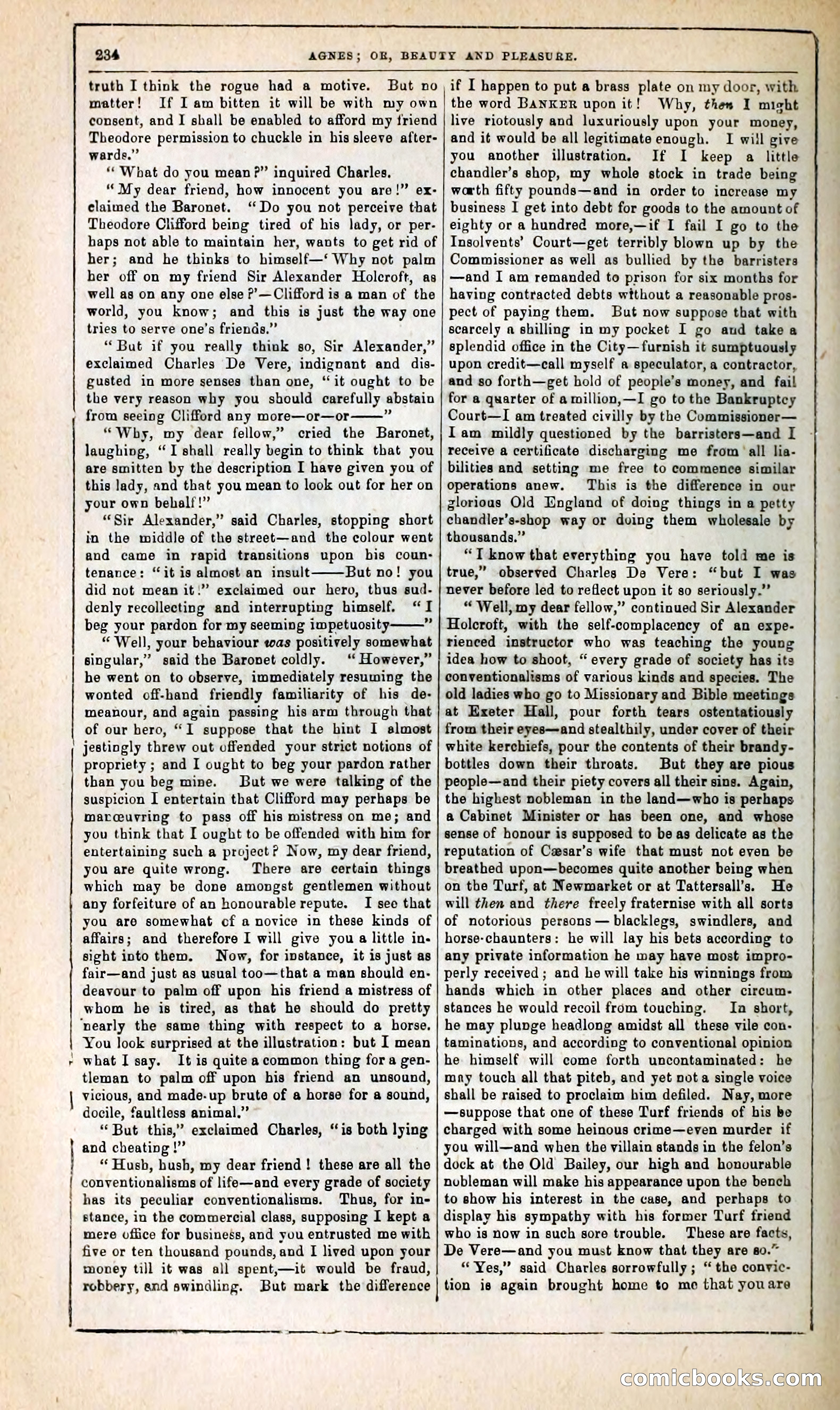
A restored page from Penny Dreadfuls, 1857. Page through the whole issue in the reader above.
📄 Transcribed text from this page (OCR, searchable)
Machine-transcribed from the original scan — historical spelling and the odd misread are preserved.
— — 234 truth I think the rogue had a motive. But no matter! If I am bitten it will be with my own consent, and I shall be enabled to afford my friend Theodore permission to chuckle in his sleeve after- wards.” ‘What do you mean?” inquired Charles, “My dear friend, how innocent you are!” ex- claimed the Baronet. ‘Do you not perceive that Theodore Clifford being tired of his lady, or per- haps not able to maintain her, wants to get rid of her; and he thinks to himself—‘ Why not palm her off on my friend Sir Alexander Holcroft, as well as on any one else ?’—Clifford is a man of the world, you know; and this is just the way one tries to serve one’s friends.” “But if you really think so, Sir Alexander,” exclaimed Charles De Vere, indignant and dis- gusted in more senses than one, “it ought to be the very reason why you should carefully abstain from seeing Clifford any more—or—or . “Why, my dear fellow,” cried the Baronet, laughing, “I shall really begin to think that you are smitten by the description I have given you of this lady, and that you mean to look out for her on your own behalf!” “Sir Alexander,” said Charles, stopping short in the middle of the street—and the colour went and came in rapid transitions upon bis coun- tenance: “it is almost an insult But no! you did not mean it!” exclaimed our hero, thus sud- denly recollecting and interrupting himself. “I beg your pardon for my seeming impetuosity " “Well, your behaviour toas positively somewhat singular,” said the Baronet coldly. ‘‘ However,” he went on to observe, immediately resuming the wonted off-hand friendly familiarity of his de- meanour, and again passing his arm through that of our hero, “I suppose that the hint I almost jestingly threw out offended your strict notions of propriety ; and I ought to beg your pardon rather than you beg mine. But we were talking of the suspicion I entertain that Clifford may perhaps be marceuvring to pass off his mistress on me; and you think that I ought to be offended with him for entertaining such a project? Now, my dear friend, you are quite wrong. There are certain things which may be done amongst gentlemen without any forfeiture of an honourable repute. I see that you are somewhat cf a novice in these kinds of affairs; and therefore I will give you a little in- sight into them. Now, for instance, it is just as fair—and just as usual too—that a man should en- deavour to palm off upon his friend a mistress of whom he is tired, as that he should do pretty ‘nearly the same thing with respect to a horse. You look surprised at the illustration: but I mean what I say. It is quite a common thing fora gen- tleman to palm off upon his friend an unsound, vicious, and made-up brute of a horse for a sound, docile, faultless animal.” “But this,” exclaimed Charles, “is both lying and cheating!” “ Husb, hush, my dear friend ! these are all the conventionalisms of life—and every grade of society has its peculiar conventionalisms. Thus, for in- stance, in the commercial class, supposing I kept a mere office for business, and you entrusted me with five or ten thousand pounds, and I lived upon your money till it was all spent,—it would be fraud, AGNES; OR, BEAUTY AND PLEASURE. if I happen to put a brass plate on my door, with the word BANKER upon it! Why, thes I micht live riotously and luxuriously upon your money, and it would be all legitimate enough. I will give you another illustration. If I keep a little chandler’s shop, my whole stock in trade being worth fifty pounds—and in order to increase my business I get into debt for goods to the amount of eighty or a hundred more,—if I fail I go to the Insolvents’ Court—get terribly blown up by the Commissioner as well as bullied by the barristers —and I am remanded to prison for six months for having contracted debts wtthout a reasonable pros- pect of paying them. But now suppose that with scarcely a shilling in my pocket I go aud take a splendid office in the City—furnish it sumptuously upon credit—call myself a speculator, a contractor, and so forth—get hold of people’s money, and fail for a quarter of amillion,—I go to the Bankruptcy Court—I am treated civilly by the Commissioner— Iam mildly questioned by the barristers—and I receive a certificate discharging me from ‘all lia- bilities and setting me free to commence similar operations anew. This is the difference in our glorioas Old England of doing things in a petty chandler’s-shop way or doing them wholesale by thousands.” “T know that everything you have told me is true,” observed Charles De Vere: “but I was never before led to reflect upon it so seriously.” “ Well, my dear fellow,” continued Sir Alexander Holcroft, with the self-complacency of an expe- rienced instructor who was teaching the young idea how to shoot, “every grade of society has its conventionalisms of various kinds and species. The old ladies who go to Missionary and Bible meetings at Exeter Hall, pour forth tears ostentatiously from their eyes—and stealthily, under cover of their white kerchiefs, pour the contents of their brandy- bottles down their throats. But they are pious people—and their piety covers all their sins. Again, the highest nobleman in the land—who is perhaps a Cabinet Minister or has been one, and whose sense of honour is supposed to be as delicate as the reputation of Caesar’s wife that must not even be breathed upon—becomes quite another being when on the Turf, at Newmarket or at Tattersall’s. He will then and there freely fraternise with all sorts of notorious persons — blacklegs, swindlers, and horse-chaunters: he will lay his bets according to any private information he may have most impro- perly received; and he will take his winnings from hands which in other places and other circum- stances he would recoil from touching. Ia short, he may plunge headlong amidst all these vile con- taminations, and according to conventional opinion he himself will come forth uncontaminated: he mny touch all that piteb, and yet nota single voice shall be raised to proclaim him defiled. Nay, more —suppose that one of these Turf friends of his be charged with some heinous crime—even murder if you will—and when the villain stands in the felon’s dock at the Old Bailey, our high and honourable nobleman will make his appearance upon the bench to show his interest in the case, and perhaps to display his sympathy with his former Turf friend who is now in such sore trouble. These are facts, De Vere—and you must know that they are 80.” “Yes,” said Charles sorrowfully; “ the convic- robbery, and swindling. But mark the difference | tion is again brought home to mo that youare Comilicbooks