
Penny Dreadfuls, 1857 · page 239 of 394
Agnes, or, Beauty and Pleasure — page 239: what you’re looking at
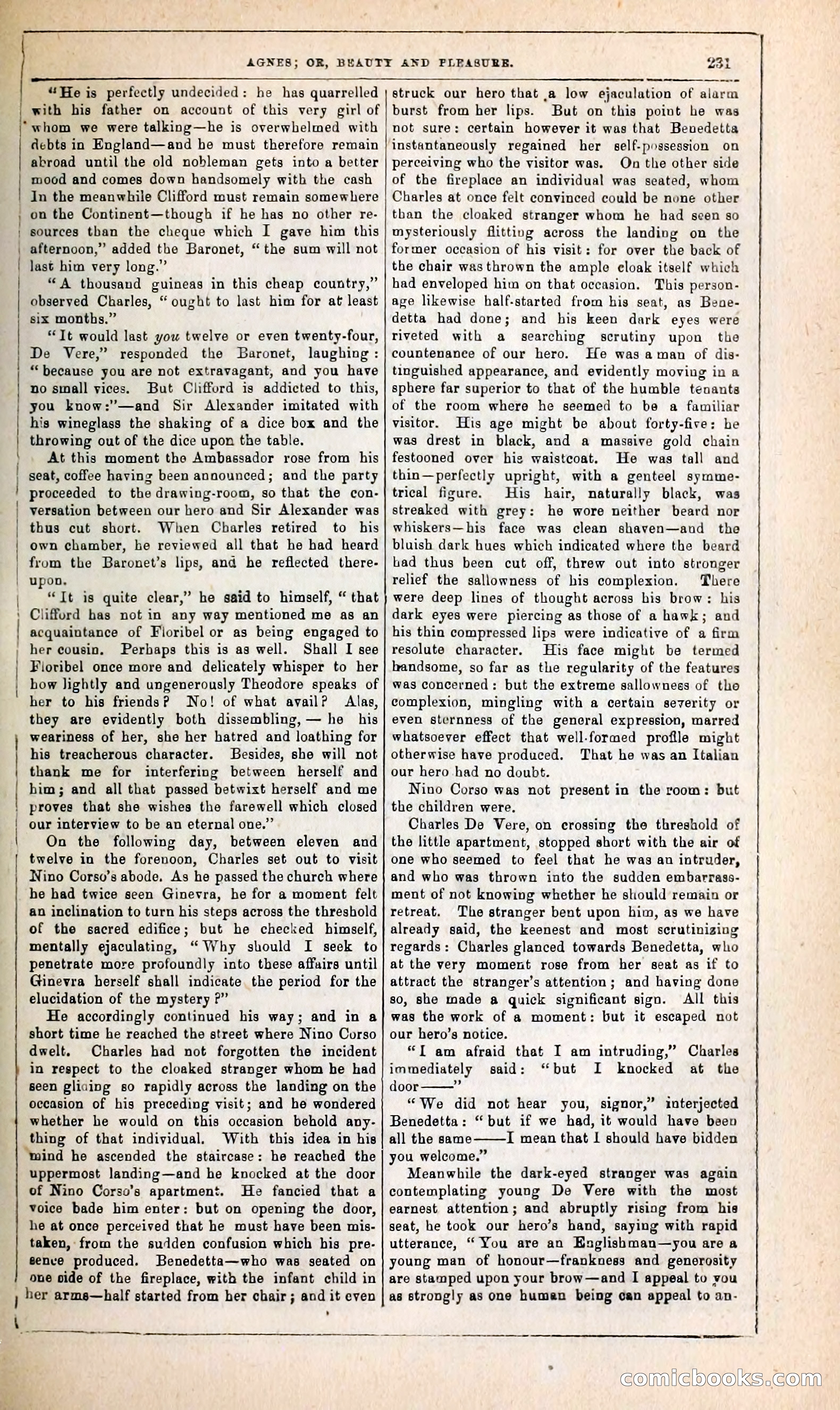
A restored page from Penny Dreadfuls, 1857. Page through the whole issue in the reader above.
📄 Transcribed text from this page (OCR, searchable)
Machine-transcribed from the original scan — historical spelling and the odd misread are preserved.
AGNES; OR, BEAUTY AND PLEASURE. “He is perfectly undecided: he has quarrelled with his father on account of this very girl of “whom we were talking—he is overwhelmed with debts in England—and be must therefore remain abroad until the old nobleman gets into a better mood and comes down handsomely with the cash | In the meanwhile Clifford must remain somewhere | | | | | | | | nr - ee eee eee ee ee ee a ss0so0. SS _ on the Continent—though if he has no other re- sources than the cheque which I gave him this _ afternoon,” added the Baronet, “the sum will not last him very long.” “A thousand guineas in this cheap country,” observed Charles, “ ought to last him for at least six months.” “Tt would last you twelve or even twenty-four, De Vere,” responded the Baronet, laughing : “because you are not extravagant, and you have no small yices. But Clifford is addicted to this, you know:’—and Sir Alexander imitated with his wineglass the shaking of a dice box and the throwing out of the dice upon the table. At this moment the Ambassador rose from his seat, coffee having been announced; and the party proceeded to the drawing-room, so that the con- versation between our hero and Sir Alexander was thus cut short. When Charles retired to his own chamber, he reviewed all that he had heard from the Baronet’s lips, and he reflected there- upon, “It is quite clear,” he said to himself, “ that ' Clifford has not in any way mentioned me as an acquaintance of Fioribel or as being engaged to her cousio. Perbaps this is as well. Shall I see Floribel once more and delicately whisper to her how lightly and ungenerously Theodore speaks of her to his friends? No! of what avail? Alas, they are evidently both dissembling, — he his weariness of her, she her hatred and loathing for his treacherous character. Besides, she will not thank me for interfering between herself and him; and all that passed betwixt herself and me proves that she wishes the farewell which closed our interview to be an eternal one.” On the following day, between eleven and twelve in the forenoon, Charles set out to visit Nino Corso’s abode. As he passed the church where he had twice seen Ginevra, he for a moment felt an inclination to turn his steps across the threshold of the sacred edifice; but he checked himself, mentally ejaculating, “ Why should I seek to penetrate more profoundly into these affairs until Ginevra herself shall indicate the period for the elucidation of the mystery ?” He accordingly continued his way; and in a short time he reached the street where Nino Corso dwelt. Charles bad not forgotten the incident in respect to the cloaked stranger whom he had seen gliaing so rapidly across the landing on the occasion of his preceding visit; and he wondered whether he would on this occasion behold any- thing of that individual. With this idea in his ind he ascended the staircase: he reached the uppermost landing—and he knocked at the door of Nino Corso’s apartment. He fancied that a Voice bade him enter: but on opening the door, he at once perceived that he must have been mis- taken, from the sudden confusion which his pre- senve produced. Benedetta—who was seated on one oide of the fireplace, with the infant child in her arms—half started from her chair; and it even 231 struck our hero that .a low ejaculation of alarm burst from her lips. But on this point he was not sure: certain however it was that Beuedetta instantaneously regained her self-possession on perceiving who the visitor was. On the other side of the fireplace an individual was seated, whom Charles at once felt convinced could be none other than the cloaked stranger whom he had seen so mysteriously flitting across the landing on the former occasion of his visit: for over the back of the chair was thrown the ample eloak itself which had enveloped him on that occasion. This person- age likewise half-started from his seat, as Bene- detta had done; and his keen dark eyes were riveted with a searching scrutiny upon the countenance of our hero. He was aman of dis- tinguished appearance, and evidently moving ina sphere far superior to that of the humble tenants of the room where he seemed to be a familiar visitor. His age might be about forty-five: he was drest in black, and a massive gold chain festooned over hig waistcoat. He was tall and thin—perfectly upright, with a genteel symme- trical figure. His hair, naturally black, was streaked with grey: he wore neither beard nor whiskers—his face was clean shaven—and the bluish dark hues which indicated where the beard bad thus been cut off, threw out into stronger relief the sallowness of his complexion. There were deep lines of thought across his brow: his dark eyes were piercing as those of a hawk; and his thin compressed lips were indicative of a firm resolute character. His face might be termed handsome, so far as the regularity of the features was concerned: but the extreme sallownees of tho complexion, mingling with a certain severity or even sternness of the general expression, marred whatsoever effect that well-formed proflle might otherwise have produced. That he was an Italian our hero had no doubt. Nino Corso was not present in the room: but the children were. Charles De Vere, on crossing the threshold of the little apartment, stopped short with the air of one who seemed to feel that he was an intruder, and who was thrown into the sudden embarrass- ment of not knowing whether he should remain or retreat. The stranger bent upon him, as we have already said, the keenest and most scrutinizing regards: Charles glanced towards Benedetta, who at the very moment rose from her seat as if to attract the stranger’s attention; and having done so, she made a quick significant sign. All this was the work of a moment: but it escaped not our hero’s notice. “Tf am afraid that I am intruding,” Charles immediately said: “but I knocked at the door is “We did not hear you, signor,” interjected Benedetta: “ but if we had, it would have been all the same I mean that I should have bidden you welcome.” Meanwhile the dark-eyed stranger was again contemplating young De Vere with the most earnest attention; and abruptly rising from hie seat, he took our hero’s hand, saying with rapid utterance, “ You are an Enaglishman—you are a young man of honour—frankness and generosity are stamped upon your brow—and I appeal to vou as strongly as one humen being can appeal to an- a 5 COMmiclooolkks —_ a ee _—_~- Oimn