
Penny Dreadfuls, 1857 · page 230 of 394
Agnes, or, Beauty and Pleasure — page 230: what you’re looking at
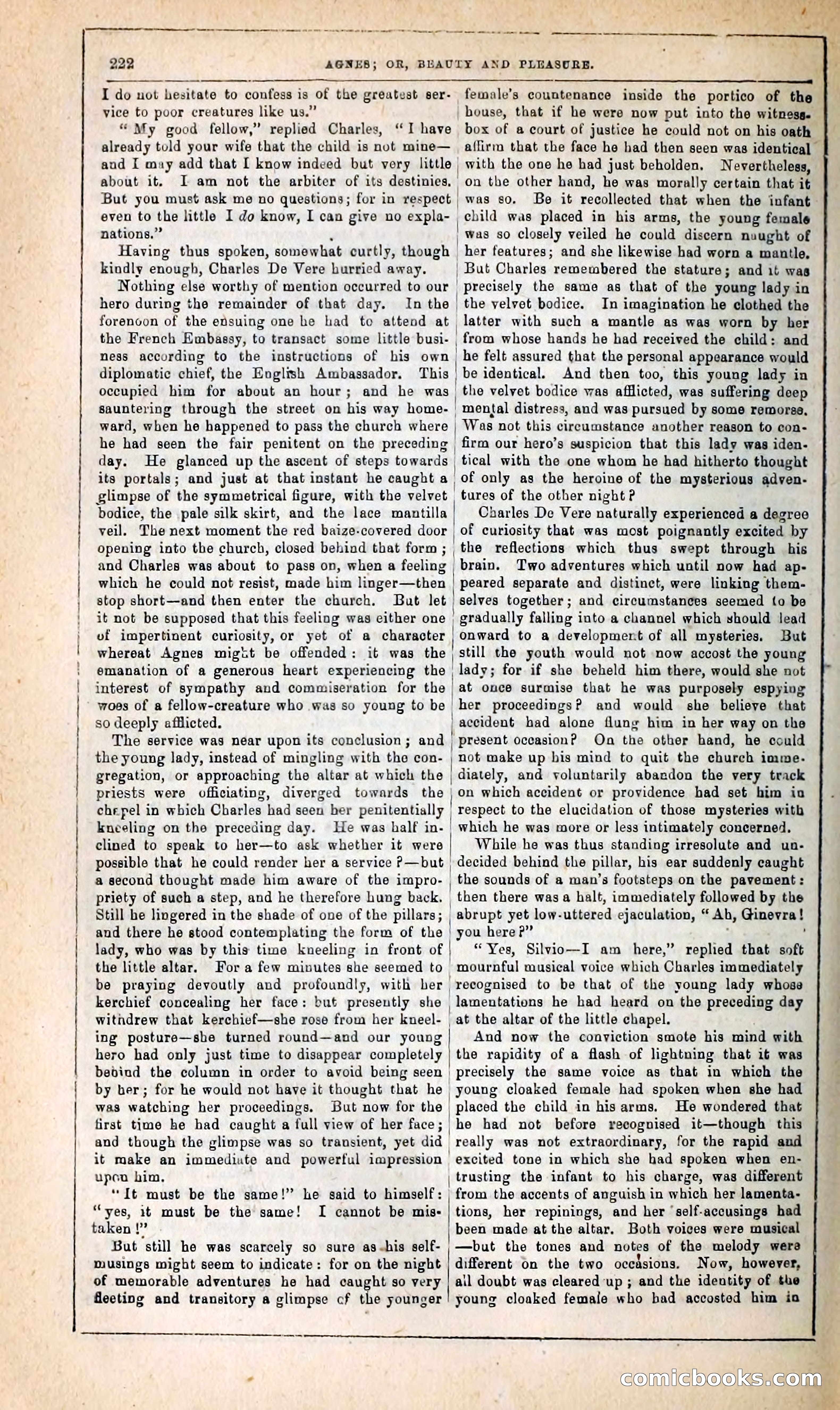
A restored page from Penny Dreadfuls, 1857. Page through the whole issue in the reader above.
📄 Transcribed text from this page (OCR, searchable)
Machine-transcribed from the original scan — historical spelling and the odd misread are preserved.
LL 222 I do not hesitate to confess is of the greatest ser- vice to poor creatures like us.” * My good fellow,” replied Charles, “I have already told your wife that the child is not mine— aud I may add that [ know indeed but very little about it. I am not the arbiter of its destinies, — But you must ask me no questions; for in respect even to the little I do know, I can give no expla- nations.” : Having thus spoken, somewhat curtly, though kindly enough, Charles De Vere burried away. Nothing else worthy of mention occurred to our hero during the remainder of that day. Inthe forenoon of the ensuing one he had to attend at. the French Hmbassy, to transact some little busi- ness according to the instructions of his own diplomatic chief, the English Ambassador. This occupied him for about an hour; and he was 8auntering through the street on his way home- ward, when he happened to pass the church where he had seen the fair penitent on the preceding day. He glanced up the ascent of steps towards its portals; and just at that instant he caught a. glimpse of the symmetrical figure, with the velvet bodice, the pale silk skirt, and the lace mantilla veil, The next moment the red baize-covered door opening into the church, closed behind that form ; and Charles was about to pass on, when a feeling which he could not resist, made him linger—then stop short—and then enter the church. But let it not be supposed that this feeling was either one vf impertinent curiosity, or yet of a character whereat Agnes migtt be offended: it was the emanation of a generous heart experiencing the interest of sympathy and commiseration for the woes of a fellow-creature who was so young to be so deeply afflicted. The service was near upon its conclusion; and the young lady, instead of mingling with the con- EO EE a RE RT Sete! AGNES; OR, BEAUTY AND PLEASURE. selves together; and circumstances seemed {o be gradually falling into a channel which should lead her proceedings? and would she believe that ‘present occasion? On the other band, he could gregation, or approaching the altar at which the priests were officiating, diverged towards the chepel in which Charles had seen ber penitentially kneeling on the preceding day. He was half in- clined to speak to her—to ask whether it were possible that he could render her a service P—but a second thought made him aware of the impro- priety of such a step, and he therefore hung back. Still be lingered in the shade of one of the pillars; and there he stood contemplating the form of the lady, who was by this time kneeling in front of | the little altar. Fora few minutes she seemed to be praying devoutly and profoundly, with ber, kerchief concealing her face: but presently she withdrew that kerchief—she rose from her kneel- | ing posture—she turned round—and our young hero had only just time to disappear completely beodind the column in order to avoid being seen | by ber; for he would not have it thought that he was watching her proceedings. But now for the | first time he had caught a full view of her face; | and though the glimpse was so transient, yet did it make an immediute and powerful impression upoo him, “It must be the same!” he said to himself: “yes, it must be the same! I cannot be mis- taken |” But still he was scarcely so sure as-his self- musings might seem to indicate: for on the night of memorable adventures he had caught so very fleeting and transitory a glimpse cf the younger —_-—--- ——— | On which accident or providence had set him in | you here P” female’s countenance inside the portico of the house, that if he were now put into the witness. box of a court of justice he could not on his oath affirm that the face he had then seen was identical _ with the one he had just beholden. Nevertheless, on the other hand, he was morally certain that it was so. Be it recollected that when the infant child was placed in his arms, the young female was so closely veiled he could discern nought of her features; and she likewise had worn a mantle, But Charles remembered the stature; and it was precisely the same as that of the young lady in the velvet bodice. In imagination he clothed the latter with such a mantle as was worn by her from whose hands he had received the child: and he felt assured that the personal appearance would be identical. And then too, this young lady in the velvet bodice was afflicted, was suffering deep mental distress, and was pursued by some remorse, Was not this circumstance another reason to con- firm our hero’s suspicion that this lady was iden- tical with the one whom he had hitherto thought of only as the heroine of the mysterious adven- tures of the other night? Charles De Vere naturally experienced a degree of curiosity that was most poignantly excited by the reflections which thus swept through his brain. Two adventures which until now had ap- peared separate and distinct, were linking them- onward to a development of all mysteries. But still the youth would not now accost the young lady; for if she beheld him there, would she not at once surmise that he was purposely espyiog accident had alone flung him in her way on the not make up bis mind to quit the church imme. diately, and voluntarily abandon the very track respect to the elucidation of those mysteries with which he was more or less intimately concerned. While he was thus standing irresolute and un- decided behind the pillar, his ear suddenly caught the sounds of a man’s footsteps on the pavement: then there was a halt, immediately followed by the abrupt yet low-uttered ejaculation, “ Ah, Ginevra! “Yes, Silvio—I am here,” replied that soft mournful musical voice which Charles immediately recognised to be that of the young lady whose lamentations he had heard on the preceding day at the altar of the little chapel. And now the conviction smote his mind with the rapidity of a flash of lightning that if was precisely the same voice as that in which the young cloaked female had spoken when she had placed the child in hisarms. He wondered that he had not before recognised it—though this really was not extraordinary, for the rapid and excited tone in which she had spoken when en- trusting the infant to his charge, was different from the accents of anguish in which her lamenta- tions, her repinings, and her ‘self-accusings had been made at the altar. Both voices were musical —but the tones and notes of the melody were different on the two occasions. Now, however, ail doubt was cleared up ; and the identity of the young cloaked female who bad accosted him ia cComilcbooks —— —_—