
Penny Dreadfuls, 1857 · page 21 of 394
Agnes, or, Beauty and Pleasure — page 21: what you’re looking at
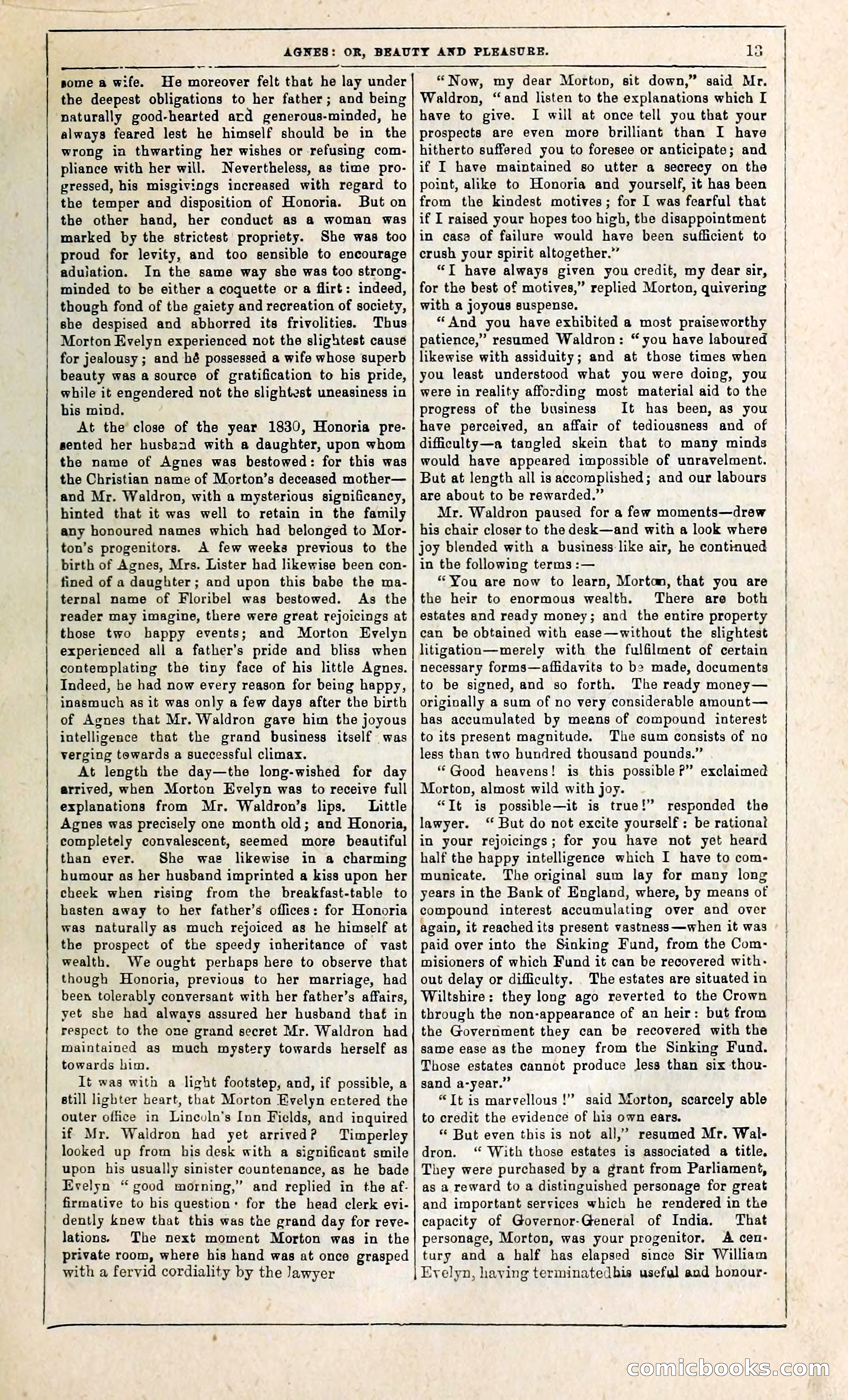
A restored page from Penny Dreadfuls, 1857. Page through the whole issue in the reader above.
📄 Transcribed text from this page (OCR, searchable)
Machine-transcribed from the original scan — historical spelling and the odd misread are preserved.
ee nn ee EE AL ee ee ae ee a TT eS lst ee AGNES: OR, BEAUTY AND PLEASURE. some a wife. He moreover felt that he lay under the deepest obligations to her father; and being naturally good-hearted ard generous-minded, he always feared lest he himself should be in the wrong in thwarting her wishes or refusing com- pliance with her will. Nevertheless, as time pro- gressed, his misgivings increased with regard to the temper and disposition of Honoria. But on the other hand, her conduct as a woman was marked by the strictest propriety. She was too proud for levity, and too sensible to encourage aduiation. In the same way she was too strong- minded to be either a coquette or a flirt: indeed, though fond of the gaiety and recreation of society, she despised and abhorred its frivolities. Thus Morton Evelyn experienced not the slightest cause for jealousy ; and hé possessed a wife whose superb beauty was a source of gratification to his pride, while it engendered not the slightest uneasiness in bis mind. At the close of the year 1830, Honoria pre- sented her husband with a daughter, upon whom the name of Agnes was bestowed: for this was the Christian name of Morton’s deceased mother— and Mr. Waldron, with a mysterious significancy, hinted that it was well to retain in the family any honoured names which had belonged to Mor- ton’s progenitors. A few weeks previous to the birth of Agnes, Mrs. Lister had likewise been con- fined of a daughter; and upon this babe the ma- ternal name of Floribel was bestowed. As the reader may imagine, there were great rejoicings at those two happy events; and Morton Evelyn experienced all a father’s pride and bliss when contemplating the tiny face of his little Agnes. Indeed, he had now every reason for being happy, inasmuch as it was only a few days after the birth of Agnes that Mr. Waldron gave him the joyous intelligence that the grand business itself was verging towards a suecessful climax. At length the day—the long-wished for day arrived, when Morton Evelyn was to receive full explanations from Mr. Waldron’s lips. Little Agnes was precisely one month old; and Honoria, completely convalescent, seemed more beautiful than ever. She wae likewise in a charming humour as her husband imprinted a kiss upon her cheek when rising from the breakfast-table to hasten away to her father’s offices: for Honoria was naturally as much rejoiced as he himeelf at the prospect of the speedy inheritance of vast wealth. We ought perbaps here to observe that though Honoria, previous to her marriage, had been tolerably conversant with her father’s affairs, yet she had always assured her husband thaf in respect to the one grand secret Mr. Waldron had maintained as much mystery towards herself as towards him. It was with a light footstep, and, if possible, a still lighter heart, that Morton Evelyn ertered the outer office in Lincoln's Inn Fields, and inquired if Mr. Waldron had yet arrived? Timperley looked up from his desk with a significant smile upon his usually sinister countenance, as he bade Evelyn “good morning,” and replied in the af- firmative to bis question: for the head clerk eyvi- dently knew that this was the grand day for reve- lations. The next moment Morton was in the private room, where his hand was at once grasped with a fervid cordiality by the Jawyer 13 * Now, my dear Morton, sit down,” said Mr. Waldron, “and listen to the explanations which I have to give. I will at once tell you that your prospects are even more brilliant than I have hitherto suffered you to foresee or anticipate; and if I have maintained so utter a secrecy on the point, alike to Honoria and yourself, it has been from the kindest motives; for I was fearful that if I raised your hopes too high, the disappointment in case of failure would have been sufficient to crush your spirit altogether.” “T have always given you credit, my dear sir, for the best of motives,” replied Morton, quivering with a joyous suspense. “And you have exhibited a most praiseworthy patience,” resumed Waldron: “you have laboured likewise with assiduity; and at those times when you least understood what you were doing, you were in reality affording most material aid to the progress of the business It has been, as you have perceived, an affair of tediousness and of difficulty—a tangled skein that to many minds would have appeared impossible of unravelment. But at length all is accomplished; and our labours are about to be rewarded.” Mr. Waldron paused for a few moments—drew his chair closer to the desk—and with a look where joy blended with a business-like air, he continued in the following terms :— “You are now to learn, Morton, that you are the heir to enormous wealth. There are both estates and ready money; and the entire property can be obtained with ease—without the slightest litigation—merely with the fulfilment of certain necessary forms—aflidavits to bo made, documents to be signed, and so forth. The ready money— originally a sum of no very considerable amount— has accumulated by means of compound interest to its present magnitude. The sum consists of no less than two hundred thousand pounds.” ‘Good heavens! is this possible P” exclaimed Morton, almost wild with joy. “Tt is possible—it is true!’ responded the lawyer. ‘ But do not excite yourself: be rational in your rejoicings; for you have not yet heard half the happy intelligence which I have to com- municate. The original sum lay for many long years in the Bank of England, where, by means of compound interest accumulating over and over again, it reached its present vastness—when it was paid over into the Sinking Fund, from the Com- misioners of which Fund it can be recovered with- out delay or difficulty. The estates are situated in Wiltshire: they long ago reverted to the Crown through the non-appearance of an heir: but from the Government they can be recovered with the same ease as the money from the Sinking Fund. Those estates cannot produce Jess than six thou- sand a-year.” “Tt is marvellous!” said Morton, scarcely able to credit the evidence of his own ears. * But even this is not all,” resumed Mr. Wal- dron. ‘ With those estates is associated a title. They were purchased by a grant from Parliament, as a reward to a distinguished personage for great and important services which he rendered in the capacity of Governor-General of India. That personage, Morton, was your progenitor. A cen: tury and a half has elapsed since Sir William Evelyn, having terminatedhis usefal and bonour- Comiclooolkks ee ed CO