
Penny Dreadfuls, 1857 · page 189 of 394
Agnes, or, Beauty and Pleasure — page 189: what you’re looking at
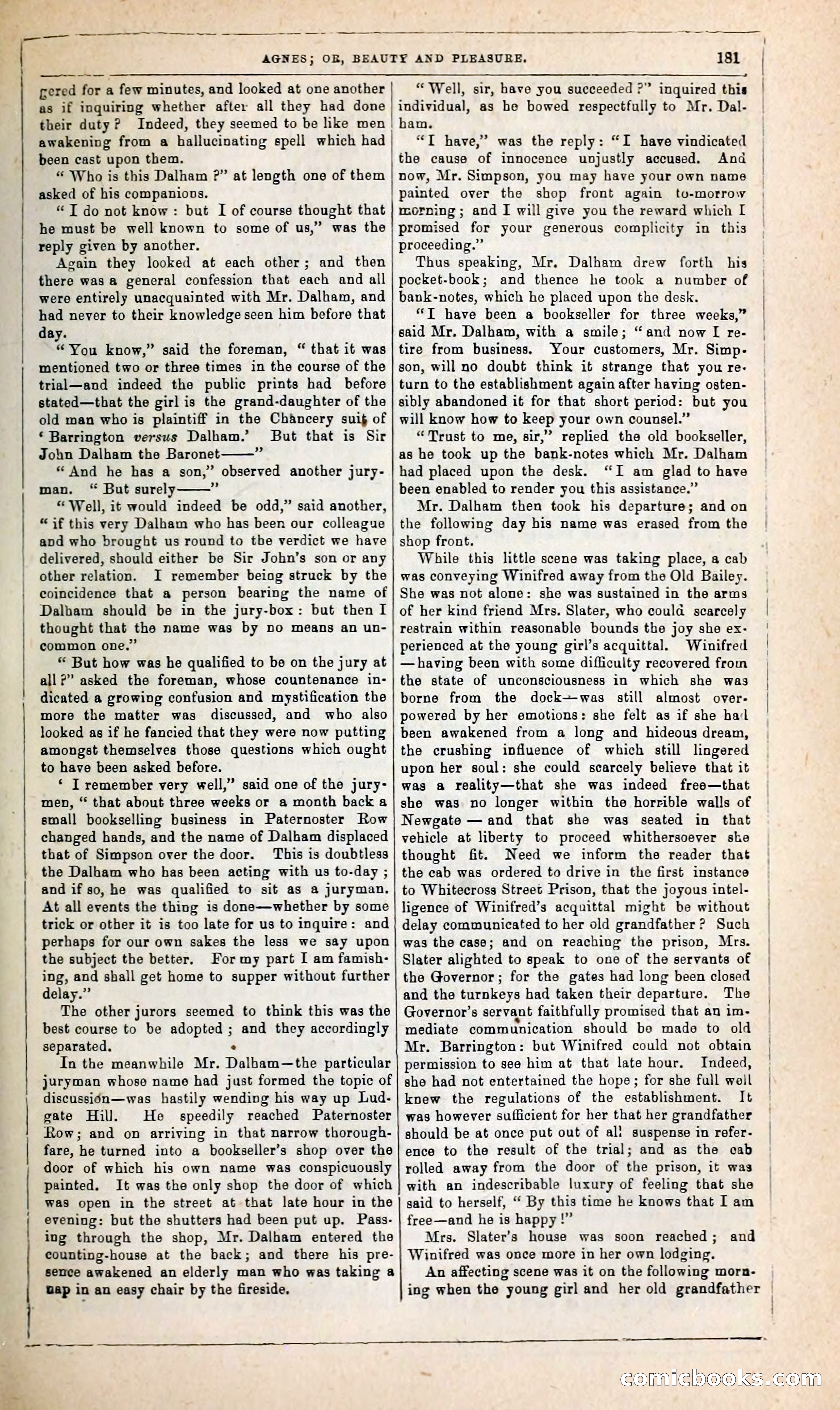
A restored page from Penny Dreadfuls, 1857. Page through the whole issue in the reader above.
📄 Transcribed text from this page (OCR, searchable)
Machine-transcribed from the original scan — historical spelling and the odd misread are preserved.
— ——— ee - O AGNES; OR, BEAUTY AND PLEASURE, gered for a few minutes, and looked at one another as if inquiring whether after all they had done ——_—— —— -O C—C—“— 181 “Well, sir, have you succeeded ?” inquired this individual, as he bowed respectfully to Mr. Dal- their duty? Indeed, they seemed to be hike men‘ ham. awakening from a hallucinating spell which had been cast upon them. “ Who is this Dalham ?” at length one of them asked of his companions. “ T do not know: but I of course thought that he must be well known to some of us,” was the reply given by another. Again they looked at each other; and then there was a general confession that each and all were entirely unacquainted with Mr. Dalham, and had never to their knowledge seen him before that day. “You know,” said the foreman, “ that it was mentioned two or three times in the course of the trial—and indeed the public prints had before stated—that the girl is the grand-daughter of the old man who is plaintiff in the Chancery suif of ‘ Barrington versus Dalham.’ But that is Sir John Dalham the Baronet is And he has a son,” observed another jury- man. “ But surely Z “Well, it would indeed be odd,” said another, “if this very Dalham who has been our colleague and who brought us round to the verdict we have delivered, should either be Sir John’s son or any other relation. I remember being struck by the coincidence that a person bearing the name of Dalbam should be in the jury-box: but then I thought that the name was by no means an un- common one.” ** But how was he qualified to be on the jury at 1?” asked the foreman, whose countenance in- dicated a growing confusion and mystification the more the matter was discussed, and who also looked as if he fancied that they were now putting amongst themselves those questions which ought to have been asked before. ‘ I remember very well,” said one of the jury- men, “ that about three weeks or a month back a small bookselling business in Paternoster Row changed hands, and the name of Dalham displaced that of Simpson over the door. This is doubtless the Dalham who has been acting with us to-day ; and if so, he was qualified to sit as a juryman. At all events the thing is done—whether by some trick or other it is too late for us to inquire: and perhaps for our own sakes the less we say upon the subject the better. For my part I am famish- ing, and shall get home to supper without further delay.” The other jurors seemed to think this was the best course to be adopted; and they accordingly separated. In the meanwhile Mr. Dalham—the particular juryman whose name had just formed the topic of discussidn—was hastily wending his way up Lud- gate Hill. He speedily reached Paternoster Row; and on arriving in that narrow thorough- fare, he turned into a bookseller’s shop over the door of which his own name was conspicuously painted. It was the only shop the door of which was open in the street at that late hour in the evening: but the shutters had been put up. Pass- ing through the shop, Mr. Dalham entered the counting-house at the back; and there his pre- inal SS i MEE EE map in an easy chair by the fireside. sence awakened an elderly man who was taking a “IT have,” was the reply: “I have vindicated the cause of innocence unjustly accused. And now, Mr. Simpson, you may have your own name painted over the shop front again to-morrow morning; and I will give you the reward which [ promised for your generous complicity in this proceeding.” Thus speaking, Mr. Dalham drew forth his pocket-book; and thence he took a number of bank-notes, which he placed upon the desk. *‘T have been a bookseller for three weeks,” said Mr, Dalham, with a smile; “and now [ re- tire from business. Your customers, Mr. Simp- son, will no doubt think it strange that you re- turn to the establishment again after having osten- sibly abandoned it for that short period: but you will know how to keep your own counsel.” “Trust to me, sir,” replied the old bookseller, as he took up the bank-notes which Mr. Dalham had placed upon the desk. “I am glad to have been enabled to render you this assistance.” Mr. Dalham then took his departure; and on the following day his name was erased from the shop front. While this little scene was taking place, a cab was conveying Winifred away from the Old Bailey. She was not alone: she was sustained in the arms of her kind friend Mrs. Slater, who coulda scarcely restrain within reasonable bounds the joy she ex- perienced at the young girl’s acquittal. Winifred —having been with some difficulty recovered from the state of unconsciousness in which she was borne from the dock—was still almost over- powered by her emotions: she felt as if she hal | been awakened from a long and hideous dream, the crushing influence of which still lingered upon her soul: she could scarcely believe that it was a reality—that she was indeed free—that she was no longer within the horrible walls of Newgate — and that she was seated in that vehicle at liberty to proceed whithersoever ske thought fit. Need we inform the reader that the cab was ordered to drive in the first instance to Whitecross Street Prison, that the joyous intel- ligence of Winifred’s acquittal might be without delay communicated to her old grandfather? Such was the case; and on reaching the prison, Mrs. Slater alighted to speak to one of the servants of the Governor; for the gates had long been closed and the turnkeys had taken their departure. The Governor’s servant faithfully promised that an im- ai ws . mediate communication should be made to old Mr. Barrington: but Winifred could not obtain permission to see him at that late hour. Indeed, she had not entertained the hope; for she full well knew the regulations of the establishment. It was however sufficient for her that her grandfather should be at once put out of al! suspense in refer- ence to the result of the trial; and as the cab rolled away from the door of the prison, it was with an indescribable luxury of feeling that she said to herself, “ By this time he knows that I am free—and he is happy !” Mrs. Slater’s house was soon reached ; Winifred was once more in her own lodging. An affecting scene was it on the following morn- ing when the young girl and her old grandfather and COMmmcooolkks |