
Penny Dreadfuls, 1857 · page 178 of 394
Agnes, or, Beauty and Pleasure — page 178: what you’re looking at
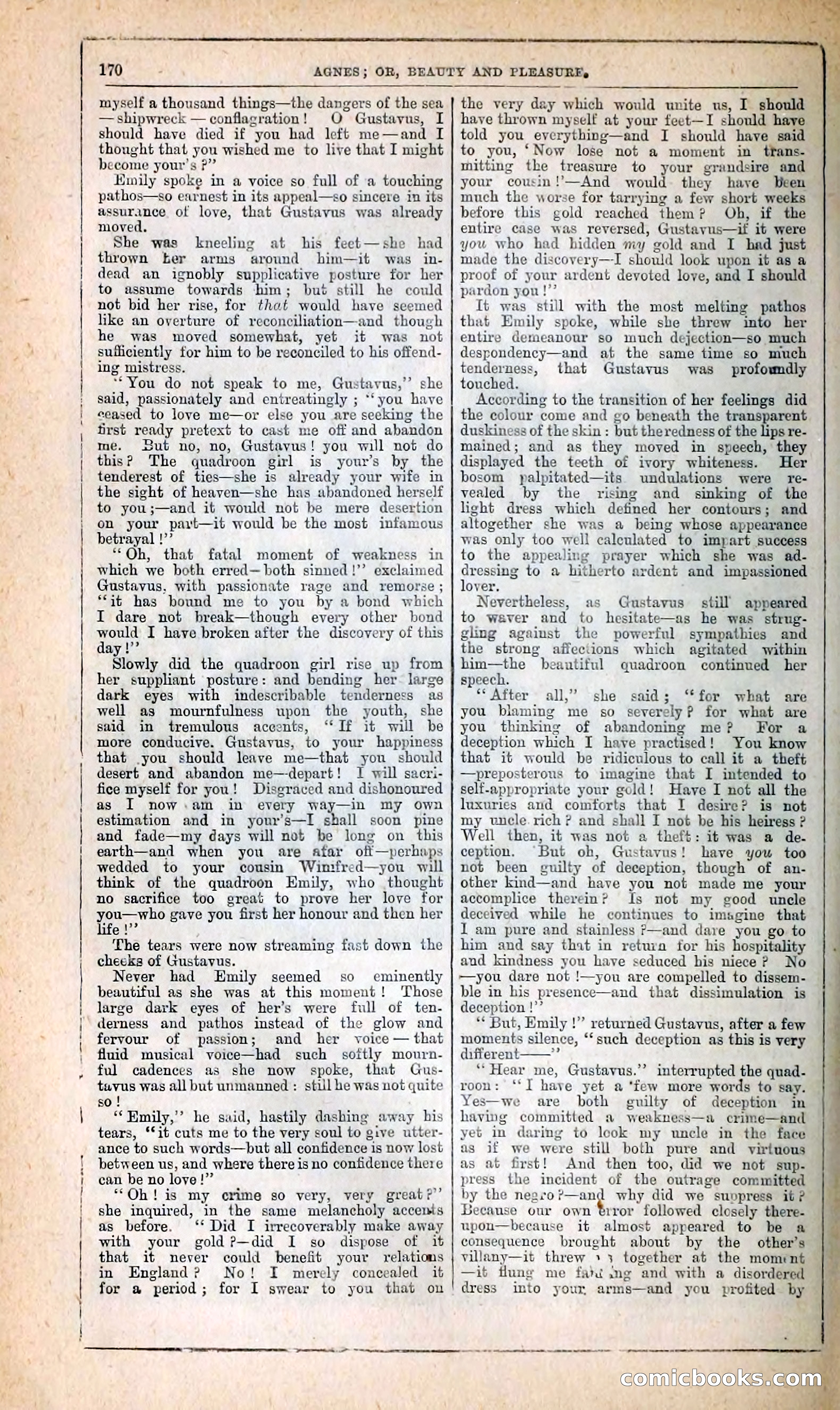
A restored page from Penny Dreadfuls, 1857. Page through the whole issue in the reader above.
📄 Transcribed text from this page (OCR, searchable)
Machine-transcribed from the original scan — historical spelling and the odd misread are preserved.
« , . . ‘” . , Ne ee ee . - 2 170 | myself a thousand things—the dangers of the sea — shipwreck — conflagration! O Gustavus, I should have died if you had left me—and I thought that you wished me to live that I might become your's ?” Himily spoke in a voice so full of a touching pathos—so earnest in its appeal—so sincere in its assurance of love, that Gustavus was already moved. She was kneeling at his feet—she had thrown ker arms around him—it was in- | dead an ignobly supplicative posture for her to assume towards him; but still he could not bid her rise, for that would have seemed like an overture of reconciliation—and though he was moved somewhat, yet it was not sufficiently for him to be reconciled to his offend- | ing mistress. | ‘*You do not speak to me, Gustavus,’’ she ; Said, passionately and entreatingly ; “‘ you have | ceased to love me—or else you are seeking the first ready pretext to cast me off and abandon | me. Sut no, no, Gustavus! you will not do this? The quadroon girl is your’s by the | tenderest of ties—she is already your wife in the sight of heaven—she has abandoned herself to you;—and it would not be mere desertion ' on your part—it would be the most infamous betrayal !”’ “Oh, that fatal moment of weakness in which we both erred—both sinned!” exclaimed Gustavus. with passionate rage and remorse ; “it has bound me to you by a bond which I dare not break—though every other bond Eire I have broken after the discovery of this ay!” Slowly did the quadroon girl rise up from her suppliant posture: and bending her large dark eyes with indescribable tenderness as well as mournfulness upon the youth, she said in tremulous accents, “If it will be more conducive. Gustavus, to your happiness that _you should leave me—that you should desert and abandon me—depart! I will sacri- fice myself for you! Disgraced and dishonoured |; as I now.am in every way—in my own estimation and in your’s—I shall soon pine | and fade—my days will not be long on this | earth—and when you are afar oft—perhaps wedded to your cousin Wimfred—you will think of the quadroon Emily, who thought no sacrifice too great to prove her love for you—who gave you first her honour and then her life !”” The tears were now streaming fast down the cheeks of Gustavus. Never had Emily seemed so eminently beautiful as she was at this moment! ‘Those large dark eyes of her’s were full of ten- derness and pathos instead of the glow and fervour of passion; and her voice — that fluid musical voice—had such softly mourn- ful cadences as she now spoke, that Gus- tauvus was all but unmanned : stil he was not quite so! | ‘Emily,’ he said, hastily dashing away his tears, ‘*it cuts me to the very soul to give utter- ance to such words—but all confidence is now lost between us, and where there is no confidence there can be no love!” **Oh! is my crime so very, very great?”’ she inquired, in the same melancholy accemis as before. ‘‘ Did I irrecoverably make away with your gold ?—did I so dispose of it that it never could benefit your relations in England? No! I merely concealed it for a period; for I swear to you that on x a ees eee r,s AGNES; OR, BEAUTY AND PLEASURE, , : - a. the very day which would unite us, I should |} have thrown myself at your feet—I should pe | told you everything—and I should have i | to you, ‘Now lose not a moment in tfans- } mitting the treasure to your grandsire and [| your cousin!’—And would they haye Ween | much the worse for tarrying a few short weeks before this gold reached them? Oh, if the entire case was reversed, Gustavus—if it were you who had hidden my gold and I had just made the discovery—I should look upon it as a proof of your ardent devoted love, and I should pardon you !”’ [t was still with the most melting pathos that Emily spoke, while she threw into her entire demeanour so much dejection—so much despondency—and at the same time so much tenderness, that Gustavus was profowdly touched. According to the transition of her feelings did the colour come and go beneath the transparent duskiness of the skin : but theredness of the lips re- mained; and as they moved in speech, they displayed the teeth of ivory whiteness. Her bosom palpitated—its undulations were re- vealed by the rising and sinking of the light dress which defined her contours; and altogether she was a being whose appearance was only too well caleulated to impart success to the appealing prayer which she was ad- ares to a hitherto ardent and impassioned over. Nevertheless, as Gustavus still appeared to waver and to hesitate—as he was strug- gling against the powerful sympathies and the strong affections which agitated within him—the beautiful quadroon continned her speech. ‘‘After all,” she said; ‘“*for what are you blaming me so severely? for what are you thinking of abandoning me? For a deception which I have practised! You know that it would be ridiculous to call it a theft —preposterons to imagine that I intended to self-appropriate your gold! Have I not all the luxuries aud comforts that I desire? is not my wuele. rich? and shall I not be his heiress ? Well then, it was not a theft: it was a de- ception. But oh, Gustavus! have you too not been guilty of deception, though of an- other kind—and have you not made me your accomplice therein? Is not my good unele deceived while he continues to imagine that I am pure and stainless ?—and dare you go to him and say that in retuva for his hospitality and landness you have seduced his niece? No —you dare not !—you are compelled to dissem- — ble in his presence—and that dissimulation is deception !”’ ** But, Emily !” returned Gustavus, after a few moments silence, ‘“‘such deception as this is yery different ¥ “Hear me, Gustavus.’ interrupted the quad- roon: ‘‘I have yet a ‘few more words to say. — Yes—we are both guilty of deception in having committed a weakness—a crime—and yet in daring to leok my uncle in the face | as if we were still both pure and vyirtuous © as at first! And then too, did we not sup- press the incident of the outrage committed | by the negro?—and why did we suppress it? | Because our own trror followed closely there- | upon—because it almost appeared to be a |} consequence brought about by the other’s | villany—it threw +3 together at the moment | —it flung me fatd ing and with a disordered — dress into your arms—and you profited by © ‘ be * +t pia, Put? = COMMGEIOOKMSactolit