
Penny Dreadfuls, 1857 · page 172 of 394
Agnes, or, Beauty and Pleasure — page 172: what you’re looking at
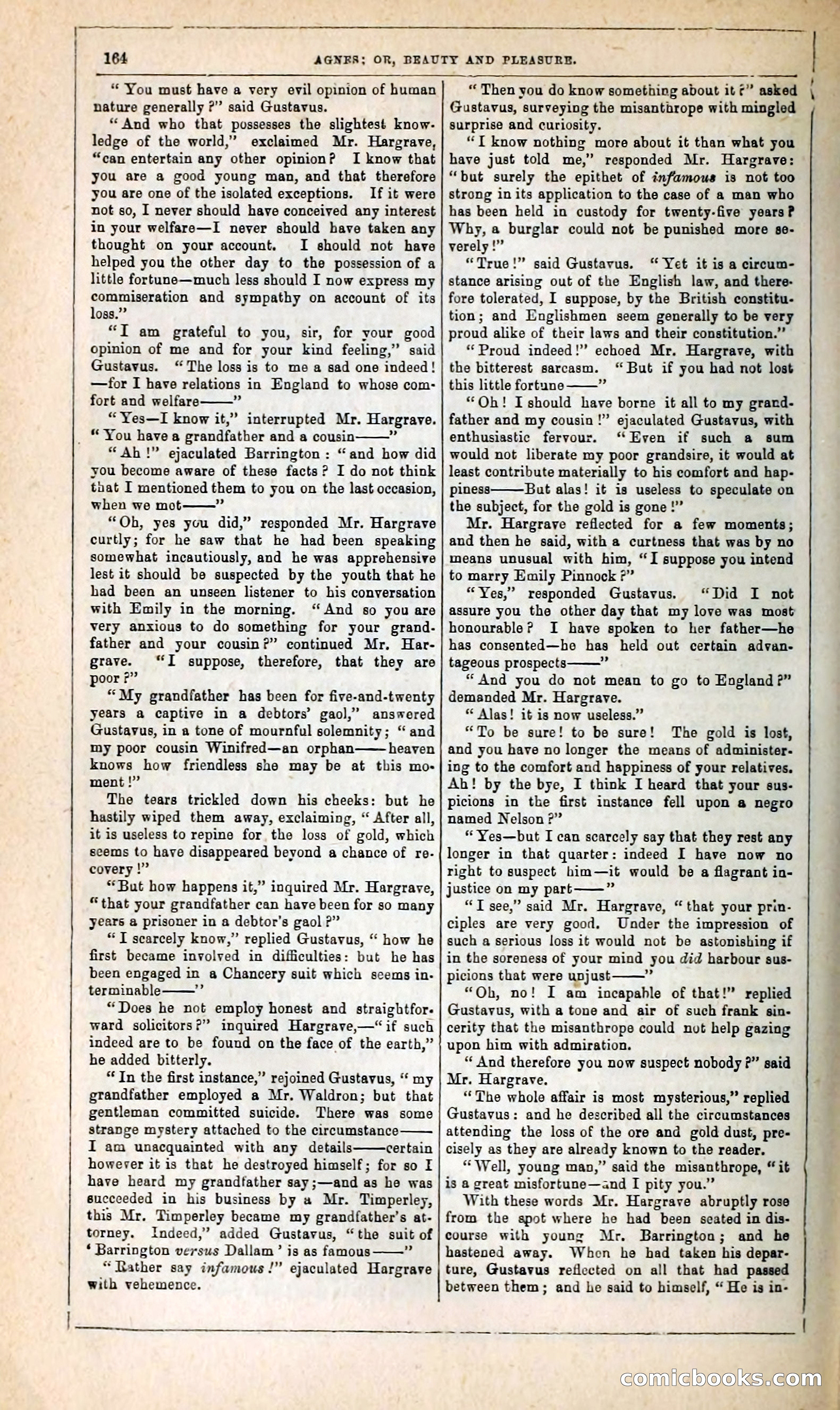
A restored page from Penny Dreadfuls, 1857. Page through the whole issue in the reader above.
📄 Transcribed text from this page (OCR, searchable)
Machine-transcribed from the original scan — historical spelling and the odd misread are preserved.
ee _—oO oo 164 ** You must have a very evil opinion of human nature generally ?” said Gustavus. *“And who that possesses the slightest know- ledge of the world,’ exclaimed Mr. Hargrave, “can entertain any other opinion? I know that you are a good young man, and that therefore you are one of the isolated exceptions. If it were not so, I never should have conceived any interest in your welfare—I never should have taken any thought on your account. I should not have helped you the other day to the possession of a little fortune—much less should I now express my commiseration and sympathy on account of its loss.” “T am grateful to you, sir, for your good opinion of me and for your kind feeling,” said Gustavus. “The loss is to mea sad one indeed! —for I have relations in England to whose com- fort and welfare a “Yes—I know it,” interrupted Mr. Hargrave. “You have a grandfather and a cousin 2 * Ah!” ejaculated Barrington : “and how did you become aware of these facts? I do not think tnat I mentioned them to you on the last occasion, when we mot 4 “Ob, yes you did,” responded Mr. Hargrave curtly; for he saw that he had been speaking somewhat incautiously, and he was apprehensive lest it should be suspected by the youth that he had been an unseen listener to his conversation with Emily in the morning. “And so you are very anxious to do something for your grand- father and your cousin?” continued Mr. Har- “T suppose, therefore, that they are grave. oor ?” “My grandfather has been for five-and-twenty years a captive in a debtors’ gaol,” answered Gustavus, in a tone of mournful solemnity; “and my poor cousin Winifred—an orphan—— heaven knows how friendless she may be at this mo- ment !” The tears trickled down his cheeks: but he hastily wiped them away, exclaiming, “ After all, it is useless to repine for the loss of gold, which seems to have disappeared beyond a chance of re- covery !” **But how happens it,” inquired Mr. Hargrave, “that your grandfather can have been for so many years a prisoner in a debtor's gaol ?” “JT scarcely know,” replied Gustavus, “ how he first became involved in difficulties: but he has been engaged in a Chancery suit which scems in- terminable = “Does he not employ honest and straightfor. ward solicitors?” inquired Hargrave,—“if such indeed are to be found on the face of the earth,” he added bitterly. In the first instance,” rejoined Gustavus, “‘ my grandfather employed a Mr. Waldron; but that gentleman committed suicide. There was some strange mystery attached to the circumstance I am unacquainted with any details certain however it is that he destroyed himself; for so I have heard my grandfather say ;—and as he was succeeded in his business by a Mr. Timperley, this Mr. Timperley became my grandfather’s at- torney. Indeed,’ added Gustavus, “the suit of * Barrington versus Dallam’ is as famous a3 “Rather say infamous!” ejaculated Hargrave with vehemence. AGNES; OR, BEAUTY AND PLEASURE. —_—___ “Then you do know something about it ¢” asked \ Gustavus, surveying the misanthrope with mingled surprise and curiosity. . “T know nothing more about it than what you have just told me,” responded Mr. Hargrave: “but surely the epithet of infamous is not too strong in its application to the case of a man who has been held in custody for twenty-five years? Why, a burglar could not be punished more se- verely !” “True!” said Gustavus. “ Yet it is a circum- stance arising out of the English law, and there- fore tolerated, I suppose, by the British constitu- tion; and Englishmen seem generally to be very proud alike of their laws and their constitution.” “Proud indeed!” echoed Mr. Hargrave, with the bitterest sarcasm. “But if you had not lost this little fortune % “Oh! I should have borne it all to my grand- father and my cousin!” ejaculated Gustavus, with enthusiastic fervour. ‘“‘Even if such a sum would not liberate my poor grandsire, it would at least contribute materially to his comfort and hap- piness But alas! it is useless to speculate on the subject, for the gold is gone !” Mr. Hargrave reflected for a few moments; and then he said, with a curtness that was by no means unusual with him, “I suppose you intend to marry Emily Pinnock ?” “Yes,” responded Gustavus. “Did I not assure you the other day that my love was most honourable? I have spoken to her father—he has consented—he has held out certain advan- tageous prospects # “And you do not mean to go to England ?” demanded Mr. Hargrave. “ Alas! it is now useless.” To be sure! to be sure! The gold is lost, and you have no longer the means of administer- ing to the comfort and happiness of your relatives. Ab! by the bye, I think I heard that your sus- picions in the first instance fell upon a negro named Nelson ?” *Yes—but I can scarcely say that they rest any longer in that quarter: indeed I have now no right to suspect him—it would be a flagrant in- justice on my part——” “T see,” said Mr. Hargrave, “that your prin- ciples are very good. Under the impression of such a serious loss it would not be astonishing if in the soreness of your mind you did harbour sus- picions that were upjust es “Oh, no! I am incapahle of that!” replied Gustavus, with a tone and air of such frank sin- cerity that the misanthrope could not help gazing upon him with admiration. “And therefore you now suspect nobody ?” said Mr. Hargrave. “The whole affair is most mysterious,” replied Gustavus: and he described all the circumstances attending the loss of the ore and gold dust, pre- cisely as they are already known to the reader. “Well, young man,” said the misanthrope, “ it is 8 great misfortune—and I pity you.” With these words Mr. Hargrave abruptly rose from the spot where he had been seated in dis- course with young Mr. Barrington; and he hastened away. When he had taken his depar- ture, Gustavus reflected on all that had passed between them; and he said to himself, “ He is in- hi —_—_—_—S— oS Comilcbooks <——— pe