
Penny Dreadfuls, 1857 · page 14 of 394
Agnes, or, Beauty and Pleasure — page 14: what you’re looking at
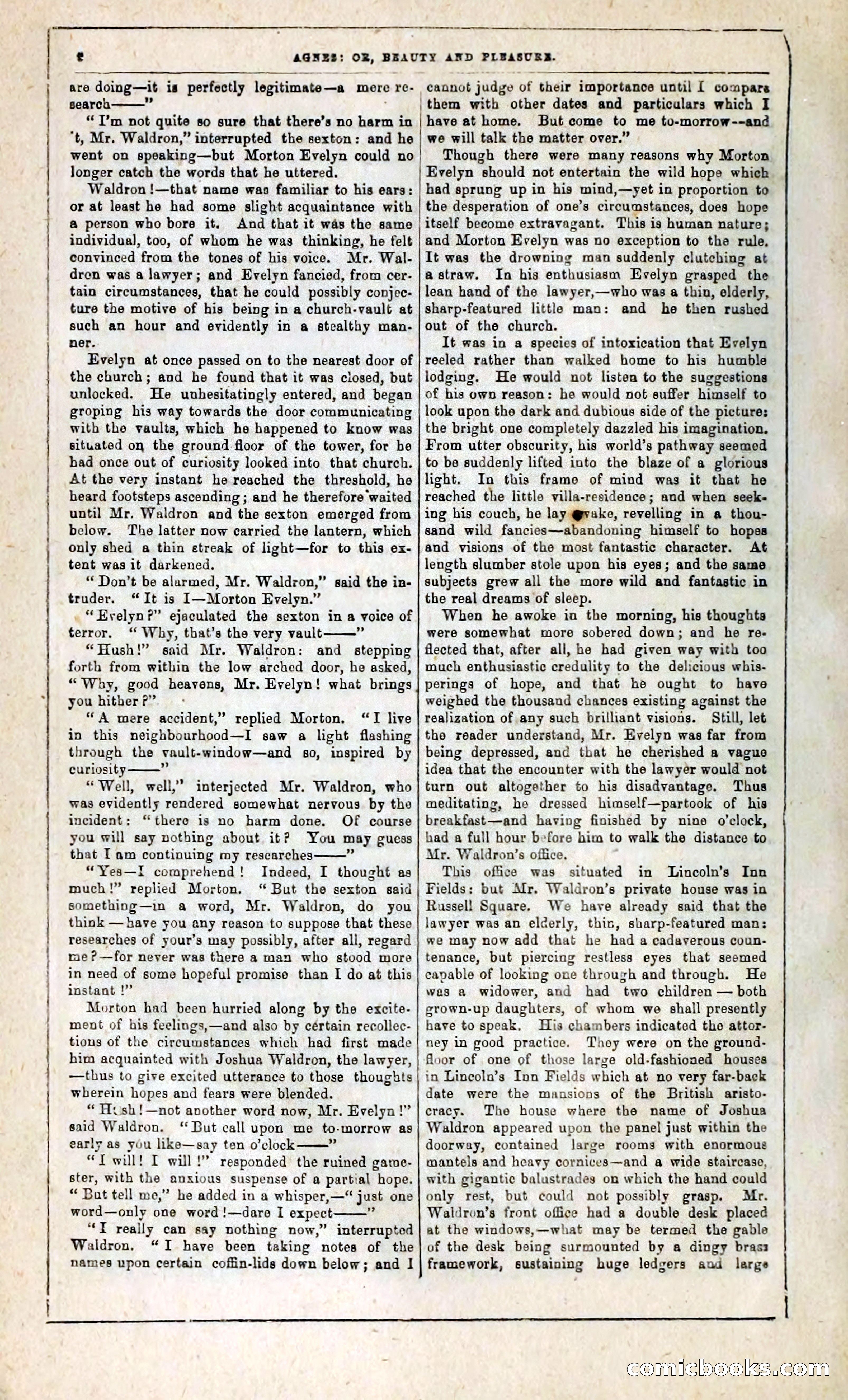
A restored page from Penny Dreadfuls, 1857. Page through the whole issue in the reader above.
📄 Transcribed text from this page (OCR, searchable)
Machine-transcribed from the original scan — historical spelling and the odd misread are preserved.
¢ i = a = RR ne wm mm a mmm a ee ee ew cr a eee ee —_—_—_——_—— rt rr ee ee ~ t AGNES: OR, BEAUTY AND PLEASUES. are doing—it is perfectly legitimate—a mere re- search ~ “T’m not quite so sure that there’s no harm in “t, Mr. Waldron,” interrupted the sexton: and he went on speaking—but Morton Evelyn could no Jonger catch the words that he uttered. Waldron !—that name was familiar to his ears: or at least he had some slight acquaintance with @ person who bore it. And that it was the same individual, too, of whom he was thinking, he felt convinced from the tones of his voice. Mr. Wal- dron was a lawyer; and Evelyn fancied, from cer- tain circumstances, that he could possibly conjec- ture the motive of his being in a church-vault at such an hour and evidently in a stealthy man- ner. Evelyn at once passed on to the nearest door of the church; and be found that it was closed, but unlocked. He unhbesitatingly entered, and began groping his way towards the door communicating with the vaults, which he happened to know was situated on the ground-floor of the tower, for he had once out of curiosity looked into that church. At the very instant he reached the threshold, he heard footsteps ascending; and he therefore waited until Mr. Waldron and the sexton emerged from below. The latter now carried the lantern, which only shed a thin etreak of light—for to this ex- tent was it darkened. “Don’t be alarmed, Mr. Waldron,” said the in- truder. “It is I—Morton Evelyn.” _ “Evelyn?” ejaculated the sexton in a voice of terror. ‘‘ Why, that’s the very vault R “Hush!” said Mr. Waldron: and stepping forth from within the low arched door, he asked, “Why, good heavens, Mr. Evelyn! what brings you hither ?” “A mere accident,” replied Morton. “TI live in this neighbourhood—I saw a light flashing through the vault-window—and so, inspired by curiosity 4 “Well, well,” interjected Mr. Waldron, who was evidently rendered somewhat nervous by the incident: “there is no harm done. Of course you will say nothing about it? You may guess that I om continuing my researches . “Yes—I comprehend! Indeed, I thoucht as much!” replied Morton. “ But the sexton said something—in a word, Mr. Waldron, do you think — have you any reason to suppose that these researches of your’s may possibly, after all, regard me?—for never was there a man who stood more in need of some hopeful promise than I do at this instant !” Morton had been hurried along by the excite- ment of his feelings,—and also by cértain recollec- tions of the circumstances which had first made him acquainted with Joshua Waldron, the lawyer, —thus to give excited utterance to those thoughts wherein hopes and fears were blended. “ Hush !—not another word now, Mr. Evelyn!” said Waldron. “But call upon me to-morrow as early as you like—say ten o'clock “1 will! I will!” responded the ruined game- ster, with the anxious suspense of a partial hope. “ But tell me,” he added in a whisper,—“ just one word—only one word !—dare I expect ip ‘“T really can say nothing now,” interrupted Waldron, “I have been taking notes of the names upon certain coffin-lids down below; and I cannot judge of their importance until [ compare them with other dates and particulars which I have at home. But come to me to-morrow--and we will talk the matter over.” Though there were many reasons why Morton Evelyn should not entertain the wild hope which had sprung up in his mind,—yet in proportion to the desperation of one’s circumstances, does hope itself become extravagant. This is human nature; and Morton Evelyn was no exception to the rule, It was the drowning man suddenly clutching at astraw. In his enthusiasm Evelyn grasped the lean hand of the lawyer,—who was a thin, elderly, sharp-featured little man: and he then rushed out of the church. It was in a species of intoxication that Evelyn reeled rather than walked home to his humble lodging. He would not listen to the suggestions of his own reason: he would not suffer himself to look upon the dark and dubious side of the picture: the bright one completely dazzled his imagination. From utter obscurity, his world’s pathway seemed to be suddenly lifted into the blaze of a glorious light. In this frame of mind was it that he reached the little villa-residence; and when seek- ing his couch, he lay @vake, revelling in a thou- sand wild fancies—abandoning himself to hopes and visions of the most fantastic character. At length slumber stole upon his eyes; and the same subjects grew all the more wild and fantastic in the real dreams of sleep. When he awoke in the morning, his thoughts were somewhat more sobered down; and he re- flected that, after all, he had given way with too much enthusiastic credulity to the delicious whis- perings of hope, and that he ought to have weighed the thousand chances existing against the realization of any such brilliant visions. Still, let the reader understand, Mr. Evelyn was far from being depressed, and that he cherished a vague idea that the encounter with the lawyer would not turn out altogether to his disadvantage. Thus meditating, he dressed himself—partook of his breakfast—and having finished by nine o'clock, had a full hour before him to walk the distance to Mr. Waldron’s office, This office was situated in Lincoln’s Inn Fields: but Mr. Waldron’s private house was in Russel! Square. We have already said that the lawyer was an elderly, this, sharp-featured man: we may now add that he had a cadaverous coun- tenance, but piercing restless eyes that seemed capable of looking one through and through. He was a widower, and had two children — both grown-up daughters, of whom we shall presently have to speak. His chambers indicated tho attor- ney in good practice. Thoy were on the ground- floor of one of those large old-fashioned houses in Lincoln’s Inn Fields which at no very far-back date were the mansions of the British aristo- cracy. The house where the name of Joshua Waldron appeared upon the panel just within the doorway, contained large rooms with enormous mantels and heavy cornices—and a wide staircase, with gigantic balustrades on which the hand could only rest, but could not possibly grasp. Mr. Waldron’s front office had a double desk placed at the windows,—what may be termed the gable of the desk being surmounted by a dingy brass framework, sustaining huge ledgers and large Corn Ghbooks (E(0)