
Penny Dreadfuls, 1857 · page 133 of 394
Agnes, or, Beauty and Pleasure — page 133: what you’re looking at
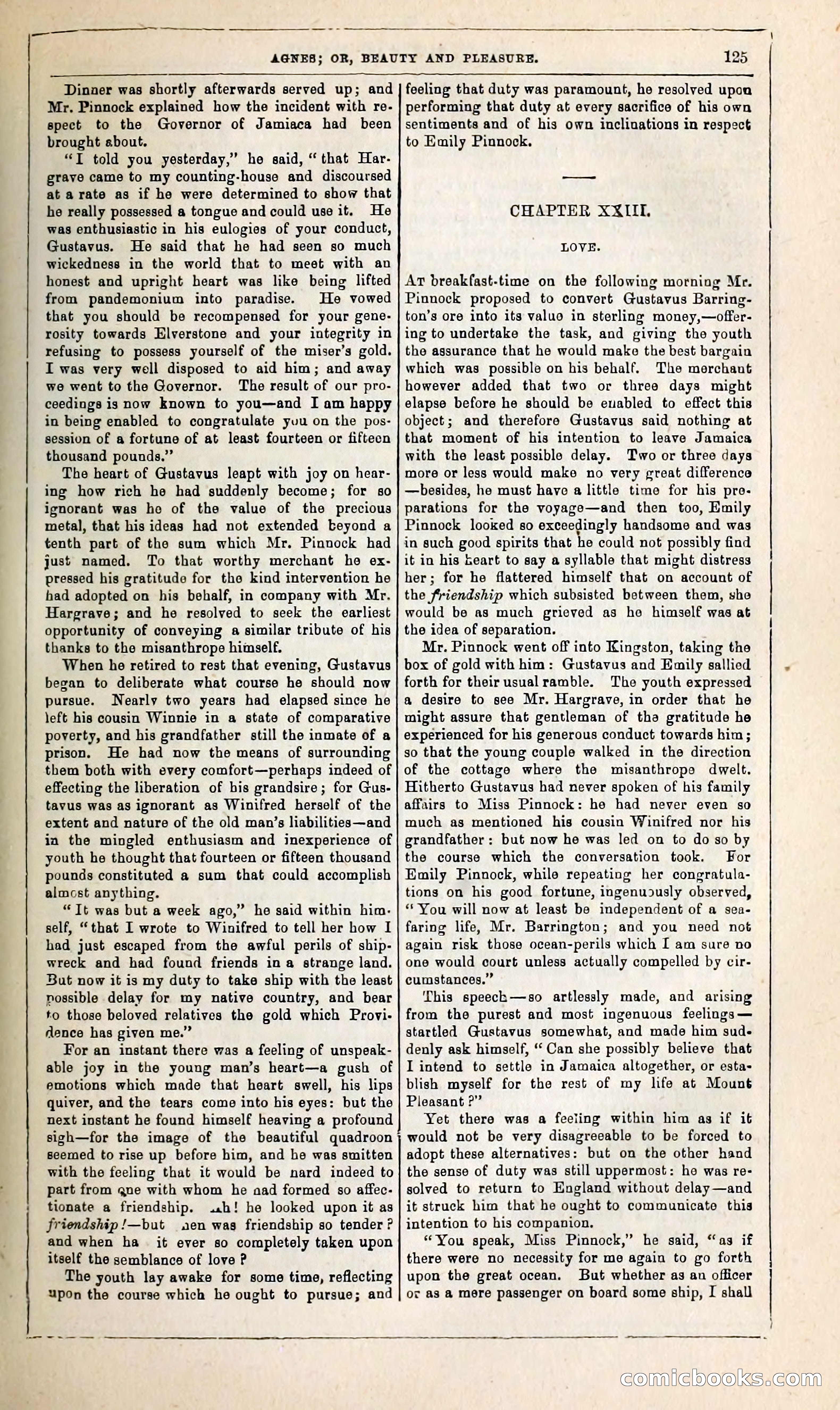
A restored page from Penny Dreadfuls, 1857. Page through the whole issue in the reader above.
📄 Transcribed text from this page (OCR, searchable)
Machine-transcribed from the original scan — historical spelling and the odd misread are preserved.
AGNES; OR, BEAUTY AND PLEASURE. 125 Dinner was shortly afterwards served up; and Mr. Pinnock explained how the incident with re- spect to the Governor of Jamiaca had been brought about. “T told you yesterday,” he said, “that Har- graye came to my counting-house and discoursed at arate as if he were determined to show that he really possessed a tongue and could use it. He was enthusiastic in his eulogies of your conduct, Gustavus. He said that he had seen so much wickedness in the world that to meet with an honest and upright heart was like being lifted from pandemonium into paradise. He vowed that you should be recompensed for your gene- rosity towards Elverstone and your integrity in refusing to possess yourself of the miser’s gold. I was very well disposed to aid him; and away we went to the Governor. The result of our pro- ceedings is now known to you—and I am happy in being enabled to congratulate yuu on the pos- session of a fortune of at least fourteen or fiftecn thousand pounds.” The heart of Gustavus leapt with joy on hear- ing how rich he had suddenly become; for so ignorant was he of the value of the precious metal, that his ideas had not extended beyond a tenth part of the sum which Mr. Pinnock had just named. To that worthy merchant he ex- pressed his gratitude for the kind intervention he had adopted on his behalf, in company with Mr. Hargrave; and he resolved to seek the earliest opportunity of conveying a similar tribute of his thanks to the misanthrope himself. When he retired to rest that evening, Gustavus bezan to deliberate what course he should now pursue. Nearly two years had elapsed since he left his cousin Winnie in a state of comparative poverty, and his grandfather still the inmate of a prison. He had now the means of surrounding them both with every comfort—perhaps indeed of effecting the liberation of bis grandsire; for Gus- tavus was as ignorant as Winifred herself of the extent and nature of the old man’s liabilities—and in the mingled enthusiasm and inexperience of youth he thought that fourteen or fifteen thousand pounds constituted a sum that could accomplish almost anything. “It was but a week ago,” he said within him. self, “that I wrote to Winifred to tell her how I had just escaped from the awful perils of ship- wreck and had found friends in a strange land. But now it is my duty to take ship with the least nossible delay for my native country, and bear to those beloved relatives the gold which Provi- fence has given me.” For an instant there was a feeling of unspeak- able joy in the young man’s heart—a gush of emotions which made that heart swell, his lips quiver, and the tears come into his eyes: but the next instant he found himself heaving a profound sigh—for the image of the beautiful quadroon seemed to rise up before him, and he was smitten with the feeling that it would be nard indeed to part from gne with whom he aad formed so affec- tionate a friendship. .sh! he looked upon it as jriendship!—but sen was friendship so tender? and when ha _ it ever so completely taken upon itself the semblance of love P The youth lay awake for some time, reflecting upon the course which he ought to pursue; and feeling that duty was paramount, he resolved upon performing that duty at every sacrifice of his own sentiments and of his own incliuations in respect to Emily Pinnock. —— CHAPTER XXIIL LOVE. Av breakfast-time on the following morning Mr. Pinnock proposed to convert Gustavus Barring- ton’s ore into its valuo in sterling money,—offer- ing to undertake the task, and giving the youth the assurance that he would make the best bargain which was possible on his behalf. The merchant however added that two or three days might elapse before he should be euabled to effect this object; and therefore Gustavus said nothing at that moment of his intention to leave Jamaica with the least possible delay. Two or three days more or less would make no very great difference —besides, he must havo a little time for his pre- parations for the voyage—and then too, Emily Pinnock looked so exceedingly handsome and was in such good spirits that he could not possibly find it in his beart to say a syllable that might distress her; for he flattered himself that on account of the friendship which subsisted between them, she would be as much grieved as he himself was at the idea of separation. Mr. Pinnock went off into Kingston, taking the box of gold with him: Gustavus and Emily sallied forth for their usualramble. The youth expressed a desire to see Mr. Hargrave, in order that he might assure that gentleman of tha gratitude he experienced for his generous conduct towards him; so that the young couple walked in the direction of the cottage where the misanthrope dwelt. Hitherto Gustavus had never spoken of his family affairs to Miss Pinnock: he had never even so much as mentioned his cousin Winifred nor his grandfather : but now he was led on to do so by the course which the conversation took. For Emily Pinnock, while repeating her congratula- tions on his good fortune, ingenudusly observed, **'You will now at least be independent of a sea- faring life, Mr. Barrington; and you need not again risk those ocean-perils which I am sure no one would court unless actually compelled by cir- cumstances.” ‘This speech—so artlessly made, and arising from the purest and most ingenuous feelings — startled Gustavus somewhat, and made him sude denly ask himself, ‘‘ Can she possibly believe that I intend to settle in Jamaica altogether, or esta- blish myself for the rest of my life at Mount Pleasant ?” Yet there was a feeling within him as if it would not be very disagreeable to be forced to adopt these alternatives: but on the other hand the sense of duty was still uppermost: hoe was re- solved to return to England without delay —and it struck him that he ought to communicate this intention to his companion. “You speak, Miss Pinnock,” he said, “as if there were no necessity for me again to go forth upon the great ocean. But whether as an officer or as & mere passenger on board some ship, I shall Comiclbooolks Oimn