
Penny Dreadfuls, 1857 · page 122 of 394
Agnes, or, Beauty and Pleasure — page 122: what you’re looking at
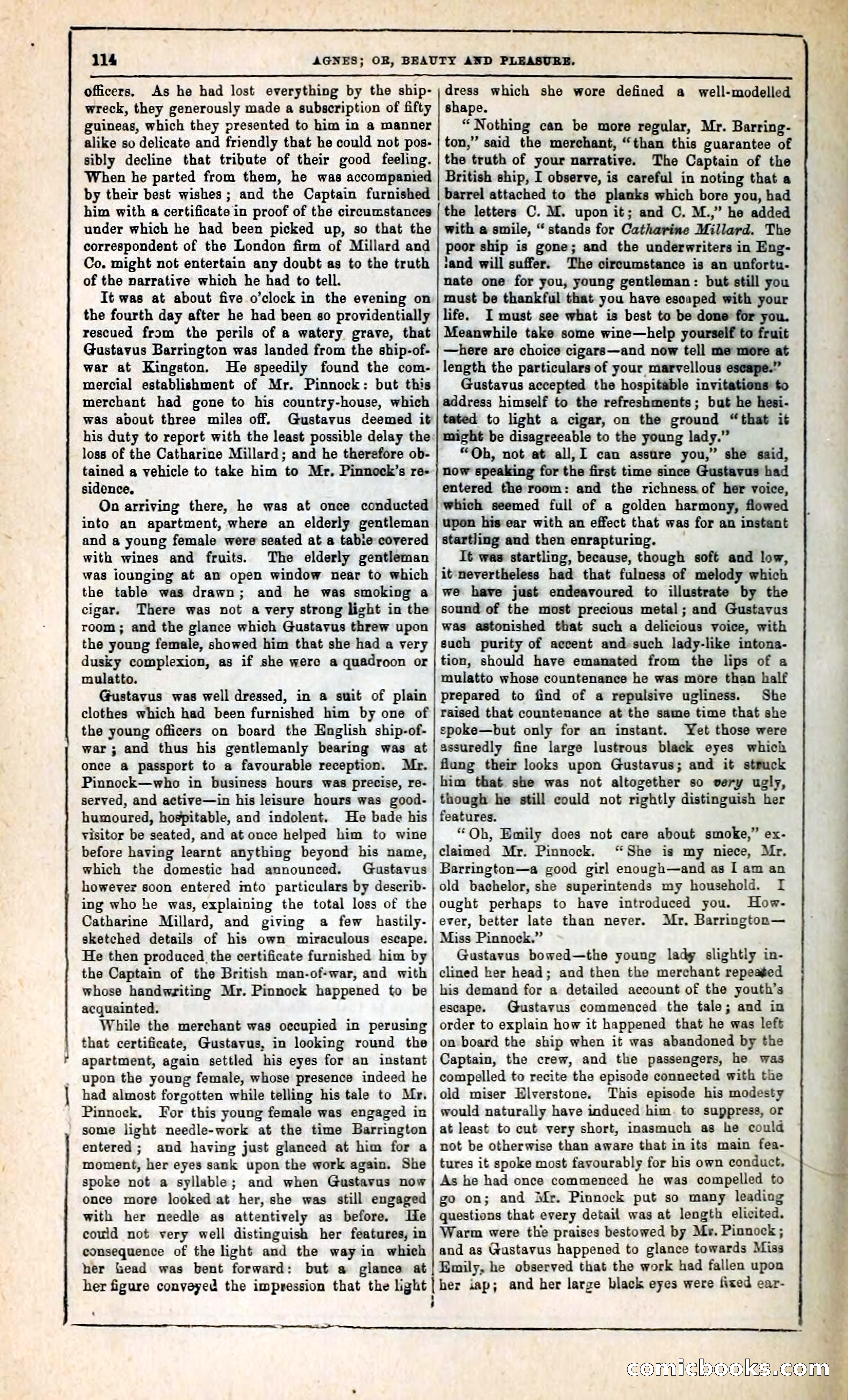
A restored page from Penny Dreadfuls, 1857. Page through the whole issue in the reader above.
📄 Transcribed text from this page (OCR, searchable)
Machine-transcribed from the original scan — historical spelling and the odd misread are preserved.
—_—__—_——— a 114 officers, As he had lost everything by the ship- wreck, they generously made a subscription of fifty guineas, which they presented to him in a manner alike so delicate and friendly that he could not pos- sibly decline that tribute of their good feeling. When he parted from them, he was accompanied by their best wishes; and the Captain furnished him with a certificate in proof of the circumstances under which he had been picked up, so that the correspondent of the London firm of Millard and Co. might not entertain any doubt as to the truth of the narrative which he had to tell. It was at about five o’clock in the evening on the fourth day after he had been so providentially rescued from the perils of a watery grave, that Gustavus Barrington was landed from the ship-of- war at Kingston. He speedily found the com- mercial establishment of Mr. Pinnock: but this merchant had gone to his country-house, which was about three miles off. Gustavus deemed it his duty to report with the least possible delay the: loss of the Catharine Millard; and he therefore ob- tained a vehicle to take him to Mr. Pinnock’s re- sidence. On arriving there, he was at once conducted into an apartment, where an elderly gentleman and a young female were seated at a tabie covered with wines and fruits. The elderly gentleman was lounging at am open window near to which the table was drawn; and he was smoking a cigar. There was not a very strong light in the room; and the glance which Gustavus threw upon the young female, showed him that she had a very dusky complexion, as if she were a quadroon or mulatto. Gustavus was well dressed, in a suit of plain clothes which had been furnished him by one of the young officers on board the English ship-of- war; and thus his gentlemanly bearing was at once a passport to a favourable reception. Mr. Pinnock—who in business hours was precise, re- served, and active—in his leisure hours was good- humoured, hospitable, and indolent. He bade his visitor be seated, and at once helped him to wine before having learnt anything beyond his name, which the domestic had announced. Gustavus however soon entered mto particulars by describ- ing who he was, explaining the total loss of the Catharine Millard, and giving a few hastily- sketched details of his own miraculous escape. He then produced the certificate furnished him by the Captain of the British man-of-war, and with whose handwriting Mr. Pinnock happened to be acquainted. While the merchant was oecupied in perusing that certificate, Gustavus, in looking round the apartment, again settled his eyes for an instant upon the young female, whose presence indeed he had almost forgotten while telling his tale to Mr, Pinnock. For this young female was engaged in some light needle-work at the time Barrington entered; and having just glanced at him for a moment, her eyes sank upon the work again. She spoke not a syllable; and when Gastavus now once more looked at her, she was still engaged with her needle as attentively as before. He could not very well distinguish her features, in consequence of the light and the wayin which her Gead was bent forward: but a glance at AGNES; OR, BEAUTY AND PLEASURE. dress which she wore defined a well-modelled shape. “Nothing can be more regular, Mr. Barring- ton,” said the merchant, “than this guarantee of the truth of your narrative. The Captain of the British ship, I observe, is careful in noting that a barrel attached to the planks which bore you, had the letters C. M. upon it; and C. M.,” he added with a smile, “ stands for Catharine Millard. The poor ship is gone; and the underwriters in Eng- iand will suffer. The circumstance is an unfortu- nate one for you, young gentleman: but still you must be thankful that you have escaped with your life. I must see what is best to be done for you. Meanwhile take some wine—help yourself to fruit —here are choice cigars—and now tell me more at length the particulars of your marvellous escape.” Gustavus accepted the hospitable invitations to address himself to the refreshments; but he hesi- tated to light a cigar, on the ground “that it might be disagreeable to the young lady.” “Oh, not at all, can assure you,” she said, now speaking for the first time since Gustavus had entered the room: and the richness of her voice, which seemed full of a golden harmony, flowed upon his'ear with an effect that was for an instant startling and then enrapturing. It was startling, because, though soft and low, it'nevertheless had that fulness of melody which we have just endeavoured to illustrate by the sound of the most precious metal; and Gustavus was astonished that such a delicious voice, with such purity of accent and such lady-like intona- tion, should have emanated from the lips of a mulatto whose countenance he was more than half prepared to find of a repulsive ugliness. She raised that countenance at the same time that she epoke—but only for an instant. Yet those were assuredly fine large lustrous black eyes which flung their looks upon Gustavus; and it st®fuck him that she was not altogether so very ugly, though he still could not rightly distinguish her features. “Oh, Emily does not care about smoke,” ex- claimed Mr. Pinnock. “She is my niece, Mr. Barrington—a good girl enough—and as I am an old bachelor, she superintends my household. [ ought perhaps to have introduced you. How- ever, better late than never. Mr. Barrington— Miss Pinnock.” Gustavus bowed—the young lady slightly in- clined her head; and then the merchant repeated his demand for a detailed account of the youth’s escape. Gustavus commenced the tale; and in order to explain how it happened that he was left on board the ship when it was abandoned by the Captain, the crew, and the passengers, he was compelled to recite the episode connected with the old miser Hiverstone. This episode his modesty would naturally have induced him. to suppress, or at least to cut very short, inasmuch as he could not be otherwise than aware that in its main fea- tures it spoke most favourably for his own conduct, As he had once commenced he was compelled to go on; and Mr. Pinnock put so many leading questions that every detail was at length elicited. Warm were the praises bestowed by Mr. Pinnock ; and as Gustavus happened to glance towards Miss Emily, he observed that the work had fallen upon her figure conveyed the impression that the light | her iap; and her large black eyes were fixed ear- Ccomlelooolks i , COL