
Penny Dreadfuls, 1857 · page 102 of 394
Agnes, or, Beauty and Pleasure — page 102: what you’re looking at
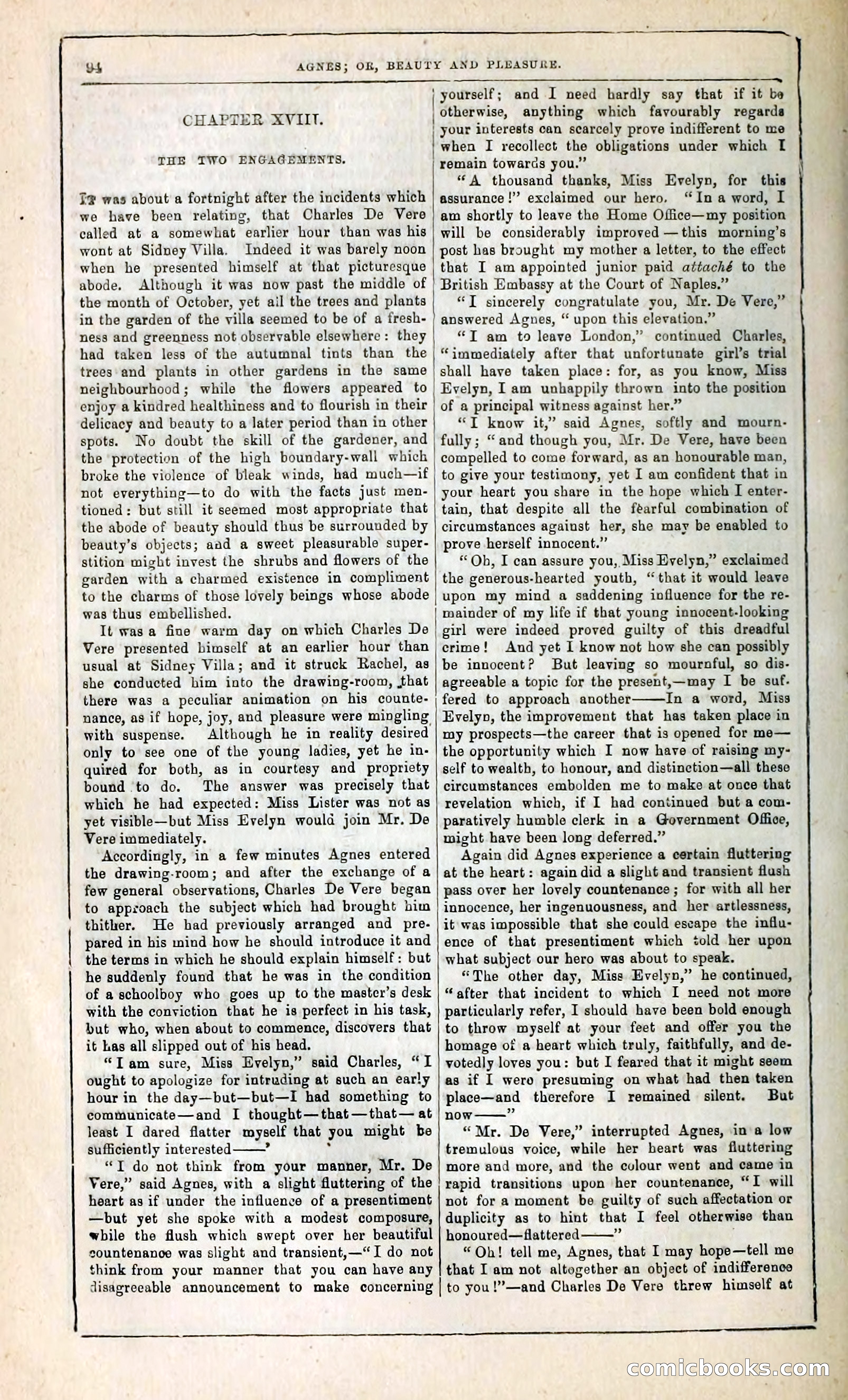
A restored page from Penny Dreadfuls, 1857. Page through the whole issue in the reader above.
📄 Transcribed text from this page (OCR, searchable)
Machine-transcribed from the original scan — historical spelling and the odd misread are preserved.
AGNES; OR, BEAUTY AND PLEASURE. CHAPTER XVIIT. THE TWO ENGAGEMENTS. Te was about a fortnight after the incidents which we have been relating, that Charles De Vere called at a somewhat earlier hour than was his wont at Sidney Villa. Indeed it was barely noon when he presented himself at that picturesque abode. Although it was now past the middle of the month of October, yet ail the trees and plants in the garden of the villa seemed to be of a fresh- ness and greenness not observable elsewhere : they had taken less of the autumnal tints than the trees and plants in other gardens in the same_ neighbourhood; while the flowers appeared to_ enjoy a kindred healthiness and to flourish in their | delicacy and beauty to a later period than in other spots. No doubt the skill of the gardener, and the protection of the high boundary-wall which broke the violence of bleak winds, had much—if not everything—to do with the facts just men- tioned: but still it seemed most appropriate that the abode of beauty should thus be surrounded by beauty’s objects; and a sweet pleasurable super- stition might invest the shrubs and flowers of the garden with a charmed existence in compliment to the charms of those lovely beings whose abode was thus embellished. It was a fine warm day on which Charles De Vere presented himself at an earlier hour than usual at Sidney Villa; and it struck Rachel, as she conducted him into the drawing-room, ,that there was a peculiar animation on his counte- nance, as if hope, joy, and pleasure were mingling with suspense. only to see one of the young ladies, yet he in- quired for both, as in courtesy and propriety bound ‘to do. The answer was precisely that which he had expected: Miss Lister was not as yet visible—but Miss Evelyn would join Mr. De Vere immediately. Accordingly, in a few minutes Agnes entered the drawing-room; and after the exchange of a few general observations, Charles De Vere began to approach the subject which had brought him thither. He had previously arranged and pre- pared in his mind how he should introduce it and the terms in which he should explain himself: but he suddenly found that he was in the condition of a schoolboy who goes up to the master’s desk with the conviction that he is perfect in his task, but who, when about to commence, discovers that it has all slipped out of his head. “Tam sure, Miss Evelyn,” said Charles, “I ought to apologize for intruding at such an early hour in the day—but—but—I had something to communicate—and I thought— that —that— at least I dared flatter myself that you might be sufficiently interested x : “T do not think from your manner, Mr. De Vere,” said Agnes, with a slight fluttering of the heart as if under the influence of a presentiment —but yet she spoke with a modest composure, while the flush which swept over her beautiful countenanoe was slight and transient,—“I do not think from your manner that you can have any Although he in reality desired eC eS ee | Yourself ; and I need hardly say that if it be otherwise, anything which favourably regards | your interests can scarcely prove indifferent to me when I recollect the obligations under which I remain towards you.” “A thousand thanks, Miss Evelyn, for this assurance !”’ exclaimed our hero. “Ina word, I am shortly to leave the Home Office—my position will be considerably improved —this morning’s post has brought my mother a letter, to the effect that I am appointed junior paid attaché to the British Embassy at the Court of Naples.” “T sincerely congratulate you, Mr. De Vere,” answered Agnes, “ upon this elevation.” “T am to leave London,” continued Charles, he immediately after that unfortunate girl’s trial shall have taken place: for, as you know, Miss Evelyn, Iam unhappily thrown into the position of a principal witness against her.” “T know it,” said Agnes, softly and mourn- fully; “and though you, Mr. De Vere, have been compelled to come forward, as an honourable man, to give your testimony, yet I am confident that in your heart you share in the hope which I enter- tain, that despite all the fearful combination of circumstances against her, she may be enabled to prove herself innocent.” “Ob, I can assure you, Miss Bvelyn,” exclaimed the generous-hearted youth, “that it would leave upon my mind a saddening influence for the re- mainder of my life if that young innocent-looking girl were indeed proved guilty of this dreadful crime! And yet I know not how she can possibly be innocent? But leaving so mournful, so dis- agreeable a topic for the present,—may I be suf. fered to approach another In a word, Miss Evelyn, the improvement that has taken place in my prospects—the career that is opened for me— the opportunity which I now have of raising my- self to wealth, to honour, and distinetion—all these circumstances embolden me to make at once that revelation which, if I had continued but a com- paratively humble clerk in a Government Office, might have been long deferred.” Again did Agnes experience a certain fluttering at the heart: again did a slight and transient flash pass over her lovely countenance ; for with all her innocence, her ingenuousness, and her artlessness, it was impossible that she could eseape the influ- ence of that presentiment which told her upon what subject our hero was about to speak. “The other day, Miss Evelyn,” he continued, “after that incident to which I need not more particularly refer, I should have been bold enough to throw myself at your feet and offer you the homage of a heart which truly, faithfully, and de- votedly loves you: but I feared that it might seem as if I wero presuming on what had then taken place—and therefore I remained silent. But now ? “Mr. De Vere,” interrupted Agnes, in a low tremulous voice, while her heart was fluttering more and more, and the colour went and came in rapid transitions upon her countenance, “I will not for a moment be guilty of such affectation or duplicity as to hint that I feel otherwise than honoured—flattered r “Oh! tell me, Agnes, that I may hope—tell me that I am not altogether an object of indifference disagreeable announcement to make concerning | to you!”—and Charles De Vere tkrew himself at com Gbooks (E(0) ee ummm ae