
Penny Dreadfuls, 1800 · page 277 of 308
The Child of Waterloo, or, The Horrors of the Battle-Field — page 277: what you’re looking at
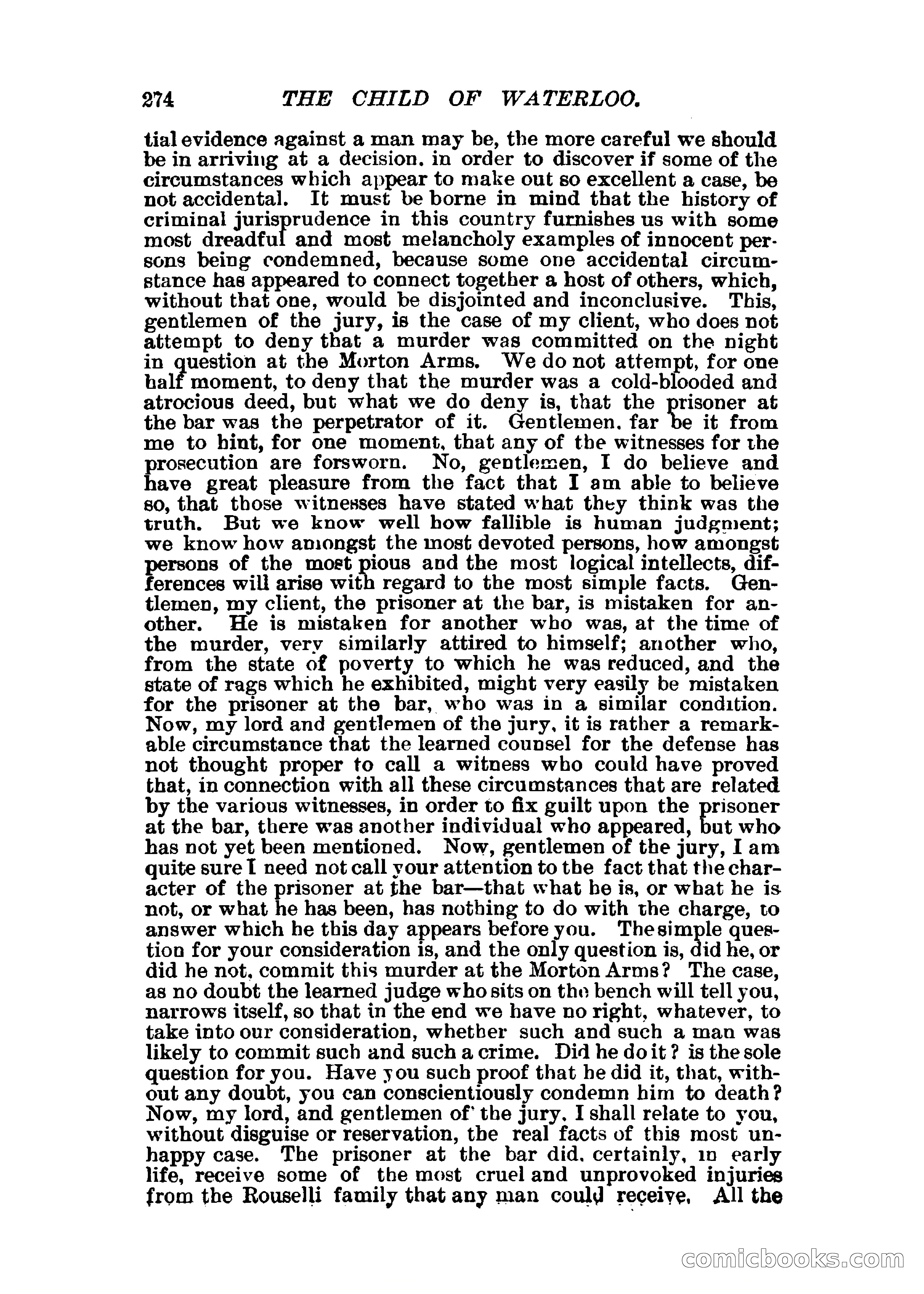
A restored page from Penny Dreadfuls, 1800. Page through the whole issue in the reader above.
📄 Transcribed text from this page (OCR, searchable)
Machine-transcribed from the original scan — historical spelling and the odd misread are preserved.
274 THE CHILD OF WATERLOO. tial evidence against a man may be, the more careful we should be in arriving at a decision. in order to discover if some of the circumstances which appear to make out so excellent a case, be not accidental. It must be borne in mind that the history of criminal jurisprudence in this country furnishes us with some most dreadful and most melancholy examples of innocent per- sons being condemned, because some one accidental circum- stance has appeared to connect together a host of others, which, without that one, would be disjointed and inconclusive. This, gentlemen of the jury, is the case of my client, who does not attempt to deny that a murder was committed on the night in question at the Morton Arms. We do not attempt, for one half moment, to deny that the murder was a cold-blooded and atrocious deed, but what we do deny is, that the prisoner at the bar was the perpetrator of it. Gentlemen. far be it from me to hint, for one moment, that any of the witnesses for the prosecution are forsworn. No, gentlemen, I do believe and have great pleasure from the fact that I am able to believe so, that those witnesses have stated what they think was the truth. But we know well how fallible is human judgment; we know how anongst the most devoted persons, how amongst persons of the most pious and the most logical intellects, dif- ferences will arise with regard to the most simple facts. Gen- tlemen, my client, the prisoner at the bar, is mistaken for an- other. He is mistaken for another who was, at the time of the murder, very similarly attired to himself; another who, from the state of poverty to which he was reduced, and the state of rags which he exhibited, might very easily be mistaken for the prisoner at the bar, who was in a similar condition. Now, my lord and gentlemen of the jury, it is rather a remark- able circumstance that the learned counsel for the defense has not thought proper to call a witness who could have proved that, in connection with all these circumstances that are related by the various witnesses, in order to fix guilt upon the prisoner at the bar, there was another individual who appeared, but who has not yet been mentioned. Now, gentlemen of the jury, Iam quite sure I need not call your attention to the fact that the char- acter of the prisoner at the bar—that what he is, or what he is not, or what he has been, has nothing to do with the charge, to answer which he this day appears before you. Thesimple ques- tion for your consideration is, and the only question is, did he, or did he not, commit this murder at the Morton Arms? The case, as no doubt the learned judge who sits on the bench will tell you, narrows itself, so that in the end we have no right, whatever, to take into our consideration, whether such and such a man was likely to commit such and suchacrime. Did he doit? is the sole question for you. Have you such proof that he did it, that, with- out any doubt, you can conscientiously condemn him to death? Now, my lord, and gentlemen of’ the jury, I shall relate to you, without disguise or reservation, the real facts of this most un- happy case. The prisoner at the bar did. certainly, 1n early life, receive some of the most cruel and unprovoked injuries from the Rouselli family that any man could receive, All the comicbooks. com