
Penny Dreadfuls, 1800 · page 260 of 308
The Child of Waterloo, or, The Horrors of the Battle-Field — page 260: what you’re looking at
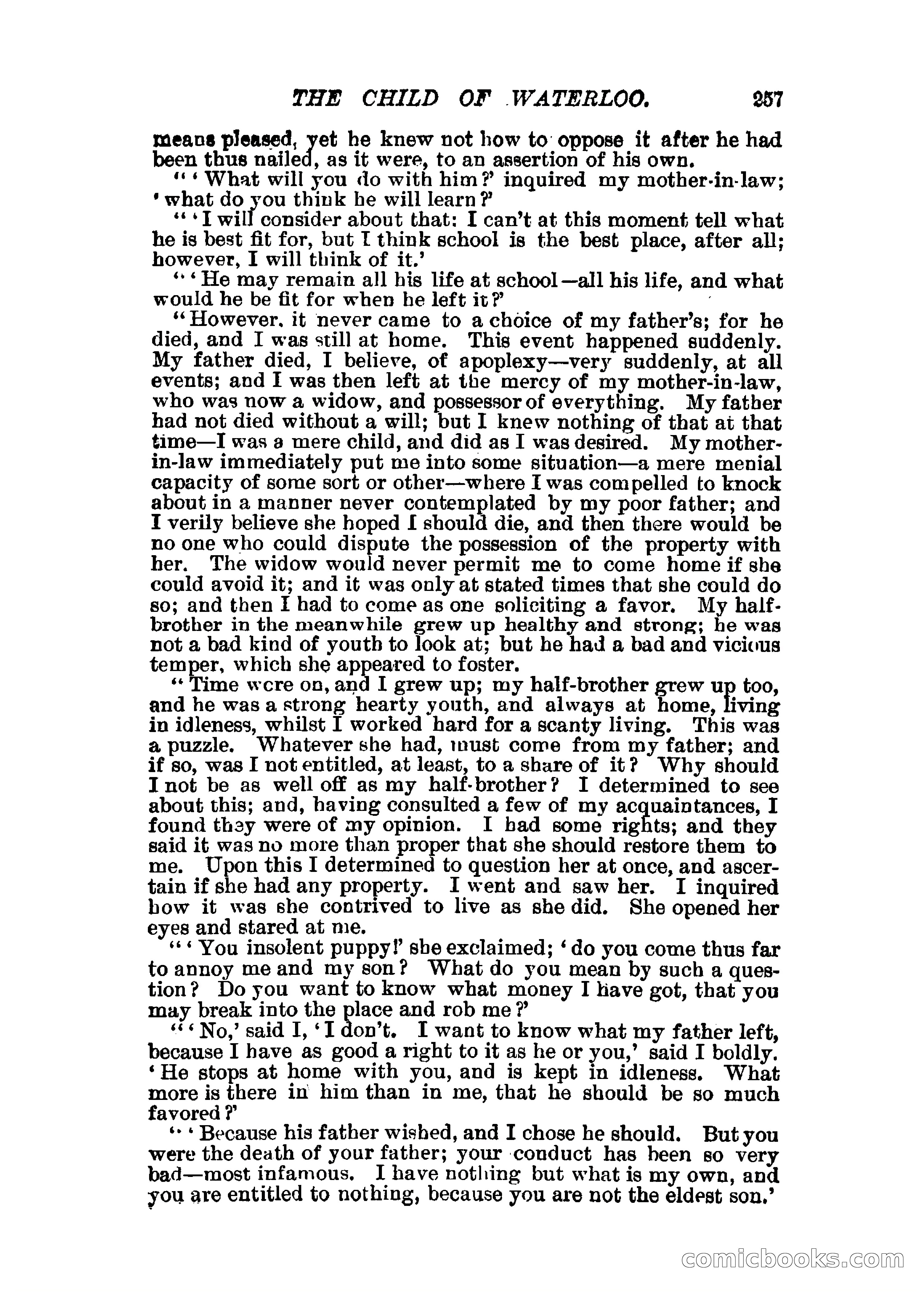
A restored page from Penny Dreadfuls, 1800. Page through the whole issue in the reader above.
📄 Transcribed text from this page (OCR, searchable)
Machine-transcribed from the original scan — historical spelling and the odd misread are preserved.
THE CHILD OF WATERLOO, 257 means pleased, yet he knew not how to oppose it after he had been thus nailed, as it were, to an assertion of his own. ‘© * What will you do with him? inquired my mother-in-law; ‘what do you think he will learn? ‘*+T will consider about that: I can’t at this moment tell what he is best fit for, but I think school is the best place, after all; however, I will think of it.’ “ «He may remain all his life at school —all his life, and what would he be fit for when he left it? “* However, it never came to achoice of my father’s; for he died, and I was still at home. This event happened suddenly. My father died, I believe, of apoplexy—very suddenly, at all events; and I was then left at the mercy of my mother-in-law, who was now a widow, and possessor of everything. My father had not died without a will; but I knew nothing of that ai that time—I was a mere child, and did as I was desired. My mother- in-law immediately put me into some situation—a mere menial capacity of some sort or other—where I was compelled to knock about in a manner never contemplated by my poor father; and I verily believe she hoped [ should die, and then there would be no one who could dispute the possession of the property with her. The widow would never permit me to come home if she could avoid it; and it was only at stated times that she could do so; and then I had to come as one soliciting a favor. My half- brother in the meanwhile grew up healthy and strong; he was not a bad kind of youth to look at; but he had a bad and vicious temper, which she appeared to foster. ‘* Time wcre on, and I grew up; my half-brother grew up too, and he was a strong hearty youth, and always at home, living in idleness, whilst I worked hard for a scanty living. This was a puzzle. Whatever she had, tnust come from my father; and if so, was I not entitled, at least, to a share of it? Why should I not be as well off as my half-brother? I determined to see about this; and, having consulted a few of my acquaintances, I found thay were of my opinion. I bad some rights; and they said it was no more than proper that she should restore them to me. Upon this I determined to question her at once, and ascer- tain if she had any property. I went and saw her. I inquired how it was she contrived to live as she did. She opened her eyes and stared at me. ‘** You insolent puppy! she exclaimed; ‘do you come thus far to annoy me and my son? What do you mean by such a ques- tion? Do you want to know what money I have got, that you may break into the place and rob me?’ “**No,’ said I, ‘I don’t. I want to know what my father left, because I have as good a right to it as he or you,’ said I boldly. ‘He stops at home with you, and is kept in idleness. What more is there in him than in me, that he should be so much favored ?” ‘- * Because his father wished, and I chose he should. But you were the death of your father; your conduct has heen so very bad—most infamous. IJ have nothing but what is my own, and you are entitled to nothing, because you are not the eldest son,’ comicbooks. com