
The Show World in Print
The New York Clipper
America's theatrical and sporting weekly — the stage, the circus, the minstrel troupe, the prize ring, the turf, and the young game of baseball, all in one crowded newsstand paper. Its engraved front pages are the picture-record of 19th-century popular entertainment, and a direct ancestor of Variety and Billboard.
The New York Clipper was, for most of its life, the paper American show business could not do without. It was founded in 1853, and within a couple of years Frank Queen — printer, sportsman, and its guiding editor for three decades — had made it the weekly record of everything that entertained a mid-century American public. In its pages the theater shared space with the prize ring, the minstrel show with the trotting track, the circus with the billiard hall and the earliest box scores of a game called base ball. It was cheap, it was crowded with type, and it was read on both sides of the footlights.
The trade paper of the stage
What set the Clipper apart was that it treated popular amusement as a business worth reporting seriously. It printed routes and bookings, salaries and disputes, benefit notices and obituaries; a performer far from home learned from the Clipper who was playing where, and whether the house had paid. Its correspondents wrote from towns up and down the country, and its "answers to correspondents" column settled bets and rules for a nation of sporting men. To be listed in the Clipper was to exist professionally.
Pictures on the newsstand
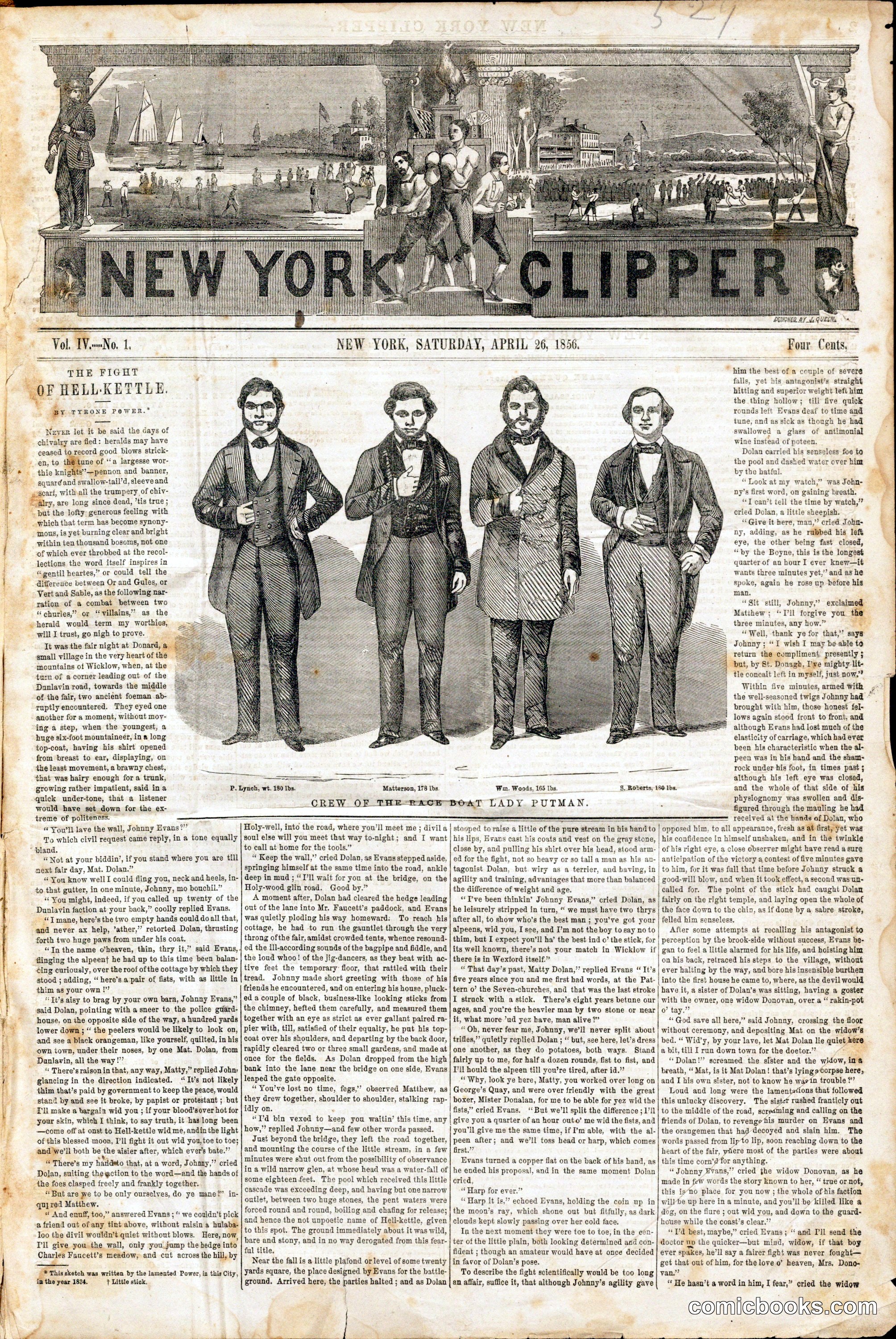
The front page carried the paper's real signature: a heavy engraved masthead and, week by week, a portrait block — a champion boxer stripped for the ring, a celebrated trotter, a stage star, a strongman. These wood engravings were not fine art and were never meant to be. They were the cheap, bold, reproducible pictures of the penny press, printed fast and read at a glance, and they helped teach a mass audience to take its news and its heroes in images as much as in words — the same habit the comic strip and the comic book would later inherit.
A timeline
- 1853The New York Clipper is founded as a weekly of the theater and the sporting world.
- 1855Frank Queen takes control and builds it into the national trade paper of American show business.
- 1856The Vol. IV run gathered here — front pages of stage, ring, and turf, week by week.
- 1861The Clipper begins reporting the young game of base ball, an early press champion of the sport.
- 1882Frank Queen dies; the paper continues under new ownership, still the bible of the stage.
- 1905Variety launches, the brash upstart that will eventually outgrow its elder.
- 1924The Clipper is absorbed by Variety, ending a seventy-year run.
The Clipper outlived nearly everyone it started with. Frank Queen died in 1882, and the paper passed through other hands, but it kept its franchise as the bible of the American stage into the twentieth century, even as the world it covered changed beyond recognition — minstrelsy giving way to variety, variety to vaudeville, the sporting weekly's territory carved up by specialized rivals. In 1924 it was absorbed by Variety, the brasher younger paper that had grown up in its shadow, and the Clipper name effectively went with it; Billboard, born to cover the outdoor and circus trades the Clipper had also served, carried the other half of its inheritance forward.
What survives in these front pages is the look and the reach of nineteenth-century popular entertainment before radio, before film, before the phonograph put a stage in every parlor — a single crowded weekly trying to hold the whole sprawling business of American amusement between two covers. The engravings are rough and the columns are dense, but together they are a photograph of a culture learning to entertain itself at scale, and to read its own celebrities in print and picture. Every issue here is public domain, restored and freely explorable, presented by comicbooks.com.