
Life, 1929-08-16 · page 25 of 36
Life — August 16, 1929 — page 25: what you’re looking at
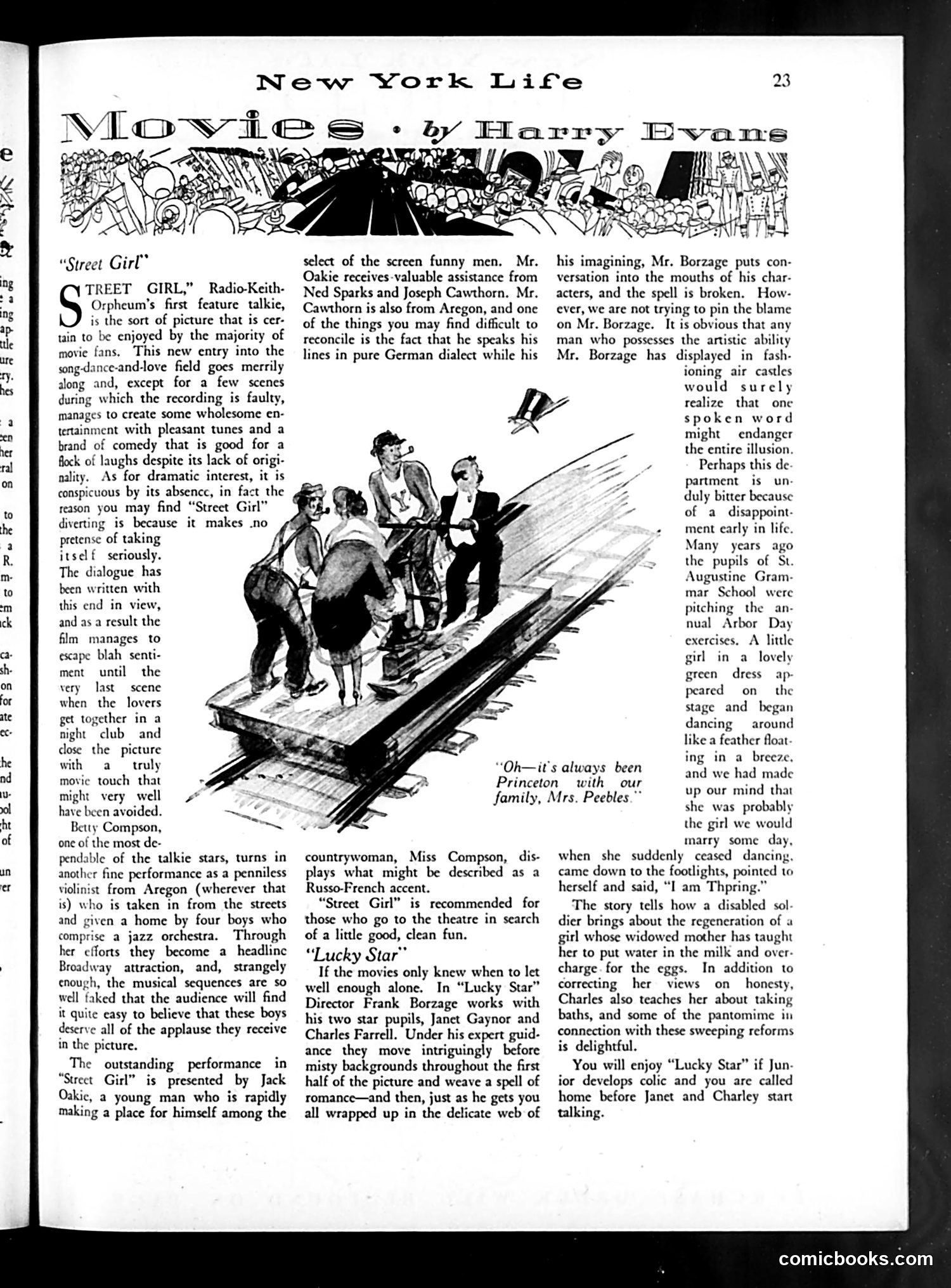
What you’re looking at
This is a film review column by Harry Evans covering two early "talkie" (sound) films from circa 1929. **"Street Girl"** is reviewed as a light musical comedy featuring Betty Compson and Jack Oakie. The reviewer praises its entertainment value while noting it lacks dramatic depth—intentionally so. A humorous observation criticizes the casting inconsistency: Joseph Cawthorn, supposedly from "Aregon," speaks in a German dialect while his scene partner (also from Aregon) uses a "Russo-French accent"—an absurdity the film doesn't acknowledge. **"Lucky Star"** features Frank Borzage directing Janet Gaynor and Charles Farrell. The reviewer criticizes Borzage for adding dialogue to what were effective silent sequences, arguing that spoken words destroy the romantic spell he'd carefully constructed. The critique includes a wry personal anecdote about childhood disappointment—when a dancing girl at an Arbor Day pageant spoke, shattering the reviewer's enchantment. Both reviews reflect early sound cinema's growing pains: the technology was new, and filmmakers hadn't yet mastered balancing visual storytelling with dialogue.
📄 Transcribed text from this page (OCR, searchable)
Machine-transcribed from the original scan — historical spelling and the odd misread are preserved.
eA ck New York Life 23 NIio Ww ie s ° by’ Ls Rete Bwans “Street Girl” TREET GIRL,” Radio-Keith- S Orpheum’s first feature talkie, is the sort of picture that is cer- tain to be enjoyed by the majority of movie fans. This new entry into the songdance: -and-love field goes merrily along and, except for a few scenes during which the recording is faulty, manages to create some wholesome en- tertainment with pleasant tunes and a brand of comedy that is good for a flock of laughs despite its lack of origi- nality. As for dramatic interest, it is conspicuous by its absence, in fact the reason you may find “Street Girl” diverting is because it makes .no pretense of taking itself seriously. The dialogue has been written with this end in view, and as a result the film manages to escape blah senti- ment until the very last scene when the lovers get together in a night’ club and close the picture with a truly movie touch that might very well have been avoided. Betty Compson, one of the most de- pendable of the talkie stars, turns in another fine performance as a penniless violinist from Aregon (wherever that is) who is taken in from the streets and given a home by four boys who comprise a jazz orchestra. Through her efforts they become a headline Broadway attraction, and, strangely enough, the musical sequences are so well faked that the audience will find it quite easy to believe that these boys deserve all of the applause they receive in the picture. The outstanding performance in “Street Girl” is presented by Jack Oakic, a young man who is rapidly making a place for himself among the select of the screen funny men. Mr. Oakie receives-valuable assistance from Ned Sparks and Joseph Cawthorn. Mr. Cawthorn is also from Aregon, and one of the things you may find difficult to reconcile is the fact that he speaks his lines in pure German dialect while his “Oh—it's always been Princeton family, Mrs. Peebles.” countrywoman, Miss Compson, dis- plays what might be described as a Russo-French accent. “Street Girl” is recommended for those who go to the theatre in search of a little good, clean fun. “Lucky Star” If the movies only knew when to let well enough alone. In “Lucky Star” Director Frank Borzage works with his two star pupils, Janet Gaynor and Charles Farrell. Under his expert guid- ance they move intriguingly before misty backgrounds throughout the first half of the picture and weave a spell of romance—and then, just as he gets you all wrapped up in the delicate web of his imagining, Mr. Borzage puts con- versation into the mouths of his char- acters, and the spell is broken. How- ever, We are not trying to pin the blame on Mr. Borzage. It is obvious that any man who possesses the artistic ability Mr. Borzage has displayed in fash- ioning air castles would surely realize that one spoken word might — endanger the entire illusion. Perhaps this de partment is un- duly bitter because of a disappoint- ment early in life. Many years ago the pupils of St. Augustine Gram- mar School were pitching the an- nual Arbor Day exercises. A little girl in a lovely green dress ap- peared on the stage and began dancing around like a feather float ing in a breeze, and we had made up our mind that she was probably the girl we would marry some day, when she suddenly ceased dancing, came down to the footlights, pointed to herself and said, “I am Thpring.” The story tells how a disabled sol- dier brings about the regeneration of a girl whose widowed mother has taught her to put water in the milk and over- charge. for the eggs. In addition to correcting her views on honesty, Charles also teaches her about taking baths, and some of the pantomime in connection with these sweeping reforms is delightful. You will enjoy “Lucky Star” if Jun- ior develops colic and you are called home before Janet and Charley start talking. with our comicbooks.com