
Life, 1929-07-19 · page 9 of 36
Life — July 19, 1929 — page 9: what you’re looking at
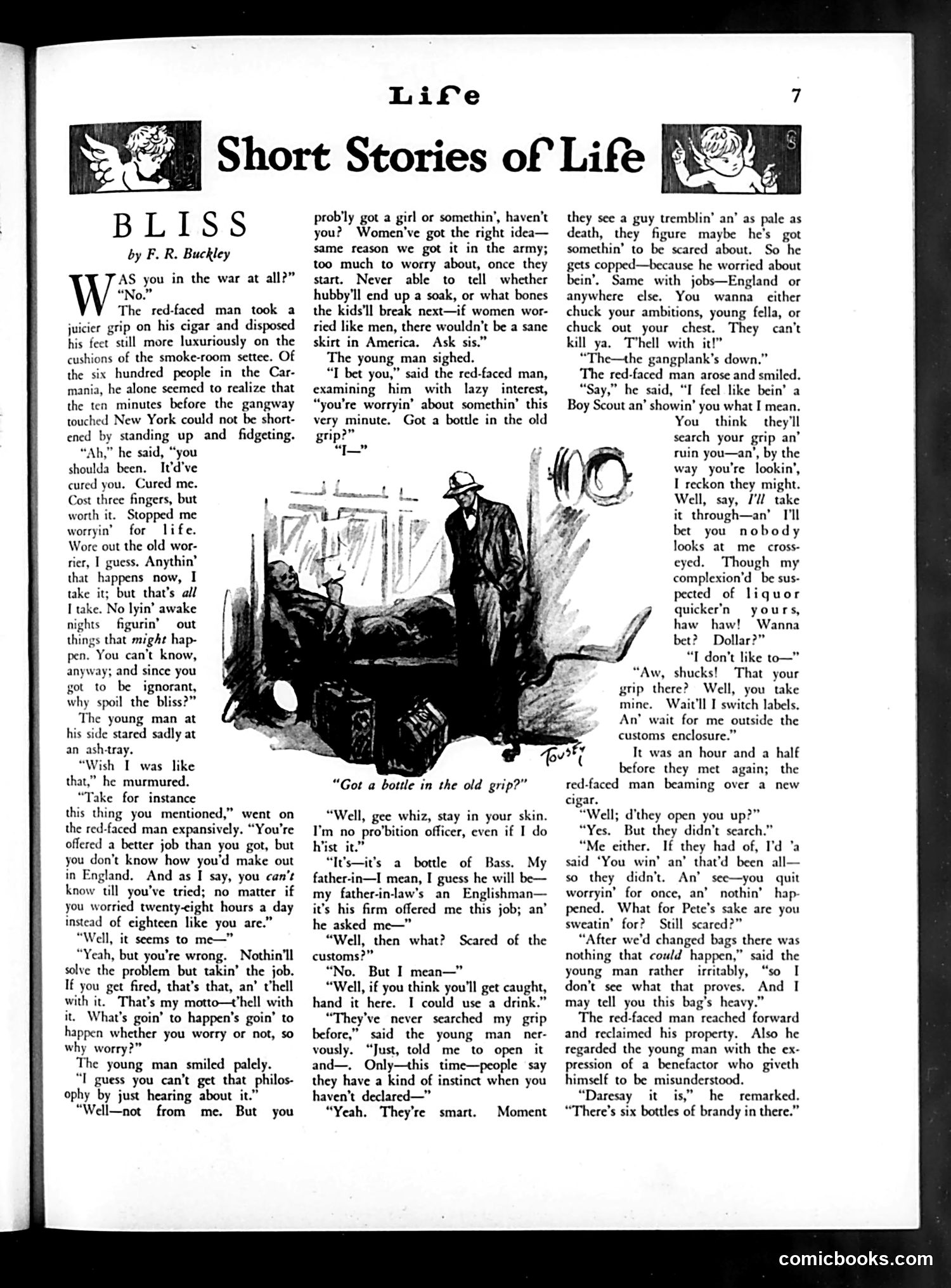
What you’re looking at
This story depicts a post-WWI encounter between a war veteran and a young soldier. The red-faced man, apparently a seasoned soldier, counsels the anxious younger man about wartime worries—romantic concerns, job prospects, and military discipline. The satire targets the romanticized notion of military service. The veteran's cynical philosophy—"take it" and stop worrying—contrasts with the young soldier's anxieties. The story mocks both the recruit's naive fears and the hardened soldier's attempt to project toughness and indifference. The "bliss" referenced in the title appears ironic: true peace comes from accepting life's uncertainties rather than fearing them. The tale critiques how war strips idealism and replaces it with resigned fatalism among servicemen.
📄 Transcribed text from this page (OCR, searchable)
Machine-transcribed from the original scan — historical spelling and the odd misread are preserved.
Life Short Stories of Life BLISS by F. R. Buckley AS you in the war at all?” \ \ ] “No.” The red-faced man took a juicier grip on his cigar and disposed his feet still more luxuriously on the cushions of the smoke-room settee. Of the six hundred people in the Car- mania, he alone seemed to realize that the ten minutes before the gangway touched New York could not be short- ened by standing up and fidgeting. “Ah,” he said, “you shoulda been. It’d’ve cured you, Cured me. Cost three fingers, but worth it. Stopped me worryin’ for life. Wore out the old wor- rier, | guess. Anythin’ that happens now, I take it; but that’s all I take. No lyin’ awake nights figurin’ out things that might hap- pen. You can’t know, anyway; and since you got to be ignorant, why spoil the bliss?” The young man at his side stared sadly at an ash-tray. “Wish I was like that,” he murmured. “Take for instance this thing you mentioned,” went on the red-faced man expansively. “You're offered a better job than you got, but you don’t know how you'd make out in England. And as I say, you can’t know till you've tried; no matter if you worried twenty-eight hours a day instead of eighteen like you are.” “Well, it seems to me—' “Yeah, but you're wrong. Nothin'll solve the problem but takin’ the job. If you get fired, that’s that, an’ t’hell with it. That's my motto—t’hell with it. What's goin’ to happen’s goin’ to happen whether you worry or not, so why worry?” The young man smiled palely. “I guess you can’t get that philos- ophy by just hearing about it.” “Well—not from me. But you prob'ly got a girl or somethin’, haven’t you? Women've got the right idea— same reason we got it in the army; too much to worry about, once they start. Never able to tell whether hubby'll end up a soak, or what bones the kids’ll break next—if women wor- ried like men, there wouldn’t be a sane skirt in America. Ask sis.” The young man sighed. “T bet you,” said the red-faced man, examining him with lazy interest, “you're worryin’ about somethin’ this very minute. Got a bottle in the old grip?” “1 “Got a bottle in the old grip?” “Well, gee whiz, stay in your skin. I'm no pro'bition officer, even if I do hist it.” “It's—it’s a bottle of Bass. My father-in—I mean, I guess he will be— my father-in-law's an Englishman— it’s his firm offered me this job; an’ he asked me—” “Well, then what? customs?” “No. But I mean—” “Well, if you think you'll get caught, hand it here. I could use a drink.” “They've never searched my grip before,” said the young man_ner- vously. “Just, told me to open it and—. Only—this time—people say they have a kind of instinct when you haven't declared—” “Yeah. They're smart. Scared of the Moment they see a guy tremblin’ an’ as pale as death, they figure maybe he’s got somethin’ to be scared about. So he gets copped—because he worried about bein’. Same with jobs—England or anywhere else. You wanna cither chuck your ambitions, young fella, or chuck out your chest. They can’t kill ya. T’hell with it!” “The—the gangplank’s down.” The red-faced man arose and smiled. “Say,” he said, “I feel like bein’ a Boy Scout an’ showin’ you what I mean. You think they'll search your grip an’ ruin you—an’, by the way you're lookin’, I reckon they might. Well, say, /'ll take it through—an’ I'll bet you nobody looks at me cross- eyed. Though my complexion'd be sus- pected of liquor quicker'n yours, haw haw! Wanna bet? Dollar?” “T don't like to—” “Aw, shucks! That your grip there? Well, you take mine. Wait'll I switch labels. An’ wait for me outside the customs enclosure.” Tt was an hour and a half before they met again; the red-faced man beaming over a new cigar. “Well; d’they open you up?” “Yes. But they didn’t search.” “Me either. If they had of, I'd ‘a said ‘You win’ an’ that'd been all— so they didn’t. An’ see—you quit worryin’ for once, an’ nothin’ hap- pened. What for Pete’s sake are you sweatin’ for? Still scared?” “After we'd changed bags there was nothing that could happen,” said the young man rather irritably, “so I don’t see what that proves. And I may tell you this bag’s heavy.” The red-faced man reached forward and reclaimed his property. Also he regarded the young man with the ex- pression of a benefactor who giveth himself to be misunderstood. “Daresay it is,” he remarked. “There's six bottles of brandy in there.” comicbooks.com