
Life, 1929-05-10 · page 27 of 44
Life — May 10, 1929 — page 27: what you’re looking at
What you’re looking at
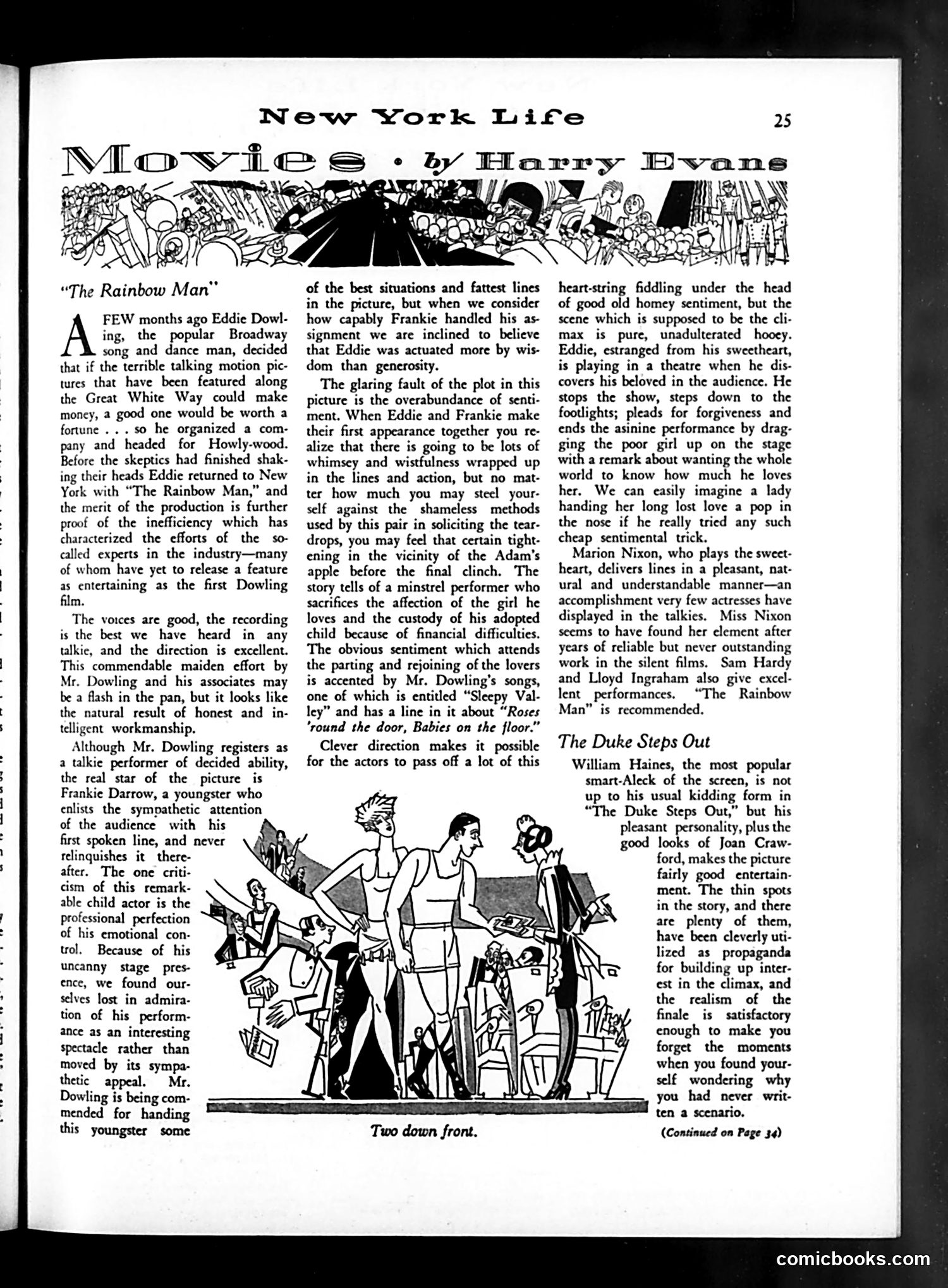
This page reviews Eddie Dowling's early talking picture "The Rainbow Man." The critic praises the film's technical quality (voices, recording, direction) and particularly commends child actor Frankie Darrow's performance, though notes his professionalism is almost *too* perfect—more impressive as spectacle than emotionally moving. The main criticism targets excessive sentimentality in the plot about a minstrel performer who sacrifices love and custody due to financial hardship. The critic finds the climax especially ridiculous: Dowling's character stops a theatrical performance to plead forgiveness from his lost love in the audience, then drags her onstage—behavior the reviewer sarcastically suggests would earn him "a pop in the nose" rather than reconciliation. The illustration depicts this absurd scene. The review represents 1920s film criticism's tension between technical achievement and artistic restraint, mocking Hollywood's then-common use of melodramatic sentiment to manipulate audiences.
📄 Transcribed text from this page (OCR, searchable)
Machine-transcribed from the original scan — historical spelling and the odd misread are preserved.
New York Life “The Rainbow Man” FEW months ago Eddie Dowl- A ing, the popular Broadway song and dance man, decided that if the terrible talking motion pic- tures that have been featured along the Great White Way could make money, a good one would be worth a fortune... so he organized a com- pany and headed for Howly-wood. Before the skeptics had finished shak- ing their heads Eddie returned to New York with “The Rainbow Man,” and the merit of the production is further proof of the inefficiency which has characterized the efforts of the so- called experts in the industry—many of whom have yet to release a feature as entertaining as the first Dowling film. The voices are good, the recording is the best we have heard in any talkie, and the direction is excellent. This commendable maiden effort by Mr. Dowling and his associates may be a flash in the pan, but it looks like the natural result of honest and in- telligent_ workmanship, Although Mr. Dowling registers as a talkie performer of decided ability, the real star of the picture is Frankie Darrow, a youngster who enlists the sympathetic attention of the audience with his first spoken line, and never relinquishes it there- after. The one criti- cism of this remark- able child actor is the professional perfection of his emotional con- tol. Because of his uncanny stage _pres- ence, we found our- selves lost in admira- tion of his perform- ance as an interesting spectacle rather than moved by its sympa- thetic appeal. Mr. Dowling is being com- mended for handing this youngster some of the best situations and fattest lines in the picture, but when we consider how capably Frankie handled his as- signment we are inclined to believe that Eddie was actuated more by wis- dom than generosity. The glaring fault of the plot in this picture is the overabundance of senti- ment. When Eddie and Frankie make their first appearance together you re- alize that there is going to be lots of whimsey and wistfulness wrapped up in the lines and action, but no mat- ter how much you may steel your- self against the shameless methods used by this pair in soliciting the tear- drops, you may feel that certain tight- ening in the vicinity of the Adam's apple before the final clinch. The story tells of a minstrel performer who sacrifices the affection of the girl he loves and the custody of his adopted child because of financial difficulties. The obvious sentiment which attends the parting and rejoining of the lovers is accented by Mr. Dowling’s songs, one of which is entitled “Sleepy Val- ley” and has a line in it about “Roses ‘round the door, Babies on the floor.” Clever direction makes it possible for the actors to pass off a lot of this Two down front. satel elena es ) i: 2: heart-string fiddling under the head of good old homey sentiment, but the scene which is supposed to be the cli- max is pure, unadulterated hooey. Eddie, estranged from his sweetheart, is playing in a theatre when he dis- covers his beloved in the audience. He stops the show, steps down to the footlights; pleads for forgiveness and ends the asinine performance by drag- ging the poor girl up on the stage with a remark about wanting the whole world to know how much he loves her. We can easily imagine a lady handing her long lost love a pop in the nose if he really tried any such cheap sentimental trick. Marion Nixon, who plays the sweet- heart, delivers lines in a pleasant, nat- ural and understandable manner—an accomplishment very few actresses have displayed in the talkies. Miss Nixon seems to have found her element after years of reliable but never outstanding work in the silent films. Sam Hardy and Lloyd Ingraham also give excel- lent performances. “The Rainbow Man” is recommended. The Duke Steps Out William Haines, the most popular smart-Aleck of the screen, is not up to his usual kidding form in “The Duke Steps Out,” but his pleasant personality, plus the good looks of Joan Craw- ford, makes the picture fairly good entertain- ment. The thin spots in the story, and there are plenty of them, have been cleverly uti- lized as propaganda for building up inter- est in the climax, and the realism of the finale is satisfactory enough to make you forget the moments when you found your- self wondering why you had never writ- ten a scenario, (Continued on Page 34) comicbooks.com