
Life, 1929-04-26 · page 22 of 36
Life — April 26, 1929 — page 22: what you’re looking at
What you’re looking at
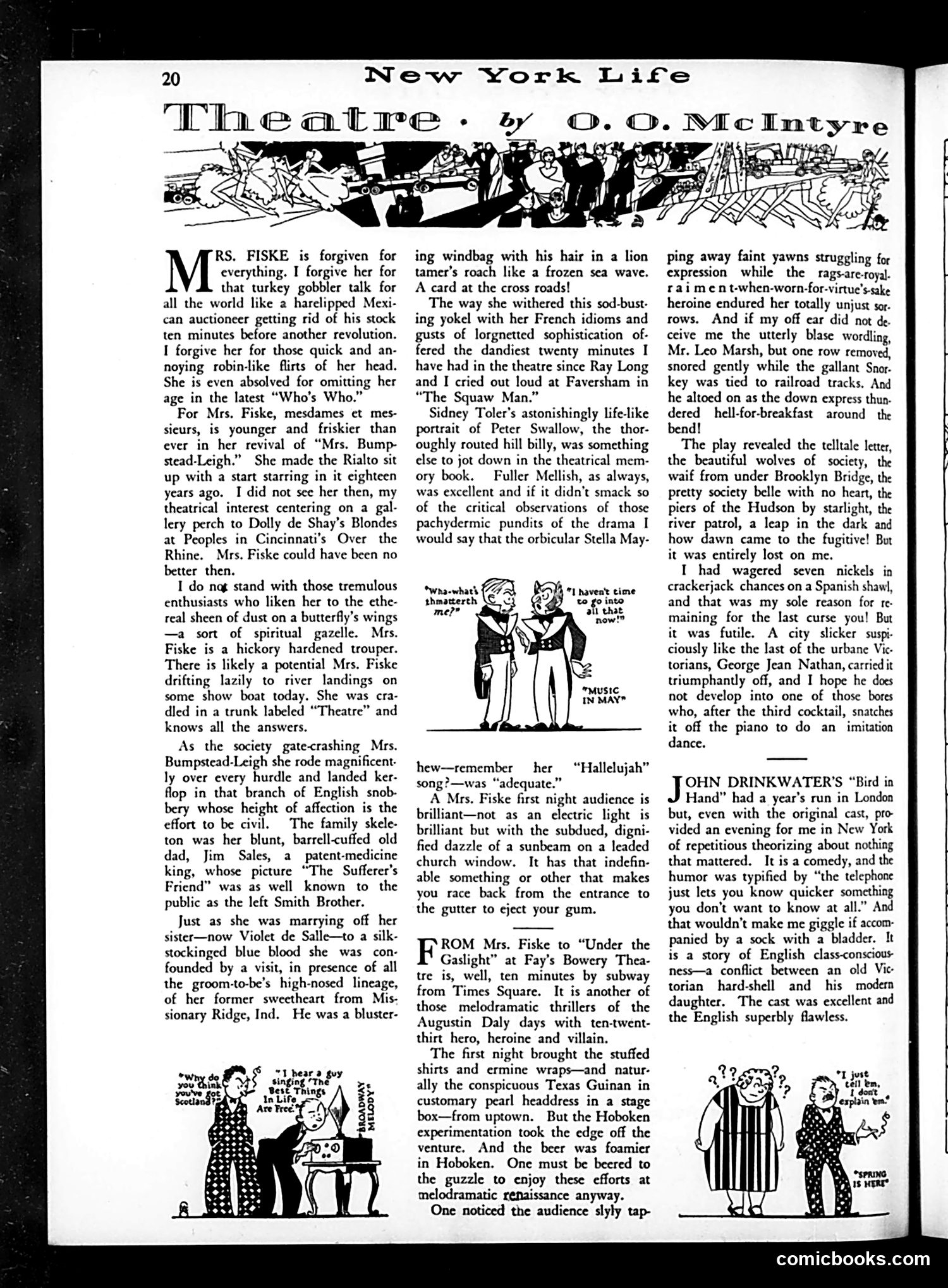
This is O.O. McIntyre's theatre column reviewing two productions. The main subject is actress **Mrs. Fiske** in her revival of "Mrs. Bumpstead-Leigh," a comedy about a socially-climbing woman who tries to hide her crude patent-medicine-king father while marrying off her sister to English nobility. McIntyre praises Fiske as a seasoned professional ("hickory hardened trouper") and celebrates a particular scene where she verbally demolishes a rural suitor using French sophistication. The column also briefly covers "Under the Gaslight" at Fay's Bowery Theatre—a melodrama from the Augustin Daly era. McIntyre notes that **Texas Guinan**, a famous speakeasy hostess, attended in her characteristic pearls, and jokes that the Hoboken location and weak beer diminished the experience. The small cartoons appear to be comic illustrations accompanying the theatrical gossip.
📄 Transcribed text from this page (OCR, searchable)
Machine-transcribed from the original scan — historical spelling and the odd misread are preserved.
20 New York Life RS. FISKE is forgiven for everything. I forgive her for that turkey gobbler talk for all the world like a harelipped Mexi- can auctioneer getting rid of his stock ten minutes before another revolution. I forgive her for those quick and an- noying robin-like flirts of her head. She is even absolved for omitting her age in the latest “Who’s Who.” For Mrs. Fiske, mesdames et mes- sicurs, is younger and friskier than ever in her revival of “Mrs. Bump- stead-Leigh.” She made the Rialto sit up with a start starring in it eighteen years ago. I did not sce her then, my theatrical interest centering on a gal- lery perch to Dolly de Shay’s Blondes at Peoples in Cincinnati's Over the Rhine. Mrs. Fiske could have been no better then. I do na stand with those tremulous enthusiasts who liken her to the ethe- real sheen of dust on a butterfly’s wings —a sort of spiritual gazelle. Mrs. Fiske is a hickory hardened trouper. There is likely a potential Mrs. Fiske drifting lazily to river landings on some show boat today. She was cra- dled in a trunk labeled “Theatre” and knows all the answers. As the society gate-crashing Mrs. Bumpstead-Leigh she rode magnificent. ly over every hurdle and landed ker- flop in that branch of English snob- bery whose height of affection is the effort to be civil. The family skele- ton was her blunt, barrell-cuffed old dad, Jim Sales, a patent-medicine king, whose picture “The Sufferer’s Friend” was as well known to the public as the left Smith Brother. Just as she was marrying off her sister—now Violet de Salle—to a silk- stockinged blue blood she was con- founded by a visit, in presence of all the groom-to-be’s high-nosed lineage, of her former sweetheart from Mis- sionary Ridge, Ind. He was a bluster- "1 hear a singing Fine y Best Things In Life ing windbag with his hair in a lion tamer’s roach like a frozen sea wave. A card at the cross roads! The way she withered this sod-bust- ing yokel with her French idioms and gusts of lorgnetted sophistication of- fered the dandiest twenty minutes I have had in the theatre since Ray Long and I cried out loud at Faversham in “The Squaw Man.” Sidney Toler’s astonishingly life-like portrait of Peter Swallow, the thor- oughly routed hill billy, was something else to jot down in the theatrical mem- ory book. Fuller Mellish, as always, was excellent and if it didn’t smack so of the critical observations of those pachydermic pundits of the drama I would say that the orbicular Stella May- ‘“Lhavent time to go into ail that now!” *wha-whats {77 thmatterth S IN MAY" hew—remember her song?—was “adequate.” A Mrs. Fiske first night audience is brilliant—not as an electric light is brilliant but with the subdued, digni- fied dazzle of a sunbeam on a leaded church window. It has that indefin- able something or other that makes you race back from the entrance to the gutter to eject your gum. “Hallelujah” ROM Mrs. Fiske to “Under the Gaslight” at Fay’s Bowery Thea- tre is, well, ten minutes by subway from Times Square. It is another of those melodramatic thrillers of the Augustin Daly days with ten-twent- thirt hero, heroine and villain. The first night brought the stuffed shirts and ermine wraps—and _natur- ally the conspicuous Texas Guinan in customary pearl headdress in a stage box—from uptown. But the Hoboken experimentation took the edge off the venture. And the beer was foamier in Hoboken. One must be beered to the guzzle to enjoy these efforts at melodramatic renaissance anyway. One noticed the audience slyly tap- ping away faint yawns struggling for expression while the rags-are-royal- raiment-when-worn-for-virtue’s-sake heroine endured her totally unjust sor. rows. And if my off ear did not de. ceive me the utterly blase wordling, Mr. Leo Marsh, but one row removed, snored gently while the gallant Snor. key was tied to railroad tracks. And he altoed on as the down express thun- dered hell-for-breakfast around the bend! The play revealed the telltale letter, the beautiful wolves of society, the waif from under Brooklyn Bridge, the pretty society belle with no heart, the piers of the Hudson by starlight, the river patrol, a leap in the dark and how dawn came to the fugitive! But it was entirely lost on me. I had wagered seven nickels in crackerjack chances on a Spanish shawl, and that was my sole reason for re- maining for the last curse you! But it was futile. A city slicker suspi- ciously like the last of the urbane Vic- torians, George Jean Nathan, carried it triumphantly off, and I hope he does not develop into one of those bores who, after the third cocktail, snatches it off the piano to do an_ imitation dance. OHN DRINKWATER’S “Bird in Hand” had a year’s run in London but, even with the original cast, pro vided an evening for me in New York of repetitious theorizing about nothing that mattered. It is a comedy, and the humor was typified by “the telephone just lets you know quicker something you don’t want to know at all.” And that wouldn’t make me giggle if accom- panied by a sock with a bladder. It is a story of English class-conscious ness—a conflict between an old Vic- torian hard-shell and his modern daughter. The cast was excellent and the English superbly flawless. comicbooks.com