
Life, 1929-04-19 · page 31 of 52
Life — April 19, 1929 — page 31: what you’re looking at
What you’re looking at
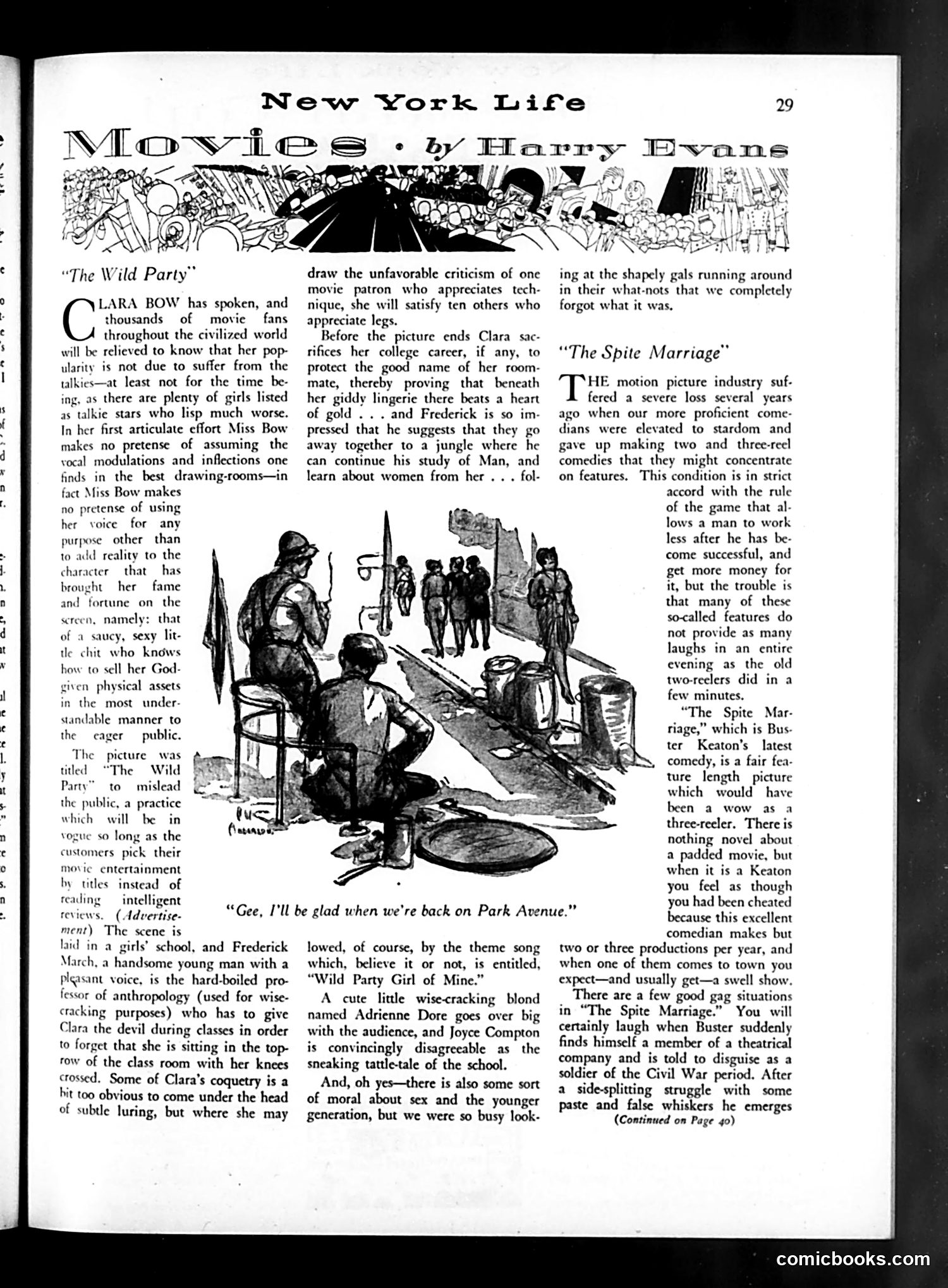
This page reviews two contemporary films. "The Wild Party" stars Clara Bow, a silent-film sex symbol whose first talkie (sound film) is being scrutinized. The reviewer celebrates her unaffected, natural delivery and her ability to use her physical appearance effectively, treating her sexual appeal as her genuine talent rather than a flaw. The plot involves a schoolgirl and her professor; the caption joke mocks how little substance matters when viewers are distracted by "shapely gals." "The Spite Marriage" features Buster Keaton. The reviewer complains that successful comedians now make padded feature-length films when they could deliver more laughs in shorter two or three-reel comedies. The implication: Hollywood prioritizes money over quality, and comedians become lazier after achieving stardom. Both reviews display the era's frank attitudes toward sex appeal and cynicism about commercial film-making practices.
📄 Transcribed text from this page (OCR, searchable)
Machine-transcribed from the original scan — historical spelling and the odd misread are preserved.
New York Life 29 “The Wild Party” LARA BOW has spoken, and C thousands of movie fans throughout the civilized world will be relieved to know that her pop- ularity is not due to suffer from the talkies—at least not for the time be- ing, as there are plenty of girls listed as talkie stars who lisp much worse. In her first articulate effort Miss Bow makes no pretense of assuming the vocal modulations and inflections one finds in the best drawing-rooms—in fact Miss Bow makes no pretense of using her voice for any purpose other than to add reality to the character that has brought her fame and fortune on the screen, namely: that of a saucy, sexy lit- tle chit who knows how to sell her God- given physical assets in the most under- standable manner to the eager public. The picture was tiled “The Wild Party” to mislead the public, a practice which will be in vogue so long as the customers pick their movie entertainment hy titles instead of reading intelligent reviews. (Advertise- ment) The scene is laid in a girls’ school, and Frederick March, a handsome young man with a pleasant voice, is the hard-boiled pro- fessor of anthropology (used for wise- cracking purposes) who has to give Clara the devil during classes in order to forget that she is sitting in the top- row of the class room with her knees crossed. Some of Clara’s coquetry is a hit too obvious to come under the head of subtle luring, but where she may draw the unfavorable criticism of one movie patron who appreciates tech- nique, she will satisfy ten others who appreciate legs. Before the picture ends Clara sac- rifices her college career, if any, to protect the good name of her room- mate, thereby proving that beneath her giddy lingerie there beats a heart of gold . . . and Frederick is so im- pressed that he suggests that they go away together to a jungle where he can continue his study of Man, and learn about women from her . . . fol- “Gee, I'll be glad when we're back on Park Avenue.” lowed, of course, by the theme song which, believe it or not, is entitled, “Wild Party Girl of Mine.” A cute little wise-cracking blond named Adrienne Dore goes over big with the audience, and Joyce Compton is convincingly disagreeable as the sneaking tattle-tale of the school. And, oh yes—there is also some sort of moral about sex and the younger generation, but we were so busy look- ing at the shapely gals running around in their what-nots that we completely forgot what it was, “The Spite Marriage” HE motion picture industry suf- fered a severe loss several years ago when our more proficient come- dians were elevated to stardom and gave up making two and three-reel comedies that they might concentrate on features. This condition is in strict accord with the rule of the game that al- lows a man to work less after he has be- come successful, and get more money for it, but the trouble is that many of these so-called features do not provide as many laughs in an entire evening as the old two-reelers did in a few minutes. “The Spite Mar- riage,” which is Bus- ter Keaton’s latest comedy, is a fair fea- ture length picture which would have been a wow as a three-reeler. There is nothing novel about a padded movie, but when it is a Keaton you feel as though you had been cheated because this excellent comedian makes but two or three productions per year, and when one of them comes to town you expect—and usually get—a swell show. There are a few good gag situations in “The Spite Marriage.” You will certainly laugh when Buster suddenly finds himself a member of a theatrical company and is told to disguise as a soldier of the Civil War period. After a side-splitting struggle with some paste and false whiskers he emerges (Continued on Page 40) comicbooks.com