
Life, 1929-04-19 · page 21 of 52
Life — April 19, 1929 — page 21: what you’re looking at
What you’re looking at
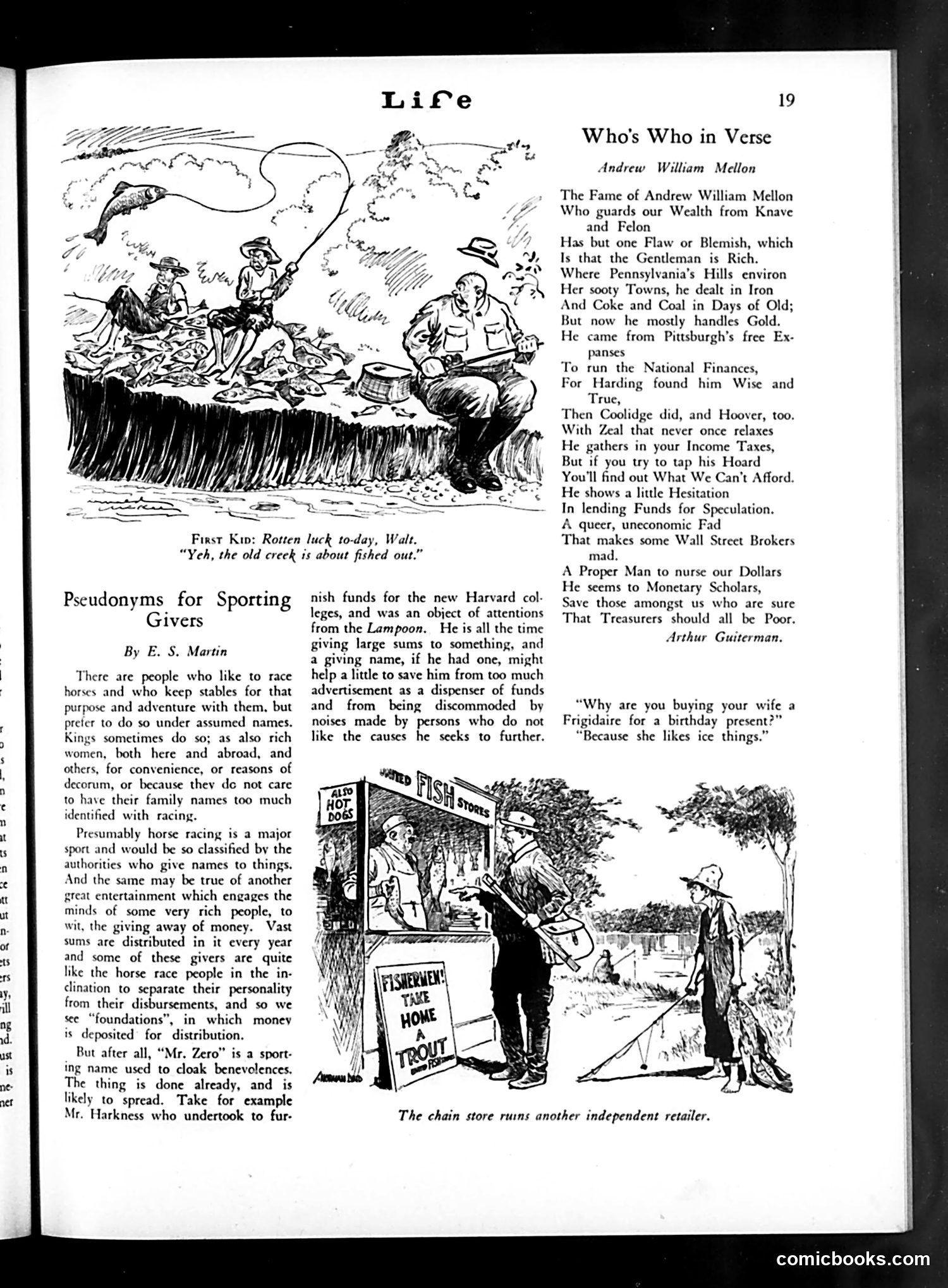
This page contains two distinct pieces of political satire targeting wealth and philanthropy in 1920s America. **"Who's Who in Verse" mocks Treasury Secretary Andrew Mellon.** The poem acknowledges Mellon's wealth and financial competence under Republican administrations (Harding, Coolidge, Hoover), but criticizes him as a hypocrite: he zealously collects taxes from ordinary citizens while protecting his own vast fortune and refusing to fund speculation. The satire's point is that Mellon aggressively extracts money from the public but resists lending or distributing his own wealth—a contradiction in a Treasury Secretary. **"Pseudonyms for Sporting Givers" satirizes wealthy philanthropists** like Mr. Harkness who hide behind "foundations" and anonymous giving. The article argues that rich donors use these structures to avoid public recognition and the "noises" (complaints) from those who dislike their chosen causes. It mocks the hypocrisy of wealthy men wanting credit for generosity while evading scrutiny. Both pieces critique how the wealthy manipulate systems—taxation, philanthropy, anonymity—to maintain power and avoid accountability.
📄 Transcribed text from this page (OCR, searchable)
Machine-transcribed from the original scan — historical spelling and the odd misread are preserved.
First Kio: Rotten luck to-day, Walt. “Yeh, the old creek ts about fished out.” Pseudonyms for Sporting Givers By E. S. Martin There are people who like to race horses and who keep stables for that purpose and adventure with them, but preter to do so under assumed names. Kings sometimes do so; as also rich women, both here and abroad, and others, for convenience, or reasons of decorum, or because they do not care to have their family names too much identified with racing. Presumably horse racing is a major sport and would be so classified by the authorities who give names to things. And the same may be true of another great entertainment which engages the minds of some very rich people, to wit, the giving away of money. Vast sums are distributed in it every year and some of these givers are quite like the horse race people in the in- clination to separate their personality from their disbursements, and so we see “foundations”, in which money is deposited for distribution. But after all, “Mr. Zero” is a sport- ing name used to cloak benevolences. The thing is done already, and is likely to spread. Take for example Mr. Harkness who undertook to fur- nish funds for the new Harvard col- leges, and was an object of attentions from the Lampoon. He is all the time giving large sums to something, and a giving name, if he had one, might help a little to save him from too much advertisement as a dispenser of funds and from being discommoded by noises made by persons who do not like the causes he seeks to further. 19 Who's Who in Verse William Mellon The Fame of Andrew William Mellon Who guards our Wealth from Knave and Felon Has but one Flaw or Blemish, which Is that the Gentleman is Rich. Where Pennsylvania’s Hills environ Her sooty Towns, he dealt in Iron And Coke and Coal in Days of Old; But now he mostly handles Gold. He came from Pittsburgh's free Ex- panses To run the National Finances, For Harding found him Wise and True, Then Coolidge did, and Hoover, too. With Zeal that never once relaxes He gathers in your Income Taxes, But if you try to tap his Hoard You'll find out What We Can't Afford. He shows a little Hesitation In lending Funds for Speculation. A queer, uneconomic Fad That makes some Wall Street Brokers mad, A Proper Man to nurse our Dollars He seems to Monetary Scholars, Save those amongst us who are sure That Treasurers should all be Poor. Arthur Guiterman. Andrew “Why are you buying your wife a Frigidaire for a birthday present?” “Because she likes ice things.” The chain store ruins another independent retailer. comicbooks.com