
Life, 1929-03-15 · page 26 of 44
Life — March 15, 1929 — page 26: what you’re looking at
What you’re looking at
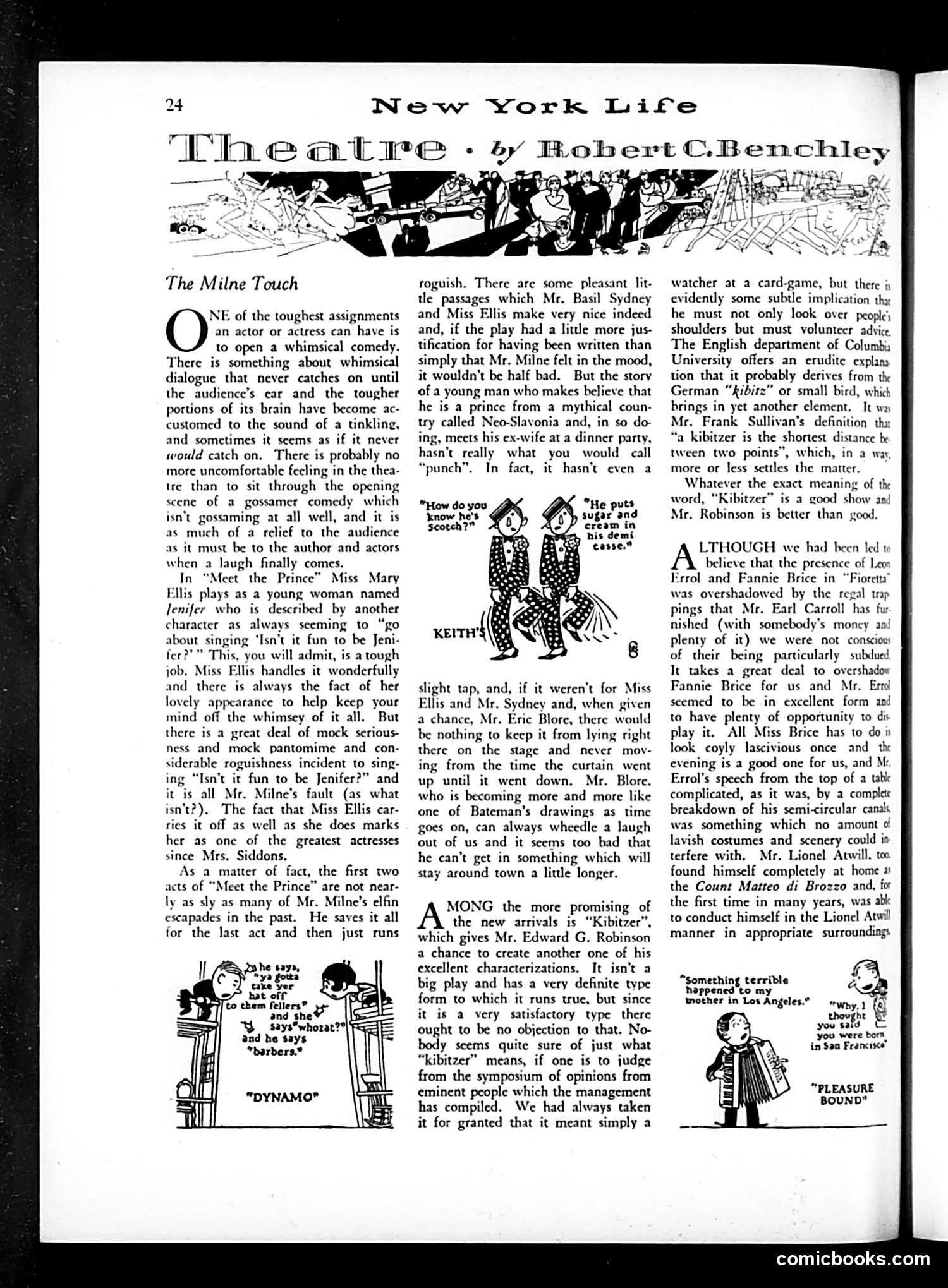
This is Robert C. Benchley's theater column reviewing three Broadway productions: "Meet the Prince" (starring Mary Ellis and Basil Sydney, written by A.A. Milne) and "Kibitzer" (starring Edward G. Robinson). **The cartoons** are small humorous illustrations unrelated to the reviews—one labeled "Dynamo" shows a barbershop scene, another titled "Pleasure Bound" depicts a musician with an accordion. **The satire targets whimsical comedies**: Benchley argues that plays with delicate, fanciful dialogue risk falling flat unless audiences adjust to their tone. He praises Ellis's performance despite the play's thin premise (a man pretending to be a mythical prince), crediting her talent and appearance for making it work. He criticizes the play's lack of genuine "punch." **On "Kibitzer"**: Benchley explains the Yiddish term (one who gives unsolicited advice while watching card games) with humorous sidebar quotes from "eminent people"—including Columbia University's German etymology and columnist Frank Sullivan's definition—showing how the word's meaning varies by source. The overall tone is sophisticated, witty criticism for an educated audience familiar with Broadway and theater conventions.
📄 Transcribed text from this page (OCR, searchable)
Machine-transcribed from the original scan — historical spelling and the odd misread are preserved.
24 New York Life The Milne Touch NE of the toughest assignments an actor or actress can have is to open a whimsical comedy. There is something about whimsical dialogue that never catches on until the audience’s ear and the tougher portions of its brain have become ac- customed to the sound of a tinkling, and sometimes it seems as if it never would catch on. There is probably no more uncomfortable feeling in the thea- tre than to sit through the opening scene of a gossamer comedy which isn’t gossaming at all well, and it is as much of a relief to the audience as it must be to the author and actors when a laugh finally comes. In “Meet the Prince” Miss Mary Ellis plays as a young woman named Jenifer who is described by another character as always seeming to “go about singing ‘Isn’t it fun to be Jeni- fer?’ This, you will admit, is a tough job. Miss Ellis handles it wonderfully and there is always the fact of her lovely appearance to help keep your mind off the whimsey of it all. But there is a great deal of mock serious- ness and mock pantomime and con- siderable roguishness incident to sing- ing “Isn't it fun to be Jenifer?” and it is all Mr. Milne’s fault (as what isn’t?). The fact that Miss Ellis car- ries it off as well as she does marks her as one of the greatest actresses since Mrs. Siddons. As a matter of fact, the first two acts of “Meet the Prince” are not near- ly as sly as many of Mr. Milne’s elfin escapades in the past. He saves it all for the last act and then just runs Zo chem feliers? em fellers’ and shee SS _ says*whozat?™ and he says “barbers.” roguish. There are some pleasant lit- tle passages which Mr. Basil Sydney and Miss Ellis make very nice indeed and, if the play had a little more jus- tification for having been written than simply that Mr. Milne felt in the mood, it wouldn't be half bad. But the story of a young man who makes believe that he is a prince from a mythical coun- try called Neo-Slavonia and, in so do- ing, meets his ex-wife at a dinner party, hasn't really what you would call “punch”. In fact, it hasn't even a ” He puts suger and cream in slight tap, and, if it weren't for Miss Ellis and Mr. Sydney and, when given a chance, Mr. Eric Blore, there would be nothing to keep it from lying right there on the stage and never mov- ing from the time the curtain went up until it went down. Mr. Blore, who is becoming more and more like one of Bateman’s drawings as time goes on, can always wheedle a laugh out of us and it seems too bad that he can’t get in something which will stay around town a little longer. MONG the more promising of the new arrivals is “Kibitzer”, which gives Mr. Edward G. Robinson a chance to create another one of his excellent characterizations. It isn’t a big play and has a very definite type form to which it runs true, but since it is a very satisfactory type there ought to be no objection to that. No- body seems quite sure of just what “kibitzer” means, if one is to judge from the symposium of opinions from eminent people which the management has compiled. We had always taken it for granted that it meant simply a nchliey watcher at a card-game, but there is evidently some subtle implication that he must not only look over peoples shoulders but must volunteer advice. The English department of Columbi: University offers an erudite explana tion that it probably derives from the German “kibitz” or small bird, which brings in yet another clement. It was Mr. Frank Sullivan’s definition thx “a kibitzer is the shortest distance be tween two points”, which, in a war more or less settles the matter. Whatever the exact meaning of the word, “Kibitzer” is a good show and Mr. Robinson is better than good. LTHOUGH we had been led t believe that the presence of Leon Errol and Fannie Brice in “Fioretta” was overshadowed by the regal trap pings that Mr. Earl Carroll has fur nished (with somebody's moncy ani plenty of it) we were not consciovs of their being particularly subdued. Tt takes a great deal to overshadow Fannie Brice for us and Mr. End seemed to be in excellent form and to have plenty of opportunity to dis play it. All Miss Brice has to do is look coyly lascivious once and th evening is a good one for us, and Mr. Errol’s speech from the top of a tabk complicated, as it was, by a complete breakdown of his semi-circular canals was something which no amount o lavish costumes and scenery could ic terfere with. Mr. Lionel Atwill, too found himself completely at home a the Count Matteo di Brozzo and, fo the first time in many years, was able to conduct himself in the Lionel Atwi! manner in appropriate surroundings “something terrible happened to my mother in Los Angeles.” “PLEASURE BOUND® comicbooks.com