
Life, 1929-03-15 · page 11 of 44
Life — March 15, 1929 — page 11: what you’re looking at
What you’re looking at
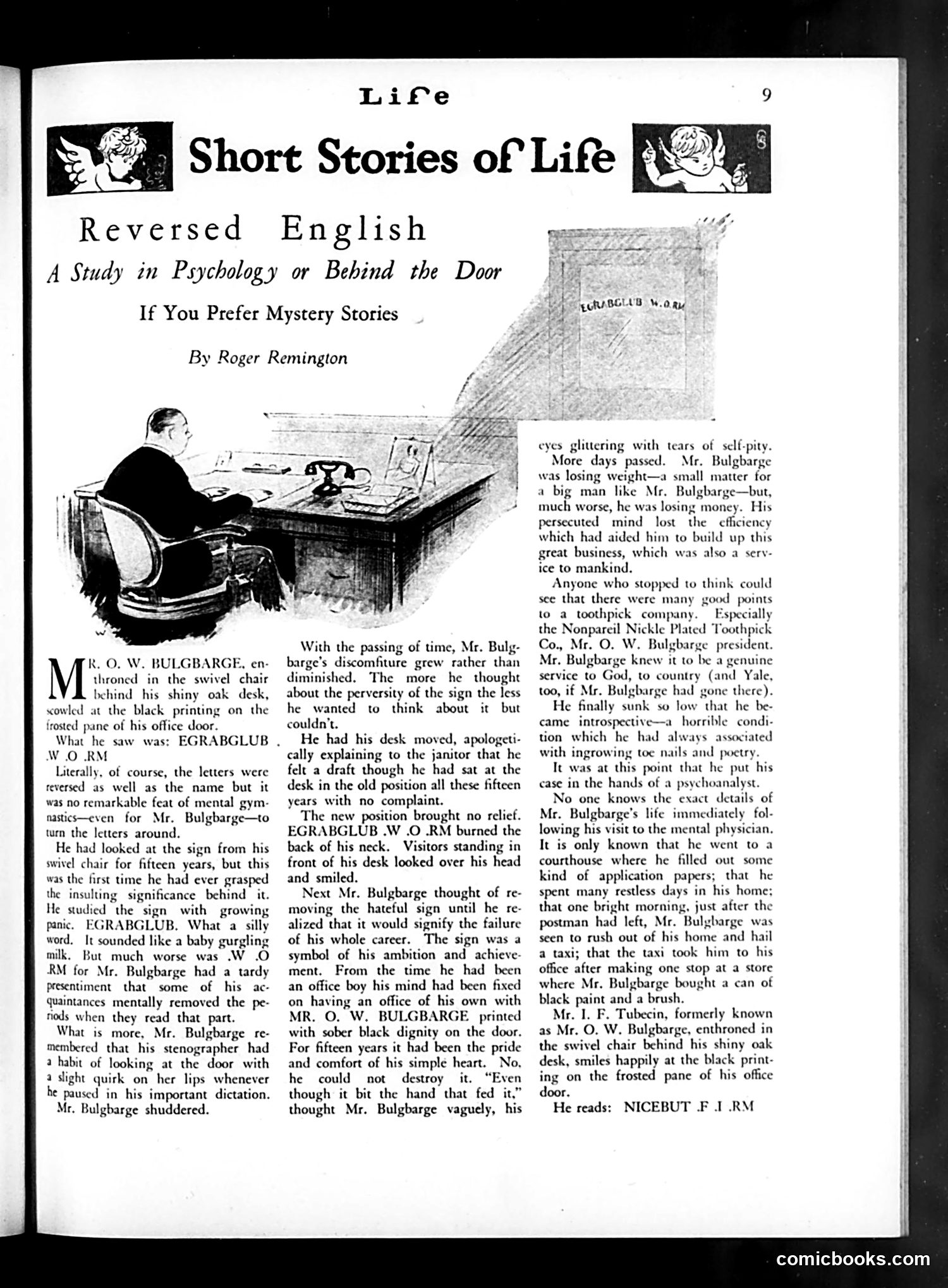
This page presents a short story about Mr. O.W. Bulbarge, an office manager obsessed with a sign on his door reading "EGRARGLUB W.O RM"—his name spelled backwards. The illustration shows him at his desk, troubled by this reversed nameplate. The satire mocks corporate vanity and misplaced priorities. Despite running a successful toothpick company, Bulbarge becomes consumed with the embarrassment of the backwards sign, losing focus on actual business concerns. He grows depressed, loses weight, and eventually seeks psychiatric help over this trivial matter. The story's title, "Reversed English," plays on the phrase meaning indirect or deceptive communication, suggesting Bulbarge's own distorted perspective has reversed his priorities and sanity.
📄 Transcribed text from this page (OCR, searchable)
Machine-transcribed from the original scan — historical spelling and the odd misread are preserved.
Life Short Stories of Life Reversed English A Study in Psychology or Behind the Door If You Prefer Mystery Stories By Roger Remington k. O. W. BULGBARGE, en- throned in the swivel chair behind his shiny oak desk, sowled at the black printing on the frosted pane of his office door. What he saw was; EGRABGLUB . WO .RM Literally, of course, the letters were reversed as well as the name but it was no remarkable feat of mental gym- nastics—even for Mr. Bulgbarge—to tum the letters around. He had looked at the sign from his swivel chair for fifteen years, but this was the first time he had ever grasped the insulting significance behind it. He studied the sign with growing panic. EGRABGLUB. What a silly word. It sounded like a baby gurgling milk. But much worse was .W .O RM for Mr. Bulgbarge had a tardy Presentiment that some of his ac- quaintances mentally removed the pe- nods when they read that part. What is more, Mr. Bulgbarge re- membered that his stenographer had a habit of looking at the door with a slight quirk on her lips whenever he paused in his important dictation. Mr. Bulgbarge shuddered. With the passing of time, Mr. Bulg- barge’s discomfiture grew rather than diminished. The more he thought about the perversity of the sign the less he wanted to think about it but couldn't. He had his desk moved, apologeti- cally explaining to the janitor that he felt a draft though he had sat at the desk in the old position all these fifteen years with no complaint. The new position brought no relief. EGRABGLUB .W .O .RM burned the back of his neck. Visitors standing in front of his desk looked over his head and smiled. Jext Mr. Bulgbarge thought of re- moving the hateful sign until he re- alized that it would signify the failure of his whole career. The sign was a symbol of his ambition and achieve- ment. From the time he had been an office boy his mind had been fixed on having an office of his own with MR. O. W. BULGBARGE printed with sober black dignity on the door. For fifteen years it had been the pride and comfort of his simple heart. No, he could not destroy it. “Even though it bit the hand that fed it,” thought Mr. Bulgbarge vaguely, his pOVBCLUD W.0. gy eyes glittering with tears of self-pity. More days passed. Mr. Bulgbarge was losing weight—a small matter for a big man like Mr, Bulgbarge—but, much worse, he was losing money. His persecuted mind lost the efficiency which had aided him to build up this great business, which was also a serv- ice to mankind. Anyone who stopped to think could see that there were many good points to a toothpick company. Especially the Nonpareil Nickle Plated Toothpick Co., Mr. O. W. Bulgbarge president. Mr. Bulgbarge knew it to be a genuine service to God, to country (and Yale, too, if Mr. Bulgbarge had gone there). He finally sunk so low that he be- came introspective—a horrible condi- tion which he had with ingrowing toe nails and poetry. Tt was at this point that he put his case in the hands of a psychoanalyst. No one knows the exact details of Mr. Bulgbarge’s life immediately fol- lowing his visit to the mental physician. It is only known that he went to a courthouse where he filled out some kind of application papers; that he spent many restless days in his home; that one bright morning, just after the postman had left, Mr. Bulgbarge was seen to rush out of his home and hail a taxi; that the taxi took him to his office after making one stop at a store where Mr. Bulgbarge bought a can of black paint and a brush. Mr. I. F. Tubecin, formerly known as Mr. O. W. Bulgbarge, enthroned in the swivel chair behind his shiny oak desk, smiles happily at the black print- ing on the frosted pane of his office door. He reads: always associated NICEBUT FF .I .RM comicbooks.com