
Life, 1929-02-22 · page 23 of 36
Life — February 22, 1929 — page 23: what you’re looking at
What you’re looking at
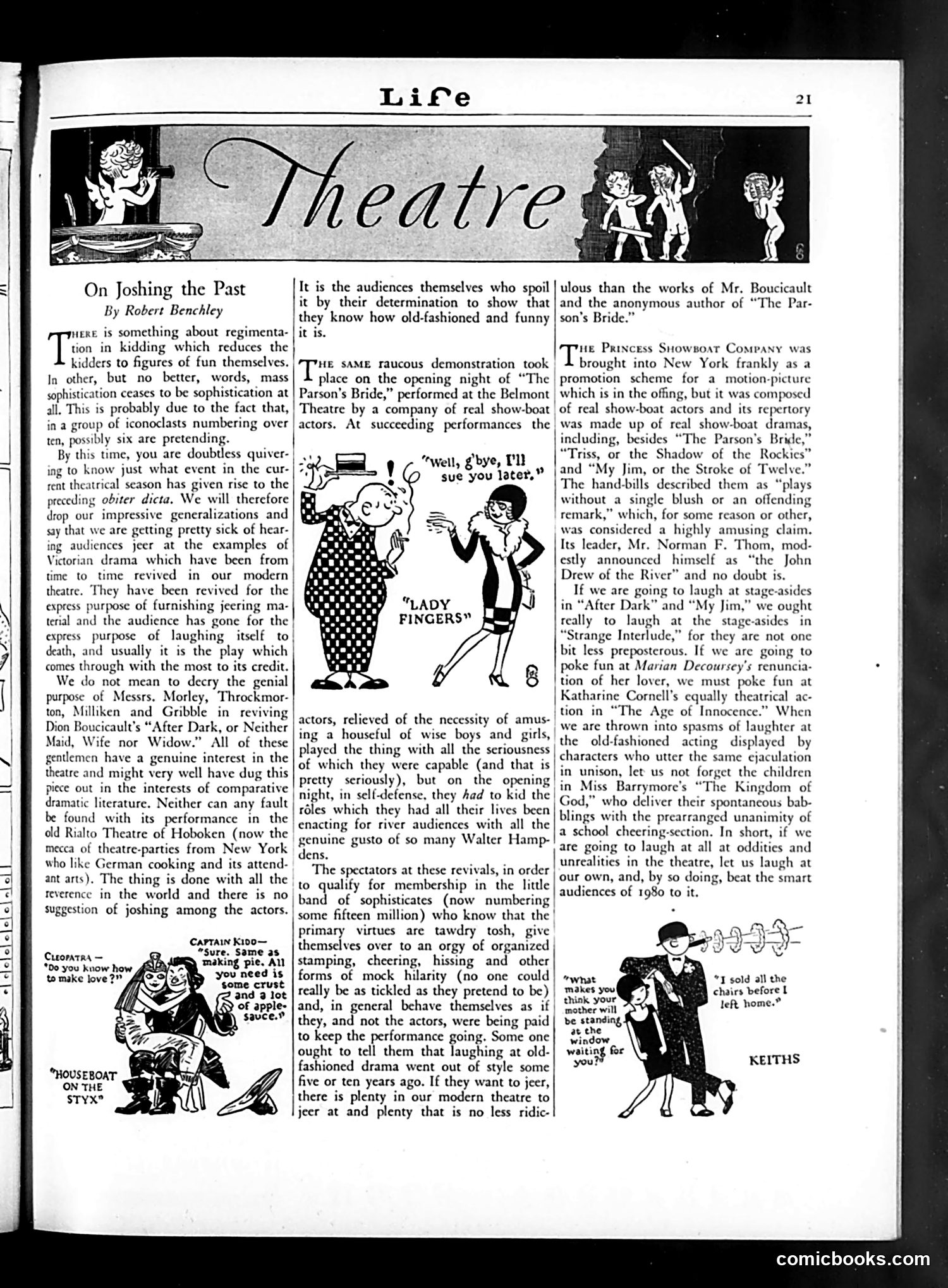
Robert Benchley critiques audiences who attend revivals of old theatrical productions—specifically *After Dark* (Dion Boucicault's Victorian melodrama) and *The Parson's Bride* (performed by the Princess Showboat Company)—solely to mock them as outdated and ridiculous. Benchley's argument: the audiences themselves ruin these performances by demonstrating their supposed sophistication through jeering and laughter. The actors, including genuine showboat performers, treat their material seriously and professionally. But modern audiences attend expressly to laugh at the old-fashioned conventions—a form of shallow, performative superiority Benchley finds tiresome. The small cartoons appear to be unrelated gags typical of Life's humor sections. Benchley argues that if audiences want to laugh at theatrical conventions, they should acknowledge equally absurd elements in contemporary plays like Eugene O'Neill's *Strange Interlude*.
📄 Transcribed text from this page (OCR, searchable)
Machine-transcribed from the original scan — historical spelling and the odd misread are preserved.
On Joshing the Past By Robert Benchley tion in kidding which reduces the kidders to figures of fun themselves. In other, but no better, words, mass sophistication ceases to be sophistication at all. This is probably due to the fact that, in a group of iconoclasts numbering over ten, possibly six are pretending. By this time, you are doubtless quiver- ing ‘to know just what event in the cur- rent theatrical season has given rise to the preceding obiter dicta, We will therefore drop our impressive generalizations and say that we are getting pretty sick of hear- ing audiences jeer at the examples of Victorian drama which have been from time to time revived in our modern theatre. They have been revived for the express purpose of furnishing jeering ma- terial and the audience has gone for the express purpose of laughing itself to death, and usually it is the play which comes through with the most to its credit. We do not mean to decry the genial purpose of Messrs. Morley, Throckmor- ton, Milliken and Gribble in reviving Dion Boucicault’s “After Dark, or Neither Maid, Wife nor Widow.” All of these gentlemen have a genuine interest in the theatre and might very well have dug this piece out in the interests of comparative dramatic literature. Neither can any fault be found with its performance in the old Rialto Theatre of Hoboken (now the mecca of theatre-parties from New York who like German cooking and its attend- ant arts), The thing is done with all the reverence in the world and there is no suggestion of joshing among the actors. Tes is something about regimenta- Carrain Ki00— “Sure. Same as RB) making pie. All you need is some crust and 2 lot &) of apple- h) sauce.” Curoratas — “Do you know how te make love?” “HOUSEBOAT. ON THE STYX? It is the audiences themselves who spoil it by their determination to show that they know how old-fashioned and funny it is. TT SAME raucous demonstration took place on the opening night of “The Parson's Bride,” performed at the Belmont | Theatre by a company of real show-boat |actors. At succeeding performances the “weil, Sbye, TL sue you later.” | FINGERS” ulous than the works of Mr. Boucicault and the anonymous author of “The Par- son’s Bride.” TH Princess SHowsoat Company was brought into New York frankly as a promotion scheme for a motion-picture which is in the offing, but it was composed of real show-boat actors and its repertory was made up of real show-boat dramas, including, besides “The Parson's Bride, “Triss, or the Shadow of the Rockies’ and “My Jim, or the Stroke of Twelve.” | The hand-bills described them as “plays without a single blush or an offending remark,” which, for some reason or other, was considered a highly amusing claim. Its leader, Mr. Norman F. Thom, mod- estly announced himself as “the John Drew of the River” and no doubt is. If we are going to laugh at stage-asides in “After Dark” and “My Jim,” we ought really to laugh at the stage-asides in “Strange Interlude,” for they are not one bit less preposterous. If we are going to poke fun at Marian Decoursey's renuncia- tion of her lover, we must poke fun at actors, relieved of the necessity of amus- ing a houseful of wise boys and girls, played the thing with all the seriousness | of which they were capable (and that is | pretty seriously), but on the opening! | night, in self-defense, they Aad to kid the| | réles which they had all their lives been enacting for river audiences with all the genuine gusto of so many Walter Hamp- dens. The spectators at these revivals, in order | to qualify for membership in the little band of sophisticates (now numbering |some fifteen million) who know that the! primary virtues are tawdry tosh, give themselves over to an orgy of organized | stamping, cheering, hissing and other forms of mock hilarity (no one could really be as tickled as they pretend to be) and, in general behave themselves as if they, and not the actors, were being paid to keep the performance going. Some one ought to tell them that laughing at old- fashioned drama went out of style some five or ten years ago. If they want to jeer, there is plenty in our modern theatre to jeer at and plenty that is no less ridic- Katharine Cornell’s equally theatrical ac- tion in “The Age of Innocence.” When we are thrown into spasms of laughter at the old-fashioned acting displayed by characters who utter the same ejaculation in unison, let us not forget the children in Miss Barrymore's “The Kingdom of God,” who deliver their spontancous bab- blings with the prearranged unanimity of a school cheering-section. In short, if we are going to laugh at all at oddities and unrealities in the theatre, let us laugh at our own, and, by so doing, beat the smart audiences of 1980 to it. f vee’ Avs “I sold all the chairs before L le home.” KEITHS comicbooks.com