
Life, 1929-01-04 · page 9 of 36
Life — January 4, 1929 — page 9: what you’re looking at
What you’re looking at
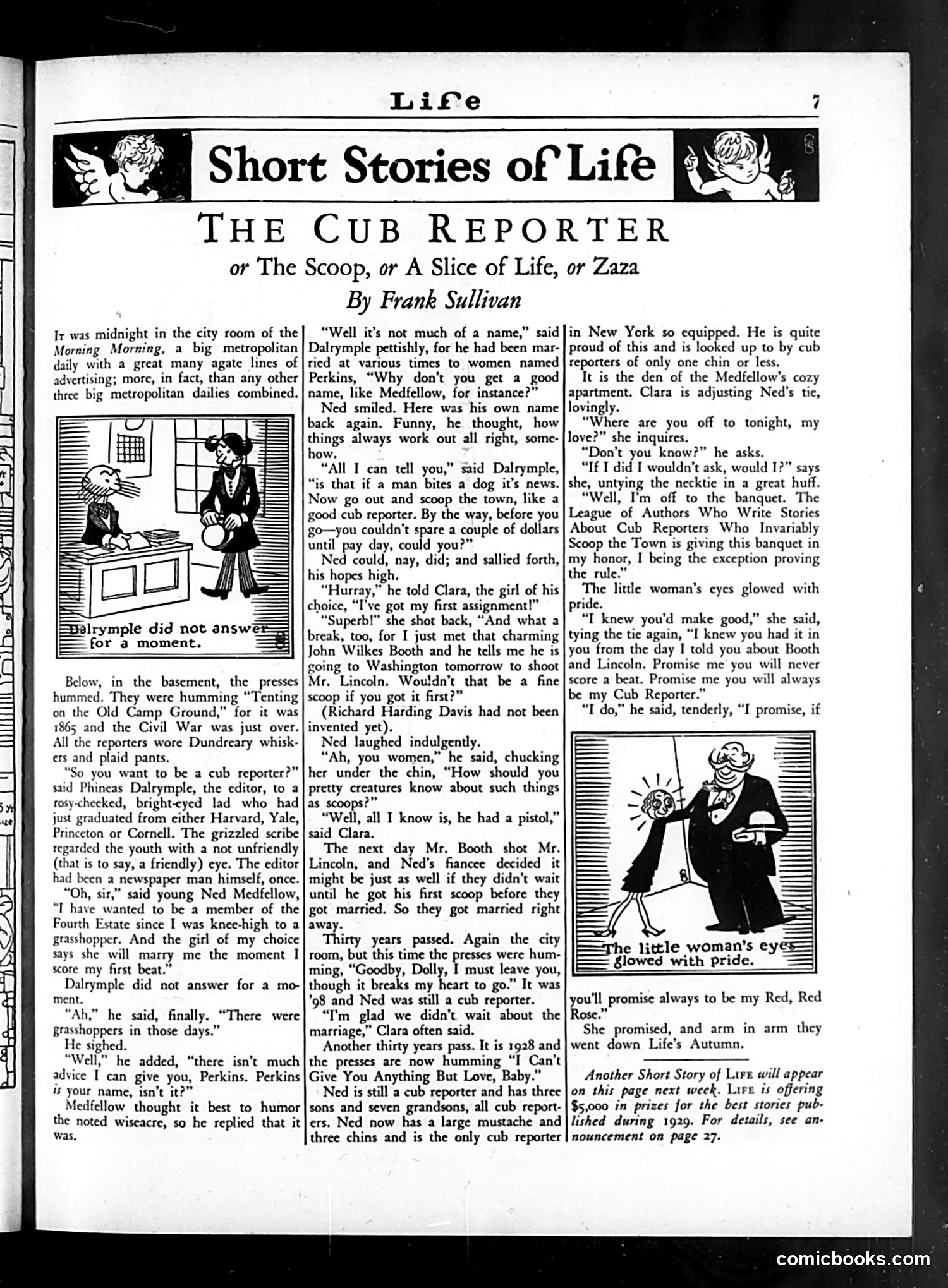
This satirical story mocks young newspaper reporters' ambitions and methods. The narrative follows Ned Meddellow, an eager cub reporter who dreams of landing a major scoop to advance his career. His editor, Dalrymple, cynically advises him that "biting a dog" (reversing the typical "dog bites man" story) constitutes real news—the implication being that reporters manufacture sensational stories rather than discover them. The humor targets journalistic ethics and the desperation of inexperienced reporters willing to fabricate or manipulate events for bylines. The story's resolution—Ned eventually marries and abandons reporting—suggests the profession attracts unrealistic young men who eventually abandon it for stability. The cartoon illustrations show the newsroom setting and Ned's earnest naiveté.
📄 Transcribed text from this page (OCR, searchable)
Machine-transcribed from the original scan — historical spelling and the odd misread are preserved.
THE CUB REPORTER or The Scoop, or A Slice of Life, or Zaza Ir was midnight in the city room of the Morning Morning, a big metropolitan daily with a great many agate lines of advertising; more, in fact, than any other three big metropolitan dailies combined. Epalrymple did not answe == for a moment. Below, in the basement, the presses hummed. They were humming “Tenting on the Old Camp Ground,” for it was 1865 and the Civil War was just over. All the reporters wore Dundreary whisk- ers and plaid pants. “So you want to be a cub reporter?” said Phineas Dalrymple, the editor, to a rosy-cheeked, bright-eyed lad who had just graduated from either Harvard, Yale, Princeton or Cornell. The grizzled scribe regarded the youth with a not unfriendly (that is to say, a friendly) eye. The editor had been a newspaper man himself, once. “Oh, sir,” said young Ned Medfellow, “I have wanted to be a member of the Fourth Estate since I was knee-high to a grasshopper. And the girl of my choice says she will marry me the moment I score my first beat.” Dalrymple did not answer for a mo- ment. “Ah,” he said, finally. “There were grasshoppers in those days.” He sighed. “Well,” he added, “there isn’t much advice I can give you, Perkins. Perkins 48 your name, isn’t it?” Medfellow thought it best to humor the noted wiseacre, so he replied that it was. By Frank Sullivan “Well it’s not much of a name,” said Dalrymple pettishly, for he had been mar- ried at various times to women named Perkins, “Why don’t you get a good name, like Medfellow, for instance?” Ned smiled. Here was his own name back again. Funny, he thought, how things always work out all right, some- how. “All I can tell you,” said Dalrymple, “is that if a man bites a dog it’s news. Now go out and scoop the town, like a good cub reporter. By the way, before you go—you couldn’t spare a couple of dollars until pay day, could you?” Ned could, nay, did; and sallied forth, his hopes high. “Hurray,” he told Clara, the girl of his choice, “I’ve got my first assignment!” “Superb!” she shot back, “And what a break, too, for I just met that charming John Wilkes Booth and he tells me he is going to Washington tomorrow to shoot Mr. Lincoln. Wouldn’t that be a fine scoop if you got it first?” (Richard Harding Davis had not been invented yet). Ned laughed indulgently. “Ah, you women,” he said, chucking her under the chin, “How should you pretty creatures know about such things as scoops?” “Well, all I know is, he had a pistol,” said Clara. The next day Mr. Booth shot Mr. Lincoln, and Ned's fiancee decided it might be just as well if they didn’t wait until he got his first scoop before they got married. So they got married right away. Thirty years passed. Again the city room, but this time the presses were hum- ming, “Goodby, Dolly, I must leave you, though it breaks my heart to go.” It was ’98 and Ned was still a cub reporter. “I'm glad we didn’t wait about the marriage,” Clara often said. Another thirty years pass. It is 1928 and the presses are now humming “I Can’t Give You Anything But Love, Baby.” Ned is still a cub reporter and has three sons and seven grandsons, all cub report- ers. Ned now has a large mustache and three chins and is the only cub reporter in New York so equipped. He is quite proud of this and is looked up to by cub reporters of only one chin or less. Tt is the den of the Medfellow’s cozy apartment. Clara is adjusting Ned’s tie, lovingly. “Where are you off to tonight, my love?” she inquires. “Don’t you know?” he asks. “If I did I wouldn’t ask, would I?” says she, untying the necktie in a great huff. “Well, I'm off to the banquet. The League of Authors Who Write Stories About Cub Reporters Who Invariably Scoop the Town is giving this banquet in my honor, I being the exception proving the rule.” The little woman's eyes glowed with pride. “I knew you'd make good,” she said, tying the tie again, “I knew you had it in you from the day I told you about Booth and Lincoln. Promise me you will never score a beat. Promise me you will always be my Cub Reporter.” “T do,” he said, tenderly, “I promise, if e little woman's ey' Slowed with Pride. you'll promise always to be my Red, Red Rose.” She promised, and arm in arm they went down Life’s Autumn. Another Short Story of Lire will appear on this page next week. Lire is offering $5,000 in prizes for the best stories pub- lished during 1929. For details, see an- nouncement on page 27. comicbooks.com