
Life, 1929-01-04 · page 26 of 36
Life — January 4, 1929 — page 26: what you’re looking at
What you’re looking at
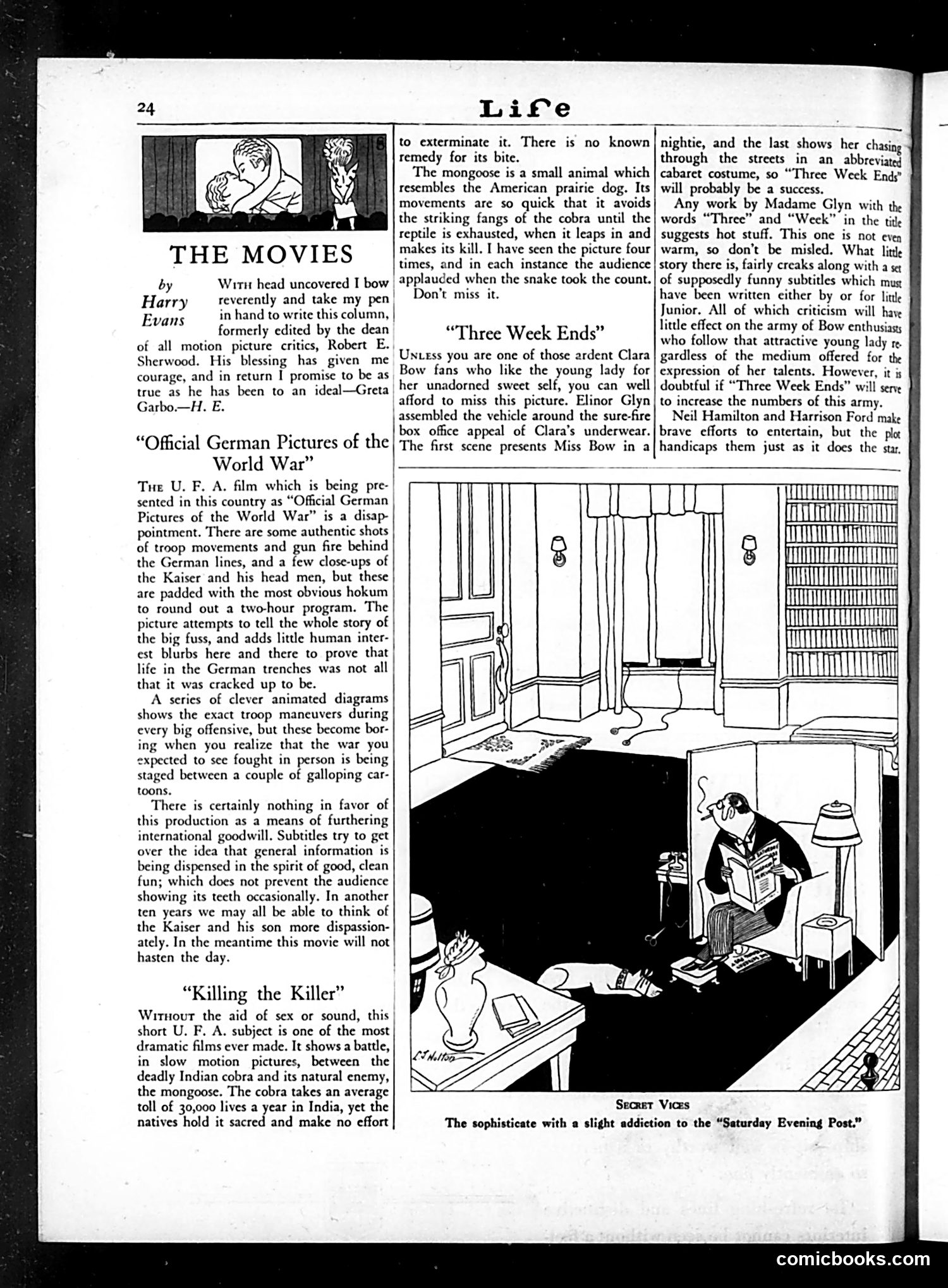
This cartoon satirizes the hypocrisy of respectability in the 1920s. It depicts a well-dressed gentleman sitting in what appears to be a library or study, openly reading what the caption identifies as "The Sophisticate with a slight addition to the 'Saturday Evening Post.'" The joke relies on the contrast between outward propriety and private behavior. The man's formal attire and refined surroundings suggest respectability, yet he's secretly reading salacious material—implied to be more explicit than the wholesome *Saturday Evening Post* magazine. The caption's coy phrasing ("slight addition") underscores the humor: respectable society members maintained facades of morality while indulging in "secret vices" behind closed doors. This reflects 1920s anxieties about changing social norms, post-WWI loosening of Victorian standards, and the gap between public morality and private desires—themes throughout Life magazine's satirical commentary.
📄 Transcribed text from this page (OCR, searchable)
Machine-transcribed from the original scan — historical spelling and the odd misread are preserved.
Life THE MOVIES Witut head uncovered I bow reverently and take my pen in hand to write this column, formerly edited by the dean of all motion picture critics, Robert E. Sherwood. His blessing has given me courage, and in return I promise to be as true as he has been to an ideal—Greta Garbo.-H. E. by Harry Evans “Official German Pictures of the World War” Tue U. F. A. film which is being pre- sented in this country as “Official German Pictures of the World War” is a disap- pointment. There are some authentic shots of troop movements and gun fire behind the German lines, and a few close-ups of the Kaiser and his head men, but these are padded with the most obvious hokum to round out a two-hour program. The | picture attempts to tell the whole story of the big fuss, and adds little human inter- | est blurbs here and there to prove that life in the German trenches was not all that it was cracked up to be. A series of clever animated diagrams shows the exact troop maneuvers during every big offensive, but these become bor- ing when you realize that the war you expected to see fought in person is being staged between a couple of galloping car- toons. There is certainly nothing in favor of this production as a means of furthering international goodwill. Subtitles try to get over the idea that general information is being dispensed in the spirit of good, clean fun; which does not prevent the audience showing its teeth occasionally. In another ten years we may all be able to think of the Kaiser and his son more dispassion- ately. In the meantime this movie will not hasten the day. | “Killing the Killer” Wrtnout the aid of sex or sound, this | short U. F. A. subject is one of the most dramatic films ever made. It shows a battle, in slow motion pictures, between the deadly Indian cobra and its natural enemy, the mongoose. The cobra takes an average toll of 30,000 lives a year in India, yet the natives hold it sacred and make no effort to exterminate it. There is no known remedy for its bite. The mongoose is a small animal which resembles the American prairie dog. Its movements are so quick that it avoids the striking fangs of the cobra until the reptile is exhausted, when it leaps in and makes its kill. I have seen the picture four times, and in each instance the audience applauded when the snake took the count. Don’t miss it. “Three Week Ends” Un ess you are one of those ardent Clara Bow fans who like the young lady for her unadorned sweet self, you can well afford to miss this picture. Elinor Glyn | assembled the vehicle around the sure-fire box office appeal of Clara’s underwear. The first scene presents Miss Bow in a nightie, and the last shows her chasing through the streets in an abbreviated cabaret costume, so “Three Week Ends’ will probably be a success. Any work by Madame Glyn with the words “Three” and “Week” in the tit suggests hot stuff. This one is not even warm, so don’t be misled. What little story there is, fairly creaks along with a set of supposedly funny subtitles which mug have been written either by or for litle Junior. All of which criticism will have little effect on the army of Bow enthusiass who follow that attractive young lady re. gardless of the medium offered for the expression of her talents. However, it is doubtful if “Three Week Ends” will serve to increase the numbers of this army. Neil Hamilton and Harrison Ford make brave efforts to entertain, but the plor handicaps them just as it does the star, TTT AMATO AGA OTTO ANNA ATA COATT TTT Secret Vices The sophisticate with a slight addiction to the “Saturday Evening Post.” comicbooks.com