
Life, 1928-12-28 · page 30 of 37
Life — December 28, 1928 — page 30: what you’re looking at
What you’re looking at
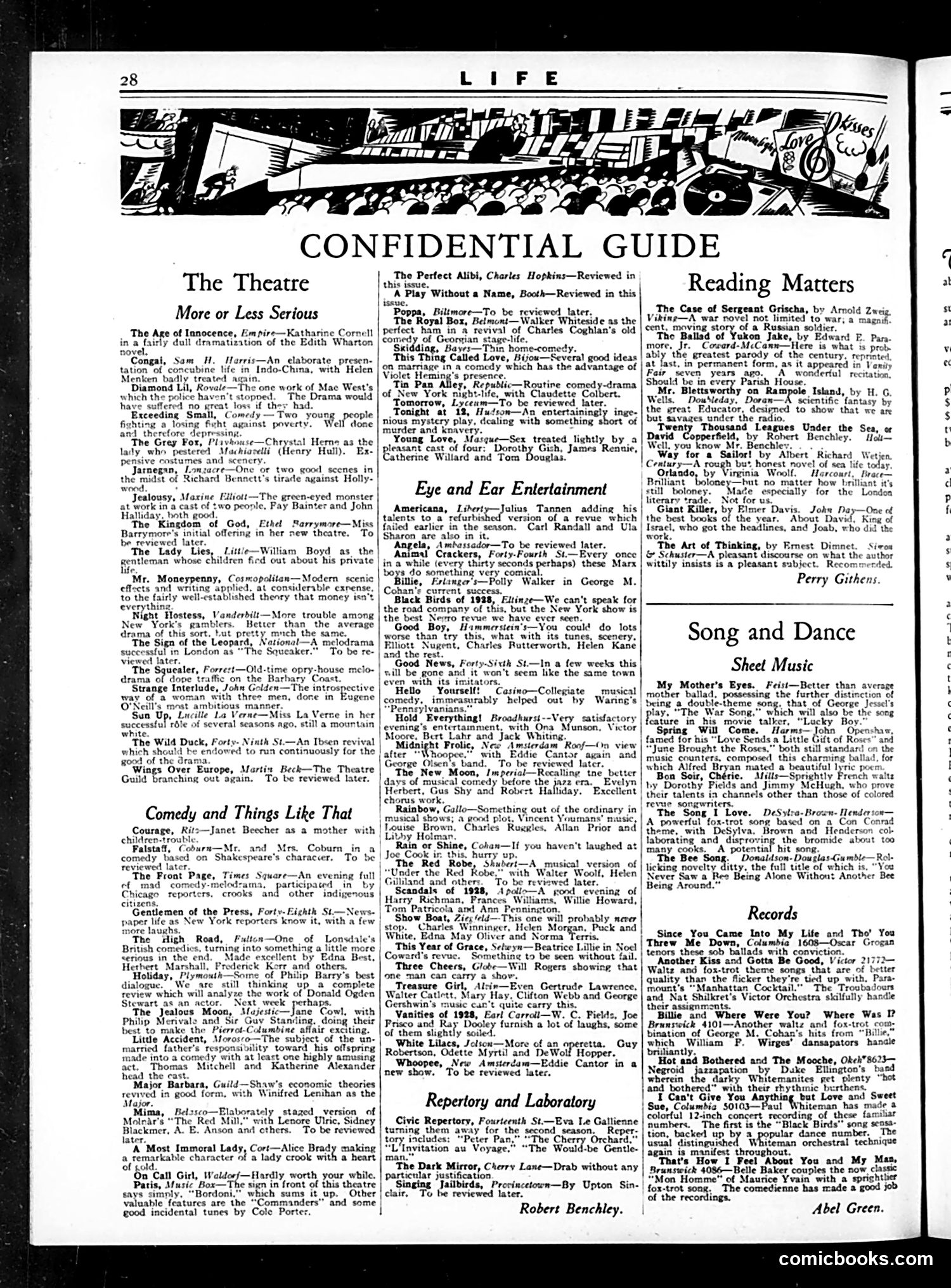
This page from Life magazine is not a cartoon or satirical piece, but rather a **"Confidential Guide"** — an entertainment review section listing Broadway theatrical productions, musicals, and records from the 1920s era. The guide contains brief critical summaries of numerous plays (such as *The Age of Innocence* with Katharine Cornell, Mae West's *Diamond Lil*, and Ibsen's *The Wild Duck*), organized by tone. Text notes which shows are worthwhile and which are tedious. The decorative header features **stylized theatrical and entertainment imagery** — musical notes, theater masks, audience silhouettes — typical Art Deco design common to the period. Rather than political satire, this represents **contemporary entertainment journalism**, helping affluent readers decide which Broadway shows merited their time and money. The frank, sometimes cutting reviews reflect Life's satirical voice applied to theater criticism rather than political commentary.
📄 Transcribed text from this page (OCR, searchable)
Machine-transcribed from the original scan — historical spelling and the odd misread are preserved.
CONFIDENTIAL GUIDE The Theatre More or Less Serious The Age of Innocence, Em pire—Katharine Cornell in a fairly dull dramatization of the Edith Wharton novel. Congai, Sam H. Harris—An_ elaborate presen- tation of concubine life in Indo-China, with Helen Menken badly treated asain. Diamond Lil, Rovale—The one work of Mac West's which the police haven't stopped. The Drama would have suffered no great loss if they had. Exceeding Small, Comely—Two young fighting a losing fight against poverty. and therefore depressing. The Grey For, Play lady who pestered Muchiazelli (Henry Hull). pensive costumes and scenery. Jarnegan, Lonzacre—One of two good scenes in the midst of Richard Bennett's tirade against Holly- wood. : Jealousy, Marine Filiott—The green-eyed monster at work in a cast of two people, Pay Bainter and John Halliday, both good The Kingdom of God, Ethel Parrymore—Miss Barrymore's initial offering in her new theatre. To be_reviewed later. The Lady Lies, /ittie—William Boyd as_ the | gentleman whose children fied out about his private life Mr. Moneypenny, Cosmopolitan—Modern scenic effects and writing applied. at considerable exnense, | to the fairly well-established theory that money isn’ everything Night Hostess, Vanderbilt—More trouble among New York's gamblers. Better than the average drama of this sort. tut pretty mnch the same. The Sign of the Leopard, National—A melodrama successful in London as “The Squeaker." To be re- viewed later. The Squealer, Forre:t—Old-time opry-house melo- drama of dope traffic on the Barbary Coast. Strange Interlude, John Golden—The introspective | way of a woman with three men, done in Eugene O'Neill's mast ambitious manner. Sun Up, Lucille La Verne—Miss La Verne in her successful rdle of several seasons ago, still a mountain white. The Wild Duck, Forty. Ninth St—An Ibsen revival which should be endowed to run continuously for the | good of the drama Wings Over Europe, Martix Beck—The Theatre Guild Eranching out again, To be reviewed later. people Well done —Chrystal Hern as the Ex- | this issue, | issue. | evening’s entertainment, with Ona Munson, Victor | Comedy and Things Like That Courage, Rit>—Janet Beecher as a mother with children-trouble Falstaff, Coburn—Mr. and . Cobum comedy based on Shakespeare's characcer. reviewed later. : f The Front Page, Times Square—An evening full ef mad comedy-melodrama, participated in by Chicago reporters, crooks and other ind citizens, Gentlemen of the Press, Forty. Eighth St-—News- | per life as New York reporters know it, with a few Jaughs. igh Road, British comedies, turning into something a little m serious in the end. Made excellent by Edna Best, | Hethert Marshall, Proderick Kerr and others. Holiday, Plymouth—Some of Philip Barry's best dialogue. "We are still thinking up_a complete review which will analyze the work of Donald Ogden Stewart as an actor. Next week The Jealoes Moon, Muje: Philip Merivale and S v Standing, doing their best to make the Pierrot-Columbine affair exciting. Little Accident, Morosro—The subject of the un- married father’s responsibility toward his offsprirg made into a comedy with at least one highly amusing act. Thomas Mitchell and Katherine Alexander head the cast. 5 P = jor Barbara, Guild—Shaw's economic theories din good form, with Winifred Lenihan as the petssco—Blaborately stazed version of The Red Mill,” with Lenore Ulric, Sidney Blackmer, A. E. Anson and cthers. To be reviewed | later. ‘A Most Immoral Lady, Cort—Alice Brady making | a remarkable character of a lady crook with a heart in a To be irl, Waldor/—Hardly worth your while. ‘Box—The sign in front of this theatre | says simply. “Bordoni.” which sums it up. Other | valuable features are the “Commanders” and some good incidental tunes by Cole Porter. | musical show | Louise Brown, Charles Ruggles, Allan | Lityy Holman The Perfect Alibi, Charles Hopkins—Reviewed in A Play Without a Name, Booth—Reviewed in this Poppa, Biltmore—To be reviewed later. The Royal Box, Belmont—Walker Whiteside as the perfect ham in a revival of Charles Coghlan’s old comedy of Georgian stage-life, Skiddiag, Bayes—Thin home-comedy. This Thing Called Love, Bijou—Several good ideas ‘on marriage ina comedy which has the advantage of Violet Heming’s presence. : Tin Pan Alley, Repudlic—Routine comedy-drama of New York night-life, with Claudette Colbert. Tomorrow, Lycenm—To be reviewed later. Tonight at 12, Hudson—An entertaining! nious mystery play murder and knavery, Young Love, Masque—Sex treated lightly by a asant cast of four: Dorothy Gish, James Rennie, therine Willard and Tom Douglas. Eye and Ear Entertainment Americana, Liherty—Julius Tannen adding his talents to a refurbish version of a revue which failed earlicr in the season. Carl Randall and Ula | Sharon are also in it. 7 ela, Ambassador—To be reviewed later. Animal Crackers, Forty-Fourth St.—Every once in a while (every thirty seconds perhaps) these Marx boys do something very comical. ie, Erlanger's—Polly Walker in George M. Cohan’s current. success. Black Birds of 1928, Eltinze—We can't speak for the road company of this, but the New York show is the best Nevro revue we have ever seen. Good Boy, Hammerstein's—You could do lots worse than try this, what with its tunes, scenery, tt Nugent, Charles Rutterworth, Helen Kane and the rest. . Good News, Forty-Sitth St—In a few weeks this sill be gone and it won't seem like the same town even with its imitators. Hello Yourself! Casino—Collegiate comedy, immeasurably helped out “Pennsylvanians.” Hold Everything! Broadhurst--Very satisfactory inge- dealing with something short of musical by Waring’s Moore, Bert Lahr and jack Whiting. Midnight Frolic, Neo Amsterdam Roof—(r after “Whoopee,” with Eddie Cantor again George Olsen's band. To be reviewed later. ‘The New Moon, Imperiai—Recalling tne better days of musical comedy before the jazz era. Evelyn Herbert, Gus Shy and Robert Halliday. Excellent | chonis work. | Rainbow, Gallo—Something out of the ordinary in ; A good plot, Vincent Youmans’ music, | Prior and view and Rain or Shine, Cohan—If you haven't laughed at Joe Cook ir this. hurry up. The Red Robe, Shuberi—A musical version of | Jnder the Red Kobe,” with Walter Woolf, Helen Villiland and ot! To be reviewed later, Scandals of 192! Apallo—A ond evening of | Harry Richman, Frances Williams, Willie Howard, Tom Patncola and Ann Pennington. Show Boat, Zies/ld—This one will probably never stop. Charles Winninger, Helen Morgan, Puck and | White, Edna May Oliver and Norma Terris. | This Year of Grace, Seiwyn—Beatrice Lillie in Noel | Coward's revue, Some’ to be seen without fail. Three Cheers, Globe—Will Rogers showing, that one man can carry a show. ‘Treasure Girl, Alsin—Even Gertrude Lawrence, Walter Catlett, Mary Hay. Clifton Webb and George Gershwin’s music can’t quite carry this. Vanities of 1928, Earl Carroll—W. C. Fields, Joe Frisco and Ray Dooley furnish a lot of faughs, tome of them slightly soiled. White Lilacs, Jolson—More of an operetta. Guy Robertson, Odette Myrtil and DeWoll Hopper. New Amsterdam—Eddie Cantor in a To be reviewed later. Repertory and Laboratory Civic Repertory, Fourteenth St—Eva Le Gallienne turning them L'Invitation au Voyage.” “The Would-be Gentle- man. The Dark Mirror, Cherry Lane—Drab without any particular justification Singing Jailbirds, Procincetown—By Upton Sin- clair, To be reviewed later. Robert Benchley. Reading Matters The Case of Sergeant Grischa, by Amold Zecig. Viking—A war novel not limited’ to war, a magnit, cent, moving mary of a Russian soldier. The Ballad of Yukon Jake, by Edward E. Pars. more, Jr. Coward-McCann—Here is what i pret. ably ‘the’ greatest parody of the century, rented at fast, in permanent form, as it appeared in Verily Fair seven years ago. A wonderlul. recitation, Should be in every Parish House. Mr. Blettsworthy on Rampole Island, by H. G. Wells. DowNleday, Doran—A scientific fantasy by the great Educator, designed to show that we a vages under the radio. Twenty Thousand Leagues Under the Sea, o ‘opperfield, by Rohert Benchley. flcu you know Mr. Benchley. . . Way for a Sailor! by Albert’ Richard Century A rough bat honest novel of ea | Orlando, by Virginia Woolf. Harcourt. Brace Brilliant boloney—but no matter how brilliant its still boloney. Made especially for the Londoa literary trade. Not for us. Giant Killer, by Elmer Davis. John Day—One ef the best books of the year. About David, King of Israel, who got the headlines, and Joab, who did the work. The Art of Thinking, by Emest Dimnet. Sivos & Schuster—A pleasant discourse on what the author wittily insists is a pleasant subject. Recommended. Perry Githens. Song and Dance Sheet Music My Mother's Eyes. Feist—Better than average mother ballad, possessing the further distinction of being a double-theme song. that of George Jesse’ lay, “The War Song,” which will also be t Katire in his movie’ talker, “Lucky Boy. Spring Will Come. Harms—John Openshaw, famed for his “Love Sends a Little Gift of Roses” and “June Brought the Roses,” both still standard on the music counters, composed this charming ballad, for which Alfred Bryan mated a beautiful lyric poem Bon Soir, Chérie. Mills—Sprightly French waltz by Dorothy Fields and Jimmy McHugh, who prove their talents in channels other than those of colored revue songwriters. The Song I Love. DeSytra-Brown- Henderion— A powerful fox-trot song based on a Con Conrad theme, with DeSylva, Brown and Henderson cob laborating and, disrroving the bromide about too many cooks, A potential hit song. ‘The Bee Song. Donaldson-Dousias-Gumble—Rol- licking novelty ditty, the full title of which is. “You Never Saw a Ree Being Alone Without Another Bee Being Around.” Records Since You Came Into My Life and Tho’ You Threw Me Down, Columbia 1608—Oscar Grogan | tenors these sob ballads with conviction. Another Kiss and Gotta Be Good, Victor 21772— Waltz and fox-trot theme songs that are of better quality than the flicker they're tied up with. Para- mount’s “Manhattan Cocktail.” The Troubadours and Nat Shilkret’s Victor Orchestra skilfully handle their assignments. Billie and Where Were You? Where Was I? Brunswick 4101—Another waltz and fox-trot dination of George M. Cohan’s hits from “Billie, which William FP. Wirges’ dansapators hancle bridiantly, Hot and Bothered and The Mooche, Okch"8623— Negroid jazzapation by Duke Ellington's basd wherein the darky Whitemanites get plenty “hot and bothered” with their rhythmic burthens. I Can't Give You Anything but Love and Sweet Sue, Columbia $0103—Paul Whiteman has made a colorful 12-inch concert recording of these familiar numbers.” The first is the “Black Birds" song seass- tion, backed up by a popular dance number, The sual distinguished Whiteman orchestral technique again is manifest throughout. That's How I Feel About You and My Mas, Brunswick 4086—Belle Baker couples the now classic “Mon Homme" of Maurice Yvain with a sprightler fox-trot song. The comedienne has made a good job of the recordings. Abel Green. comicbooks.com