
Life, 1928-12-28 · page 27 of 37
Life — December 28, 1928 — page 27: what you’re looking at
What you’re looking at
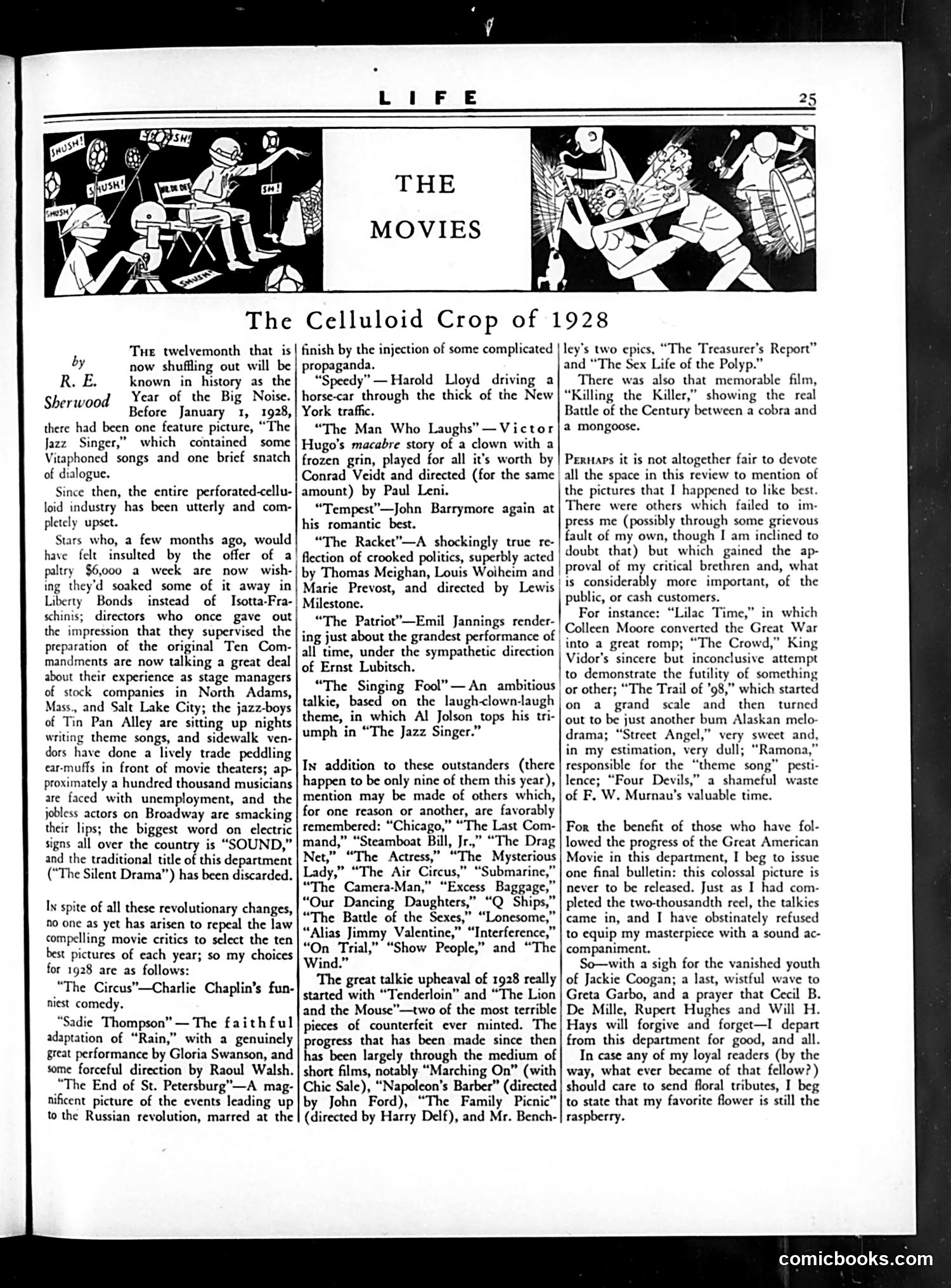
This page reviews 1928 films, a pivotal year when "talking pictures" (talkies) disrupted the silent film industry. The cartoons at the top depict the chaos of this transition—showing film crews, actors, and equipment in frantic disarray. The article explains the upheaval: silent film stars now feared obsolescence; unemployed stage actors suddenly became valuable; musicians who'd accompanied silent films lost jobs; and the industry scrambled to adapt. The author notes the ironic contradiction—despite this revolutionary turmoil, film critics still follow the old tradition of selecting "ten best pictures." The reviews praise films like Chaplin's *The Circus*, Gloria Swanson's *Sadie Thompson*, and notably *The Jazz Singer* (which launched talkies). The piece criticizes early talkies *Tenderloin* and *The Lion and the Mouse* as "terrible pieces of counterfeit," suggesting the transition's technical challenges. The satire captures 1928's anxiety: an established industry suddenly rendered obsolete by new technology, with widespread economic displacement and uncertainty about quality amid rapid change.
📄 Transcribed text from this page (OCR, searchable)
Machine-transcribed from the original scan — historical spelling and the odd misread are preserved.
Tue twelvemonth that is now shuffling out will be R. E. known in history as the P Year of the Big Noise. Sherwood Before January 1, 1928, there had been one feature picture, “The Jazz Singer,” which contained some Vitaphoned songs and one brief snatch of dialogue. Since then, the entire perforated-cellu- loid industry has been utterly and com- pletely upset. Stars who, a few months have felt insulted by the paltry $6,000 a week are ing they'd soaked some of it away in Liberty Bonds instead of Isotta-Fra- schinis; directors who once gave out the impression that they supervised the preparation of the original Ten Com- mandments are now talking a great deal about their experience as stage managers of stock companies in North Adams, Mass., and Salt Lake City; the jazz-boys of Tin Pan Alley are sitting up nights writing theme songs, and sidewalk ven- dors have done a lively trade peddling car-muffs in front of movie theaters; ap- proximately a hundred thousand musicians are faced with unemployment, and the jobless actors on Broadway are smacking their lips; the biggest word on electric signs all over the country is “SOUND,” and the traditional title of this department (“The Silent Drama”) has been discarded. by ago, would offer of a now wish- In spite of all these revolutionary changes, fo one as yet has arisen to repeal the law compelling movie critics to select the ten best pictures of each year; so my choices for 1928 are as follows: “The Circus”—Charlie Chaplin’s fun- niest comedy. “Sadie Thompson” — The faithful adaptation of “Rain,” with a genuinely great performance by Gloria Swanson, and some forceful direction by Raoul Walsh. “The End of St. Petersburg”—A mag- nificent picture of the events leading up to the Russian revolution, marred at the THE MOVIES Celluloid Crop of 1928 finish by the injection of some complicated | ley’s two epics, “The Treasurer's Report” propaganda. “Speedy” — Harold Lloyd driving a horse-car through the thick of the New York traffic. “The Man Who Laughs” — Victor Hugo's macabre story of a clown with a frozen grin, played for all it’s worth by Conrad Veidt and directed (for the same | amount) by Paul Leni. “Tempest”—John Barrymore again at his romantic best. “The Racket”—A shockingly true re- | fection of crooked politics, superbly acted by Thomas Meighan, Louis Woiheim and Marie Prevost, and directed by Lewis Milestone. “The Patriot”—Emil Jannings render- ing just about the grandest performance of | all time, under the sympathetic direction of Ernst Lubitsch. “The Singing Fool”—An ambitious talkie, based on the laugh-clown-laugh theme, in which Al Jolson tops his tri- umph in “The Jazz Singer.” In addition to these outstanders (there happen to be only nine of them this year), mention may be made of others which, for one reason or another, are favorably remembered: “Chicago,” “The Last Com- mand,” “Steamboat Bill, Jr.,” “The Drag Net,” “The Actress,” “The Mysterious Lady,” “The Air Circus,” “Submarine,” “The Camera-Man,” “Excess Baggage,” “Our Dancing Daughters,” “Q Ships,” “The Battle of the Sexes,” “Lonesome,” “Alias Jimmy Valentine,” “Interference,” “On Trial,” “Show People,” and “The Wind.” The great talkie upheaval of 1928 really started with “Tenderloin” and “The Lion and the Mouse”—two of the most terrible pieces of counterfeit ever minted. The progress that has been made since then has been largely through the medium of short films, notably “Marching On” (with Chic Sale), “Napoleon’s Barber” (directed by John Ford), “The Family Picnic” (directed by Harry Delf), and Mr. Bench- and “The Sex Life of the Polyp.” There was also that memorable film, “Killing the Killer,” showing the real Battle of the Century between a cobra and a mongoose, Pernaps it is not altogether fair to devote all the space in this review to mention of the pictures that I happened to like best. There were others which failed to im- press me (possibly through some grievous fault of my own, though I am inclined to doubt that) but which gained the ap- proval of my critical brethren and, what is considerably more important, of the public, or cash customers. For instance: “Lilac Time,” in which Colleen Moore converted the Great War into a great romp; “The Crowd,” King Vidor’s sincere but inconclusive attempt to demonstrate the futility of something or other; “The Trail of ’98,” which started on a grand scale and then turned out to be just another bum Alaskan melo- drama; “Street Angel,” very sweet and, in my estimation, very dull; “Ramona,” responsible for the “theme song” pesti- lence; “Four Devils,” a shameful waste of F. W. Murnau’s valuable time. For the benefit of those who have fol- lowed the progress of the Great American Movie in this department, I beg to issue one final bulletin: this colossal picture is never to be released. Just as I had com- pleted the two-thousandth reel, the talkies came in, and I have obstinately refused to equip my masterpiece with a sound ac- companiment. So—with a sigh for the vanished youth of Jackie Coogan; a last, wistful wave to Greta Garbo, and a prayer that Cecil B. De Mille, Rupert Hughes and Will H. Hays will forgive and forget—I depart from this department for good, and all. In case any of my loyal readers (by the way, what ever became of that fellow?) should care to send floral tributes, I beg to state that my favorite flower is still the raspberry. comicbooks.com