
Life, 1928-12-28 · page 11 of 37
Life — December 28, 1928 — page 11: what you’re looking at
What you’re looking at
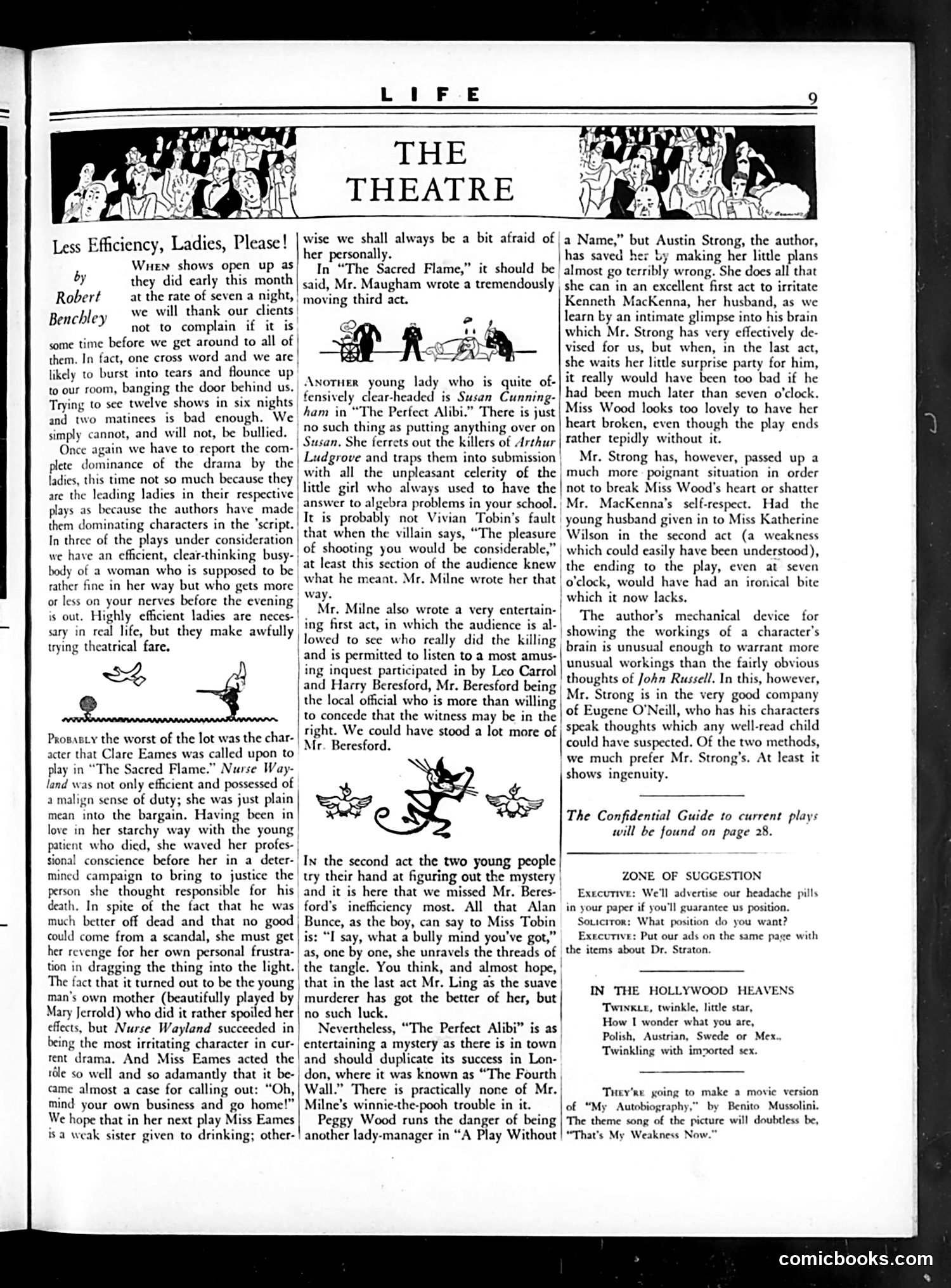
This is a theatre review page from *Life* magazine's "The Theatre" section. The content critiques several Broadway plays opening that month, with particular focus on female characters and acting efficiency. The main satirical point targets how playwrights create "inefficient" female characters—women who are supposedly fine but receive excessive stage time and emotional focus. The reviews mock plays like "The Sacred Flame" and "The Perfect Alibi" for centering weak or irritating female roles, suggesting authors have made dismissing characterization choices. The accompanying small cartoons appear to illustrate theatrical absurdities (figures in exaggerated poses), though specific caricatures aren't clearly identifiable from the image alone. The tone is witty complaint about theatrical excess and poor dramatic construction in contemporary Broadway productions.
📄 Transcribed text from this page (OCR, searchable)
Machine-transcribed from the original scan — historical spelling and the odd misread are preserved.
te, Less Efficiency, Ladies, Please! When shows open up as they did early this month at the rate of seven a night, , we will thank our clients Benchley not to complain if it is some time before we get around to all of | them. In fact, one cross word and we are} likely to burst into tears and flounce up to our room, banging the door behind us. Trying to see twelve shows in six nights and two matinees is bad enough. We simply cannot, and will not, be bullied. Once again we have to report the com- plete dominance of the drama by the} ladies, this time not so much because they are the leading ladies in their respective plays as because the authors have made them dominating characters in the ‘script. In three of the plays under consideration | we have an efficient, clear-thinking busy- body of a woman who is supposed to be rather fine in her way but who gets more or less on your nerves before the evening is out. Highly efficient ladies are neces-| sary in real life, but they make awfully | trying theatrical fare. Prosasty the worst of the lot was the char- | acter that Clare Eames was called upon to play in “The Sacred Flame.” Nurse Way- land was not only efficient and possessed of a malign sense of duty; she was just plain | mean into the bargain, Having been in love in her starchy way with the young patient who died, she waved her profes- sional conscience before her in a deter- mined campaign to bring to justice the person she thought responsible for his death. In spite of the fact that he was much better off dead and that no good could come from a scandal, she must get | her revenge for her own personal frustra- tion in dragging the thing into the light. | The fact that it turned out to be the young | man’s own mother (beautifully played by | Mary Jerrold) who did it rather spoiled her effects, but Nurse Wayland succeeded in being the most irritating character in cur-| rent drama. And Miss Eames acted the tle so well and so adamantly that it be- came almost a case for calling out: “Oh, mind your own business and go home!” We hope that in her next play Miss Eames isa weak sister given to drinking; other- wise we shall always be a bit afraid of her personally. | In “The Sacred Flame,” it should be said, Mr. Maugham wrote a tremendously moving third act. Anotner young lady who is quite of- fensively clear-headed is Susan Cunning- ham in “The Perfect Alibi.” There is just no such thing as putting anything over on Susan. She ferrets out the killers of Arthur Ludgrove and traps them into submission | with all the unpleasant celerity of the, a Name,” but Austin Strong, the author, has saved her by making her little plans almost go terribly wrong. She does all that she can in an excellent first act to irritate Kenneth MacKenna, her husband, as we learn by an intimate glimpse into his brain which Mr. Strong has very effectively de- vised for us, but when, in the last act, she waits her little surprise party for him, it really would have been too bad if he had been much later than seven o'clock. Miss Wood looks too lovely to have her heart broken, even though the play ends rather tepidly without it. Mr. Strong has, however, passed up a much more poignant situation in order litde girl who always used to have the | answer to algebra problems in your school. It is probably not Vivian Tobin's fault that when the villain says, “The pleasure of shooting you would be considerable,” at least this section of the audience knew what he meant. Mr. Milne wrote her that | way. Mr. Milne also wrote a very entertain- | ing first act, in which the audience is al-| lowed to see who really did the killing and is permitted to listen to a most amus- | ing inquest participated in by Leo Carrol | and Harry Beresford, Mr. Beresford being | the local official who is more than willing | to concede that the witness may be in the | right. We could have stood a lot more of Mr. Beresford. SS In the second act the two young people ty their hand at figuring out the mystery and it is here that we missed Mr. Beres- ford’s inefficiency most. All that Alan Bunce, as the boy, can say to Miss Tobin is: “I say, what a bully mind you've got,” as, one by one, she unravels the threads of the tangle. You think, and almost hope, that in the last act Mr. Ling as the suave | murderer has got the better of her, but no such luck. Nevertheless, “The Perfect Alibi” is as_ entertaining a mystery as there is in town and should duplicate its success in Lon- | don, where it was known as “The Fourth Wall.” There is practically none of Mr.) Milne’s winnie-the-pooh trouble in it. Peggy Wood runs the danger of being another lady-manager in “A Play Without not to break Miss Wood's heart or shatter Mr. MacKenna’s self-respect. Had the young husband given in to Miss Katherine Wilson in the second act (a weakness which could easily have been understood), the ending to the play, even at seven o'clock, would have had an ironical bite which it now lacks, The author's mechanical device for showing the workings of a character's brain is unusual enough to warrant more unusual workings than the fairly obvious thoughts of John Russell. In this, however, Mr. Strong is in the very good company of Eugene O'Neill, who has his characters speak thoughts which any well-read child could have suspected. Of the two methods, we much prefer Mr. Strong’s. At least it shows ingenuity. The Confidential Guide to current plays will be found on page 28. ZONE OF SUGGESTION Exrcutivr: We'll advertise our headache pills in your paper if you'll guarantee us position. Souictror: What position do you want? Executive: Put our ads on the same page with the items about Dr. Straton, IN THE HOLLYWOOD HEAVENS Twinxce, twinkle, little star, How I wonder what you are, Polish, Austrian, Swede or Mex., Twinkling with imported sex. Tuey're going to make a movie version of “My Autobiography,” by Benito Mussolini. The theme song of the picture will doubtless be, “That's My Weakness Now.” comicbooks.com *