
Life, 1928-12-21 · page 16 of 36
Life — December 21, 1928 — page 16: what you’re looking at
What you’re looking at
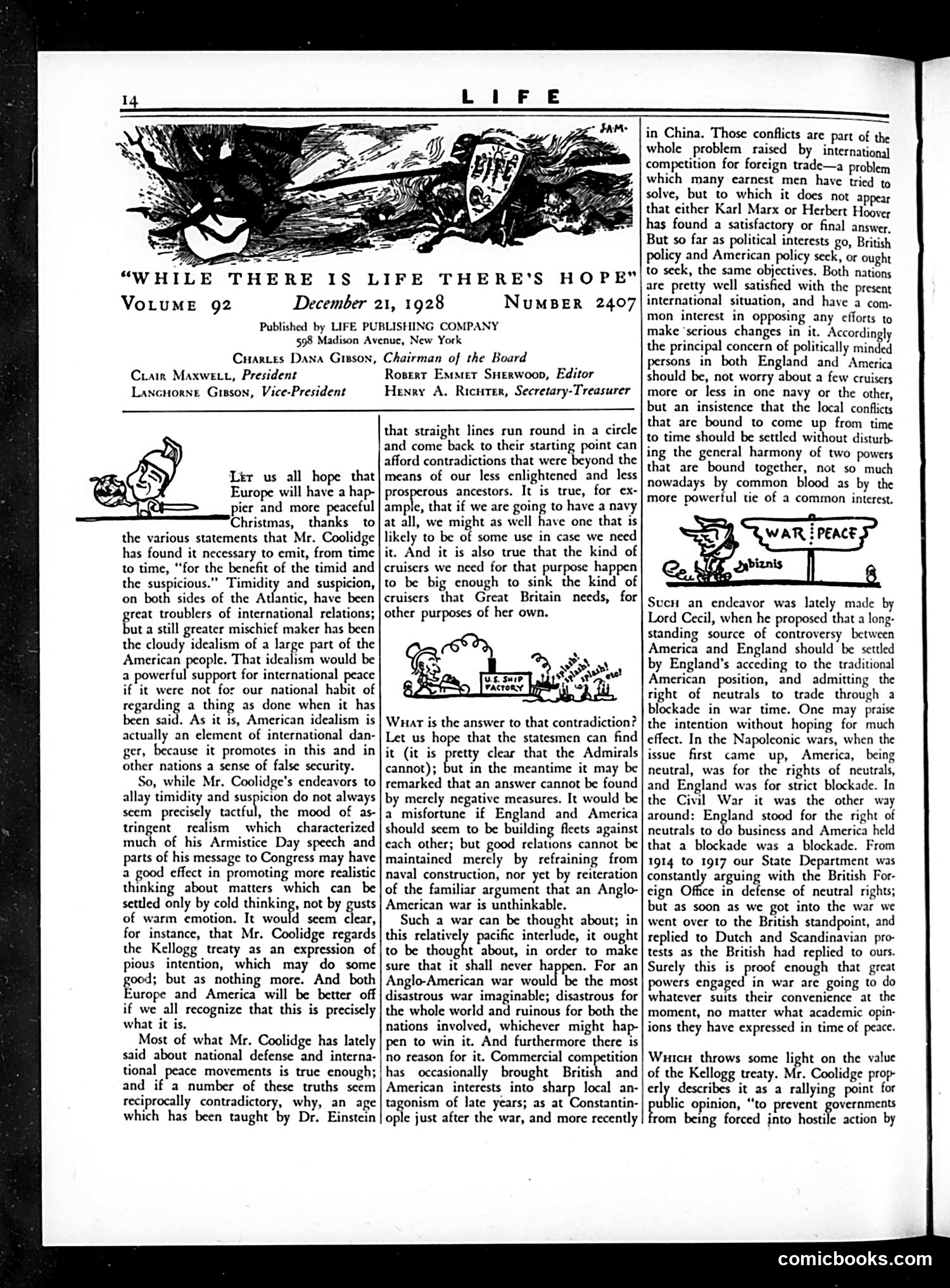
This Life magazine editorial page satirizes Secretary of State Frank B. Kellogg's peace treaty efforts. The small cartoon labeled "WAR PEACE" shows a seesaw balancing these opposing concepts—depicting the contradiction the article explores. The text critiques contradictions in American foreign policy: the U.S. promotes peace treaties (like Kellogg's) while simultaneously building naval fleets. The editorial questions how England and America can maintain "good relations" while constructing warships "against each other." The piece argues such contradictions undermine peace efforts and suggests that sincere disarmament would be more credible than rhetoric alone. It's a skeptical commentary on whether diplomatic treaties can genuinely prevent conflict when military buildup continues simultaneously.
📄 Transcribed text from this page (OCR, searchable)
Machine-transcribed from the original scan — historical spelling and the odd misread are preserved.
“WHILE THERE IS LIFE THERE’S HOPE” VoLUME 92 December 21, 1928 NuMBER 2407 Published by LIFE PUBLISHING COMPANY 598 Madison Avenue, New York Cuarces Dana Gisson, Crain Maxwe tt, President Lancnorne Grsson, Vice-President Ler us all hope that Europe will have a hap- pier and more peaceful ‘Christmas, thanks to the various statements that Mr. Coolidge has found it necessary to emit, from time to time, “for the benefit of the timid and the suspicious.” Timidity and suspicion, on both sides of the Atlantic, have been reat troublers of international relations; bak a still greater mischief maker has been the cloudy idealism of a large part of the American people. That idealism would be a powerful support for international peace if it were not for our national habit of regarding a thing as done when it has been said. As it 1s, American idealism is actually an element of international dan- ger, because it promotes in this and in other nations a sense of false security. So, while Mr. Coolidge’s endeavors to allay timidity and suspicion do not always seem precisely tactful, the mood of as- tringent realism which characterized much of his Armistice Day speech and parts of his message to Congress may have a good effect in promoting more realistic thinking about matters which can be settled only by cold thinking, not by gusts of warm emotion. It a seem clear, for instance, that Mr. Coolidge regards the Kellogg treaty as an expression of pious intention, which may do some good; but as nothing more. And both Europe and America will be better off if we all recognize that this is precisely what it is. Most of what Mr. Coolidge has lately said about national defense and interna- tional peace movements is true enough; and if a number of these truths seem reciprocally contradictory, why, an age which has been taught by Dr. Einstein Chairman of the Board Rosert Emer Suerwoop, Editor Henry A. Ricuter, Secretary-Treasurer that straight lines run round in a circle and come back to their starting point can afford contradictions that were beyond the means of our less enlightened and less prosperous ancestors. It is true, for ex- ample, that if we are going to have a navy at all, we might as well have one that is likely to be of some use in case we need it. And it is also true that the kind of cruisers we need for that purpose happen to be big enough to sink the kind of cruisers that Great Britain needs, for other purposes of her own. Wnuart is the answer to that contradiction? Let us hope that the statesmen can find it (it is pretty clear that the Admirals cannot); but in the meantime it may be remarked that an answer cannot be found by merely negative measures. It would be a misfortune if England and America should seem to be building fleets against each other; but good relations cannot be maintained merely by refraining from naval construction, nor yet by reiteration of the familiar argument that an Anglo- American war is unthinkable. Such a war can be thought about; in this relatively pacific interlude, it ought to be thought about, in order to make sure that it shall never happen. For an Anglo-American war would. be the most disastrous war imaginable; disastrous for the whole world and ruinous for both the nations involved, whichever might hap- pen to win it. And furthermore there is no reason for it. Commercial competition has occasionally brought British and American interests into sharp local an- tagonism of late years; as at Constantin- ople just after the war, and more recently in China. Those conflicts are part of the whole problem raised by international competition for foreign trade—a problem which many earnest men have tried to solve, but to which it does not appear that either Karl Marx or Herbert Hoover has found a satisfactory or final answer, But so far as political interests go, British policy and American policy seck, or ought to seek, the same objectives. Both nations are pretty well satisfied with the present international situation, and have a com. mon interest in opposing any efforts to make ‘serious changes in it. Accordin ly the principal concern of politically minded persons in both England and America should be, not worry about a few cruisers more or less in one navy or the other, but an insistence that the local conflicts that are bound to come up from time to time should be settled without disturb- ing the general harmony of two powers that are bound together, not so much nowadays by common blood as by the more powertul tie of a common interest. Suc an endeavor was lately made by Lord Cecil, when he proposed that a long- standing source of controversy between America and England should be settled by England's acceding to the traditional American position, and admitting the right of neutrals to trade through a blockade in war time. One may praise the intention without hoping for much effect. In the Napoleonic wars, when the issue first came up, America, being neutral, was for the rights of neutrals, and England was for strict blockade. In the Civil War it was the other way around: England stood for the right of neutrals to do business and America held that a blockade was a blockade. From 1914 to 1917 our State Department was constantly arguing with the British For- eign Office in defense of neutral rights; but as soon as we got into the war we went over to the British standpoint, and replied to Dutch and Scandinavian pro- tests as the British had replied to ours. Surely this is proof enough that great powers engaged in war are going to do whatever suits their convenience at the moment, no matter what academic opin- ions they have expressed in time of peace. Wuicx throws some light on the value of the Kellogg treaty. Mr. Coolidge prop- erly describes it as a rallying point for ublic opinion, “to prevent governments rom being forced jnto hostile action by comicbooks.com