
Life, 1928-12-21 · page 13 of 36
Life — December 21, 1928 — page 13: what you’re looking at
What you’re looking at
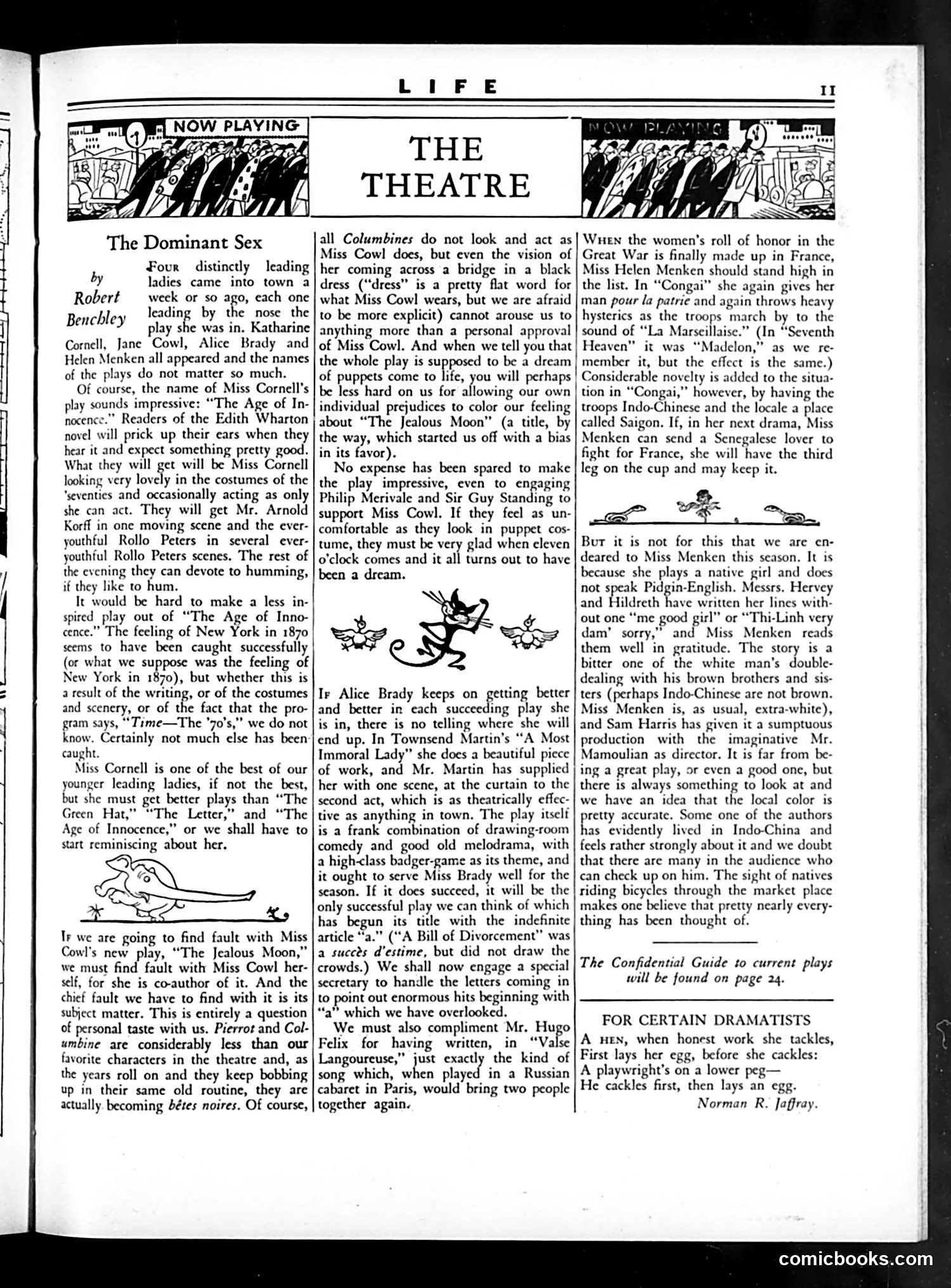
This is a theater review page from *Life* magazine discussing current Broadway productions. The main review criticizes "The Dominant Sex" by Robert Benchley, starring Jane Cowl and other leading ladies. The reviewer faults the play's lightweight premise—that women dream of dominating men—calling it uninspired despite featuring talented actresses in nice costumes. The small cartoons scattered throughout depict stylized figures in comedic poses, though they're not political satire but rather decorative illustrations reflecting the theatrical theme. The second review praises Alice Brady's performances and discusses other plays including "The Jealous Moon" and productions featuring Miss Menken. The page reflects early 1920s theater criticism, focusing on acting talent, production values, and plot merit rather than social commentary.
📄 Transcribed text from this page (OCR, searchable)
Machine-transcribed from the original scan — historical spelling and the odd misread are preserved.
LIFE NOW PLAYING PED GPO FUDGE) A The Dominant Sex Four distinctly leading ladies came into town a Robert week or so ago, each one , leading by the nose the Benchley lay she as in. Katharine Cornell, Jane Cowl, Alice Brady and Helen Menken all appeared and the names of the plays do not matter so much. Of course, the name of Miss Cornell's play sounds impressive: “The Age of In- nocence.” Readers of the Edith Wharton novel will prick up their ears when they hear it and expect something pretty good. What they will get will be Miss Cornell looking very lovely in the costumes of the ‘seventies and occasionally acting as only she can act. They will get Mr. Arnold Korff in one moving scene and the ever- youthful Rollo Peters in several ever- youthful Rollo Peters scenes. The rest of the evening they can devote to humming, if they like to hum. It would be hard to make a less in- spired play out of “The Age of Inno- cence.” The feeling of New York in 1870 seems to have been caught successfully (or what we suppose was the feeling of New York in 1870), but whether this is a result of the writing, or of the costumes and scenery, or of the fact that the pro- gram says, “‘Time—The '7o's,”” we do not know. Certainly not much else has been caught. Miss Cornell is one of the best of our younger leading ladies, if not the best, but she must get better plays than “The Green Hat,” “The Letter,” and “The Age of Innocence,” or we shall have to start reminiscing about her. by Ir we are going to find fault with Miss Cowl’s new play, “The Jealous Moon,” we must find fault with Miss Cowl her- self, for she is co-author of it. And the chief fault we have to find with it is its subject matter. This is entirely a question of personal taste with us. Pierrot and Col- umbine are considerably less than our favorite characters in the theatre and, as the years roll on and they keep bobbing up in their same old routine, they are actually. becoming bétes noires. Of course, THE THEATRE all Columbines do not look and act as Miss Cowl does, but even the vision of her coming across a bridge in a black dress (“dress” is a pretty flat word for what Miss Cowl wears, but we are afraid to be more explicit) cannot arouse us to anything more than a personal approval of Miss Cowl. And when we tell you that the whole play is supposed to be a dream of puppets come to Tie, you will perhaps be less hard on us for liswing our own individual prejudices to color our feeling about “The Jealous Moon” (a title, by the way, which started us off with a bias in its favor). No expense has been spared to make the play impressive, even to engaging Philip Merivale and Sir Guy Standing to support Miss Cowl. If they feel as un- comfortable as they look in puppet cos- tume, they must be very glad when eleven o'clock comes and it all turns out to have been a dream. ee oe Ir Alice Brady keeps on getting better and better in each succeeding play she is in, there is no telling where she will end up. In Townsend Martin's “A Most Immoral Lady” she does a beautiful piece of work, and Mr. Martin has supplied her with one scene, at the curtain to the second act, which is as theatrically effec- tive as anything in town. The play itself is a frank combination of drawing-room comedy and good old melodrama, with a high-class badger-game as its theme, and it ought to serve Miss Brady well for the season. If it does succeed, it will be the only successful play we can think of which has begun its utle with the indefinite article “a.” (“A Bill of Divorcement” was a succes d’estime, but did not draw the crowds.) We shall now engage a special secretary to handle the letters coming in to point out enormous hits beginning with “a” which we have overlooked. We must also compliment Mr. Hoge Felix for having written, in “Valse Langoureuse,” just exactly the kind of song which, when played in a Russian cabaret in Paris, would bring two people together again. Wuen the women’s roll of honor in the Great War is finally made up in France, Miss Helen Menken should stand high in the list. In “Congai” she again gives her man pour la patrie and again throws heavy hysterics as the troops march by to the sound of “La Marseillaise.” (In “Seventh Heaven” it was “Madelon,” as we re- member it, but the effect is the same.) Considerable novelty is added to the situa- tion in “Congai,”’ however, by having the troops Indo-Chinese and the locale a place called Saigon. If, in her next drama, Miss Menken can send a Senegalese lover to fight for France, she will have the third leg on the cup and may keep it. ee. aa Bur it is not for this that we are en- deared to Miss Menken this season, It is because she plays a native girl and does not speak Pidgin-English. Messrs. Hervey and Hildreth have written her lines with- out one “me good girl” or “Thi-Linh very dam’ sorry,” and Miss Menken reads them well in gratitude. The story is a bitter one of the white man’s double- dealing with his brown brothers and sis- ters (perhaps Indo-Chinese are not brown. Miss Menken is, as usual, extra-white), and Sam Harris has given it a sumptuous production with the imaginative Mr. Mamoulian as director. It is far from be- ing a great play, or even a good one, but there is always something to look at and we have an idea that the local color is pretty accurate. Some one of the authors fs evidently lived in Indo-China and feels rather strongly about it and we doubt that there are many in the audience who can check up on him. The sight of natives riding bicycles through the market place makes one believe that pretty nearly every- thing has been thought of. The Confidential Guide to current plays will be found on page 24. FOR CERTAIN DRAMATISTS A HEN, when honest work she tackles, First lays her egg, before she cackles: A playwright’s on a lower peg— He cackles first, then lays an egg. Norman R. Jaffray. comicbooks.com