
Life, 1927-01-06 · page 23 of 39
Life — January 6, 1927 — page 23: what you’re looking at
What you’re looking at
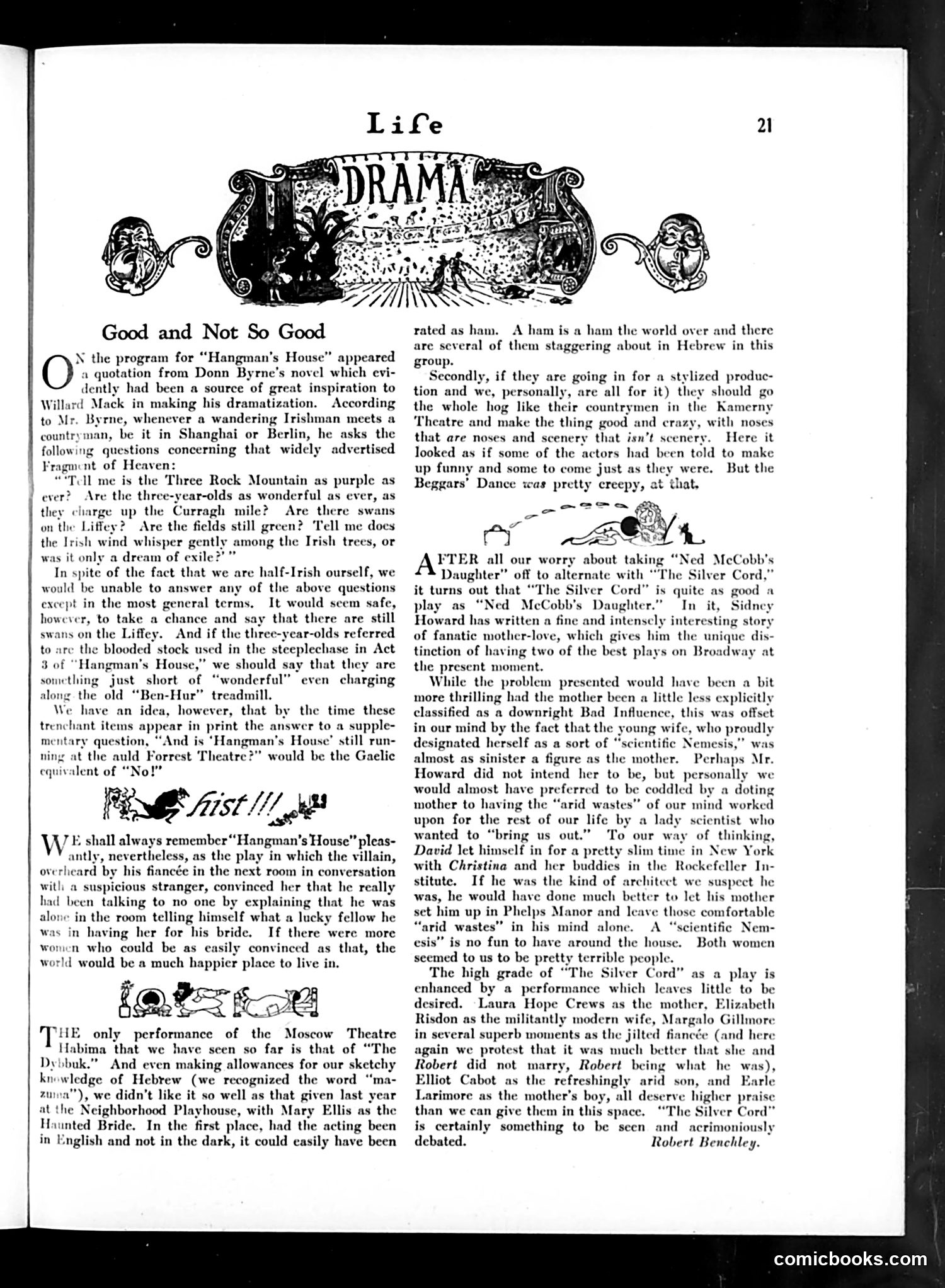
This page contains theater reviews from Life's drama section, circa the 1920s, critiquing several Broadway productions. **"Hangman's House"**: The critic reviews this Irish-themed play, mocking its heavy-handed sentimentality about Ireland. The opening quotes Donn Byrne's novel with stereotypical questions Irish emigrants supposedly ask about home (purple mountains, green fields, swans). The reviewer sarcastically suggests the play won't run long at the Forrest Theatre. There's a humorous anecdote praising the villain character for convincing his fiancée he was merely talking to himself—the joke being that gullible women accept absurd excuses. **Moscow Habima Theatre's "The Dybbuk"**: The critic dismisses the Hebrew-language production, arguing that bad acting is universally recognizable ("a ham is a ham the world over"), regardless of language. They criticize inconsistent stylization in the staging. **Sidney Howard plays**: The reviewer notes Howard has two successful Broadway plays simultaneously—"The Silver Cord" and "Ned McCobb's Daughter"—praising his exploration of "fanatic mother-love" as a psychological theme. The page demonstrates Life's theatrical sophistication while employing period-typical ethnic stereotyping.
📄 Transcribed text from this page (OCR, searchable)
Machine-transcribed from the original scan — historical spelling and the odd misread are preserved.
Good and Not So Good N the program for “Hangman’s House” appeared O a quotation from Donn Byrne's novel which evi- dently had been a source of great inspiration to Willard Mack in making his dramatization. According to Mr. Byrne, whenever a wandering Irishman meets a countryman, be it in Shanghai or Berlin, he s the following questions concerning that widely advertised Fragment of Heaven: ““Toll me is the Three Rock Mountain as purple as Are the thre r-olds as wonderful as ever, as they charge up the Curragh mile? Are there swans on the Liffey? Are the fields still green? Tell me does the Irish wind whisper gently among the Irish trees, or was it only a dream of exile In spite of the fact that we are half-Irish ourself, we would be unable to answer any of the above questions except in the most general terms. It would scem safe, however, to take a chance and say that there are still swans on the Liffey. And if the three-year-olds referred to are the blooded stock used in the steeplechase in Act 3 of “Hangman’s House,” we should say that they are something just short of “wonderful” even charging along the old “Ben-Hur” treadmill. We have an idea, however, that by the time these trenchant items appear in print the answer to a supple- mentary question, “And is ‘Hangman’s House’ still run- ning at the auld Forrest Theatre?” would be the Gaelic equivalent of “No!” PEN ist /// i \ 7E shall always remember “Hangman’ 's'House” pleas- cantly, nevertheless, as the play in which the villain, overheard by his fiancée in the next room in conversation witli a suspicious stranger, convinced her that he really had been talking to no one by explaining that he was alone in the room telling himself what a lucky fellow he was in having her for his b If there were more wonen who could be as easily convinced as that, the world would be a much happicr place to live in. L@2= § 4 ‘HE only performance of the Moscow Theatre Habima that we have scen so far is that of “The Dybbuk.” And even making allowances for our sketchy knowledge of Hebrew (we recognized the word “ma- zuna”), we didn't like it so well as that given last year at the Neighborhood Playhouse, with Mary Ellis as the Haunted Bride. In the first place, had the acting been in English and not in the dark, it could easily have been rated as ham. A ham is a ham the world over and there are several of them staggering about in Hebrew in this group. Secondly, if they are going in for a stylized produc- tion and we, personally, are all for it) they should go the whole hog like their countrymen in the Kamerny Theatre and make the thing good and ¢ with noses that are noses and scenery that isn’t scene Here it looked as if some of the actors had been told to make up funny and some to come just as they were. But the Beggars’ Dance was pretty creepy, at that, FTER ‘all our worry about taking “Ned McCobb's Daughter” off to alternate with “The Silver Cord,” it turns out that “The Silver Cord” is quite as good a play as “Ned MeCobb's In it, Sidney Howard has written a fine and inte nsely interesting story of fanatic mother-love, which gives him the unique dis- tinction of having two of the best plays on Broadway at sent moment, the problem presented would have been a bit more thrilling had the mother been a little less explicitly classified as a downright Bad Influence, this was offset in our mind by the fact that the young wife, who proudly designated herself as a sort of “scientific Nemesis,” was almost as sinister a figure as the mother. Perhaps Mr. Howard did not intend her to be, but person would almost have preferred to be coddled by mother to having the “arid wastes” of our mind worked upon for the rest of our life by a lady scientist who wanted to “bring us out.” To our way of thinking, David let himself in for a pretty slim time in New York with Christina and her buddies in the Rockefeller In- stitute. If he was the kind of architect we suspect he was, he would have done much better to let his mother set him up in Phelps Manor and leave those comfortable “arid wastes” in his mind alone. A “scientific Nem- e s no fun to have around the house. Both women seemed to us to be pretty terrible people. The high grade of “The Silver Cord” as a play is enhanced by a performance which leaves little to be desired. Laura Hope Crews as the mother, Elizabeth Risdon as the militantly modern wife, Margalo Gillmore in several superb moments as the jilted fiancée (and here again we protest that it was much better that she and Robert did not marry, Robert being what he was), Elliot Cabot as the refreshingly Hi son, and rle Larimore as the mother’s boy, « gher praise r Cord” and acrimoniously Robert Benchley. than we can give them in this space. is certainly something to be seen debated. comicbooks.com