
Life, 1927-01-06 · page 18 of 39
Life — January 6, 1927 — page 18: what you’re looking at
What you’re looking at
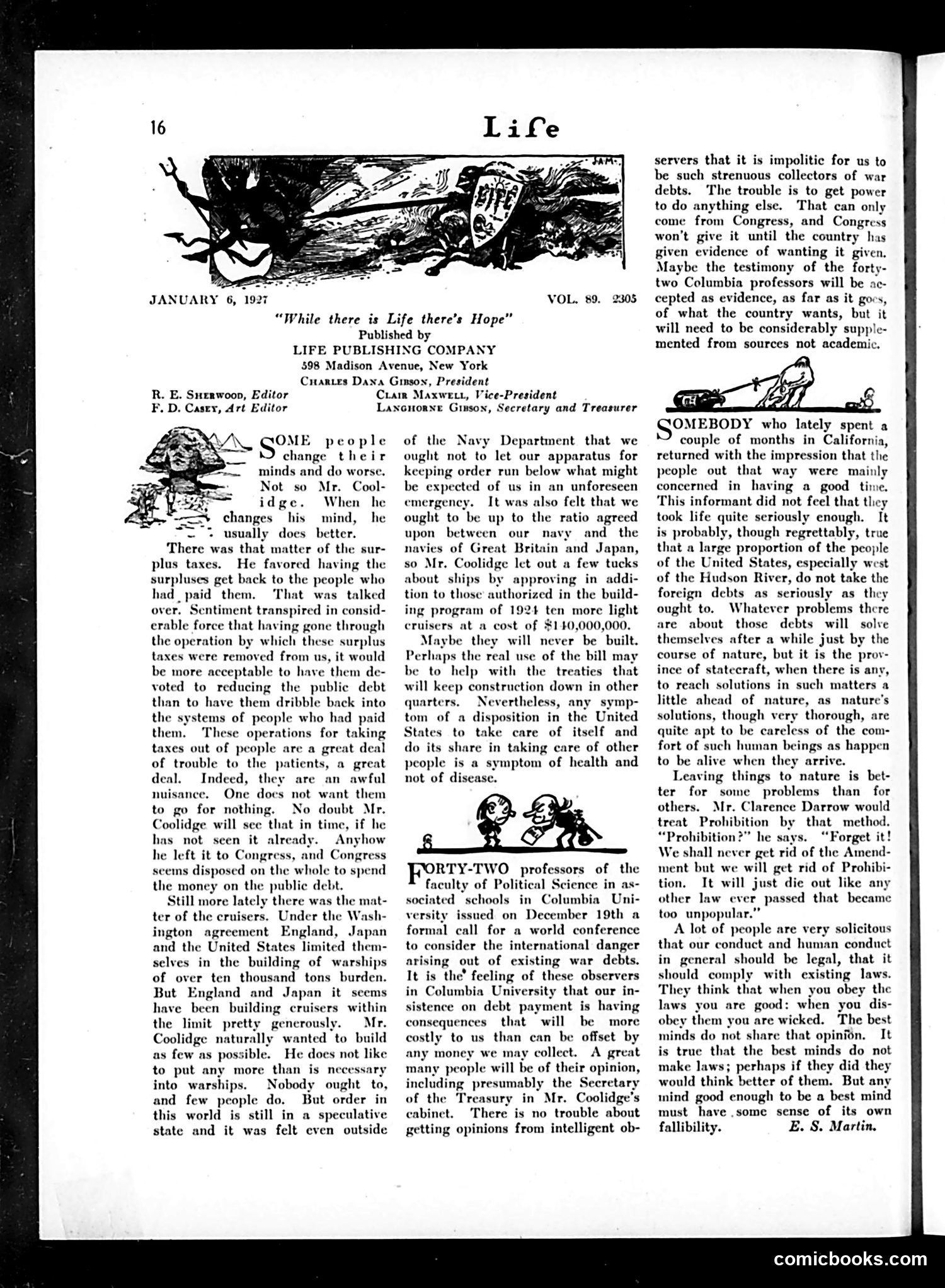
This page discusses naval policy and war debts under President Coolidge's administration. The editorial criticizes Navy Department officials for wanting to expand the fleet beyond what's fiscally necessary, arguing that such expenditures are inappropriate given existing international debts. The visible cartoon (top left) appears to show a dead or fallen soldier, illustrating the human cost of war—a visual counterpoint to bureaucratic discussions of military spending. A second cartoon depicts two figures in conversation, likely representing political debate over budgetary priorities. The page's central argument: military expansion is unwise when the nation should prioritize paying down war debts and addressing domestic concerns. The satire targets both military-industrial interests and political figures who enable wasteful spending despite fiscal constraints.
📄 Transcribed text from this page (OCR, searchable)
Machine-transcribed from the original scan — historical spelling and the odd misread are preserved.
JANUARY 6, 1927 VOL, 89. “While there is Life there’s Hope” Published by LIFE PUBLISHING COMPANY 598 Madison Avenue, New York Crartes Dana Ginson, President . E. Surrwoop, Editor *, D. Casrr, Art Editor OME people change their minds and do worse, Not so Mr. Cool- idge. When he changes his mind, he usually does better. There was that matter of the sur- plus taxes. He favored having the surpluses get back to the people who had paid them. That was talked over. Sentiment transpired in consid- erable force that having gone through the operation by which these surplus taxes were removed from us, it would be more acceptable to have them de- voted to reducing the public debt than to have them dribble back into the systems of people who had paid them. These operations for taking taxes out of people are a great deal of trouble to the patients, a great deal. Indeed, they are an awful nuisance. One docs not want them to go for nothing. No doubt Mr. Coolidge will see that in time, if he has not seen it already. Anyhow he left it to Congress, and Congress seems disposed on the whole to spend the money on the public debt. Still more lately there was the mat- ter of the cruisers. Under the Wash- ington agreement England, Ja and the United States limited them- selves in the building of warships of over ten thousand tons burden. But England and Japan it seems have been building cruisers within the limit pretty generously. | Mr. Coolidge naturally wanted to build as few as possible. He does not like to put any more than is necessary into warships. Nobody ought to, and few people do, But order in this world is still in a speculative state and it was felt even outside Cram Maxwewt, Vice-President Lanouorne Ginson, Secretary and Treasurer of the Navy Department that we ought not to let our apparatus for keeping order run below what might be expected of us in an unforeseen emergency. It was also felt that we ought to be up to the ratio agreed upon between our navy and the navies of Great Britain and Japan, so Mr. Coolidge let out a few tucks about ships by approving in addi- tion to those authorized in the build- ing program of 1924 ten more light cruisers at a cost of $140,000,000. Maybe they will never be built. Perhaps the real use of the bill may be to help with the treaties that will keep construction down in other Nevertheless, any symp- of a disposition in the United States to take care of itself and do its share in taking care of other people is a symptom of health and not of disease. RTY-TWO professors of the faculty of Political Science in as- sociated pols in Columbia Uni- versity issued on December 19th a formal call for a world conference to consider the international danger arising out of existing war debts. It is the’ feeling of these observers in Columbia University that our in- sistence on debt payment is having consequences that will be more costly to us than can be offset by any money we may collect. A great many people will be of their opinion, including presumably the Secretary of the Treasury in Mr. Coolidge’s cabinet. There is no trouble about getting opinions from intelligent ob- servers that it is impolitic for us to be such strenuous collectors of war debts. The trouble is to get power to do anything else. That can only come from Congress, and Congress won't give it until the country has given evidence of wanting it given. Maybe the testimony of the fort two Columbia professors will be ac- cepted as evidence, as far as it govs, of what the country wants, but it will need to be considerably supple- mented from sources not academic. g SOMEBODY who lately spent a couple of months in California, returned with the impression that the people out that way were mainly concerned in having a good time. This informant did not feel that they took life quite seriously enough. It is probably, though regrettably, true that a large proportion of the people of the United States, especially west of the Hudson River, do not take the foreign debts as seriously as they ought to. Whatever problems there are about those debts will solve themselves after a while just by the course of nature, but it is the prov- ince of statecraft, when there is any, to reach solutions in such matters a little ahead of nature, as nature's solutions, though very thorough, are quite apt to be careless of the com- fort of such human beings as happen to be alive when they arrive. Leaving things to nature is bet- ter for some problems than for others. Mr. Clarence Darrow would treat Prohibition by that method. “Prohibition?” he says. “Forget it! We shall never get rid of the Amend- ment but we will get rid of Prohibi- tion. It will just die out like any other law ever passed that became too unpopular.” A lot of people are very solicitous that our conduct and human conduct in general should be legal, that it should comply with existing laws. They think that when you obey the laws you are good: when you dis- obey them you are wicked. The best minds do not share that opinion. It is true that the best minds do not make laws; perhaps if they did they would think better of them. But any mind good enough to be a best mind must have .some sense of its own fallibility. E. S. Martin, comicbooks.com